Contents
To get a rebuilt title in Illinois, you must use a licensed rebuilder, complete the required repairs and inspections, and submit the necessary documents to the Illinois Secretary of State. The vehicle can then become road-legal, but its salvage history generally remains under a permanent REBUILT brand. Before buying, verify eligibility, repair costs, and inspection requirements.
Can You Turn an Illinois Salvage Certificate Into a Clean Title?
Generally, no. Under the Illinois Vehicle Code, a salvage title in Illinois normally leads to a new certificate marked REBUILT. A narrow exception covers certain theft recoveries without specified structural damage. It cannot erase collision damage, even if the car passes every required check. A junking certificate, unlike salvage, rules out ordinary rebuilding.
What Do Salvage, Rebuilt and Clear Mean in Illinois Auction Listings?
Listing labels describe paperwork rather than condition:
- Clear: Unbranded paperwork; accidents may still exist.
- Salvage: Ownership recorded under salvage rules.
- Rebuilt: A former salvage vehicle restored through the required process.
- Bill of Sale: May not independently qualify the vehicle for titling.
Using SCA passenger-vehicle auction records from January 3, 2023, through June 19, 2026, we analyzed 207 Illinois lots: 88 branded (86 Salvage, one Salvage Title, one Rebuilt), 118 Clear, and one Bill of Sale. Comparison samples include 435 New York, 529 Florida, 1,380 Texas, and 1,256 California lots: 3,807 across five states.
These are auction lots, not statewide registrations. The 88 branded Illinois lots underpin condition, model-year, and bid metrics. The Bill of Sale lot is excluded from branded-versus-Clear pricing comparisons.
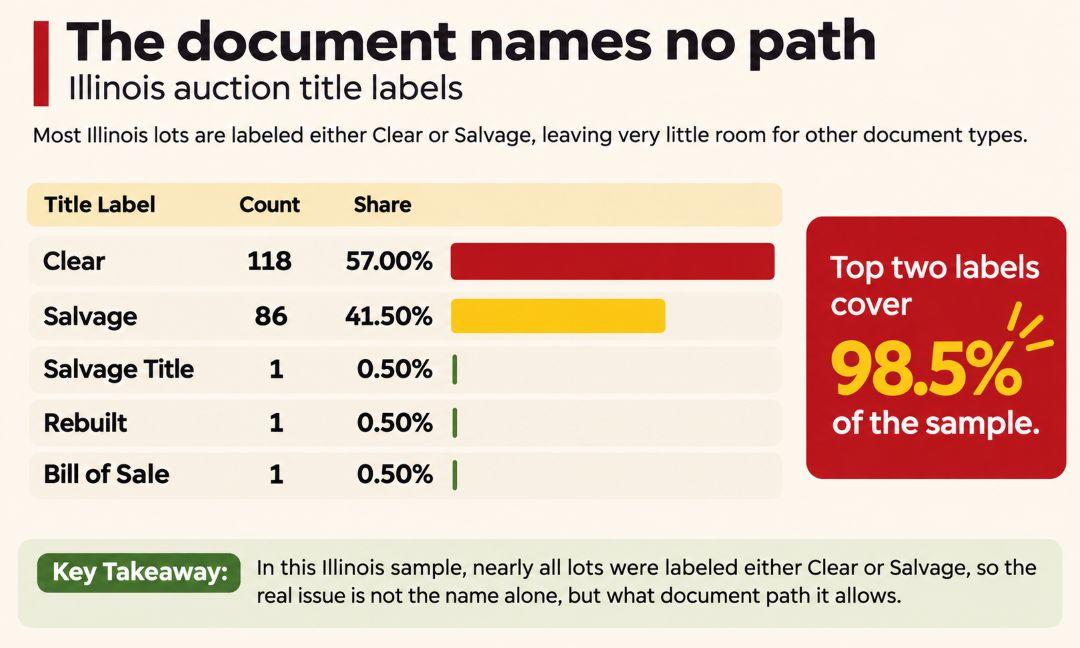
Of 207 Illinois lots, Clear accounted for 118 (57.0%), Salvage for 86 (41.5%), and Salvage Title for one (0.5%). Rebuilt and Bill of Sale each appeared once (0.5% each). Labels cannot establish rebuild eligibility.
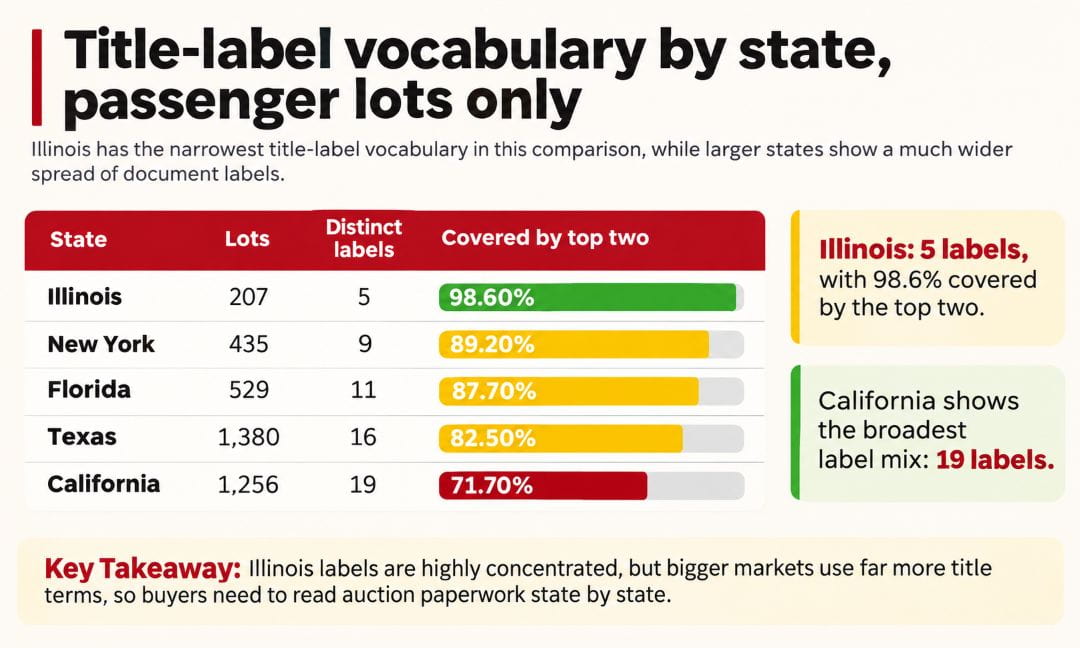
Label diversity varies sharply:
- Illinois: 207 lots, five labels; the two most common cover 98.6%.
- New York: 435 lots, nine labels; top-two coverage 89.2%.
- Florida: 529 lots, 11 labels; top-two coverage 87.7%.
- Texas: 1,380 lots, 16 labels; top-two coverage 82.5%.
- California: 1,256 lots, 19 labels; top-two coverage 71.7%.
Fewer label types do not guarantee clearer legal status.
Does the REBUILT Brand Ever Disappear?
The REBUILT notation generally stays. The REBUILT brand may be avoided only under a narrow qualifying theft-recovery exception. When buying a rebuilt vehicle, compare older title information with the current certificate. Advertisements are no substitute for title records.
Under Illinois Vehicle Code Section 3-118.1, this exception is limited to eligible insurance companies and licensed businesses that also hold a used-vehicle dealer license. They must provide proof that the vehicle was declared a total loss because of theft and recovered without structural damage caused by collision, fire, flood, theft, rust, or corrosion.
Can an Out-of-State Salvage Vehicle Receive an Illinois Rebuilt Title?
Yes, an eligible used car from another state can enter Illinois’s process, but state laws vary. The state’s rebuilt-title fact sheet distinguishes a properly assigned salvage certificate from a Bill of Sale when the originating state does not issue salvage certificates. A vehicle rebuilt elsewhere may face reinspection if previously salvaged in Illinois. Documents from another state are not automatically interchangeable. A Bill of Sale does not prove that Illinois will issue the certificate you need.
How Can You Tell Whether an Illinois Salvage Car Is Worth Rebuilding?
Assess salvage damage types through three checks:
- Identity. Match VINs, paperwork, and auction photos.
- Condition. Price structural repairs, wiring, airbags, and calibration.
- Margin. Compare the projected resale value with that of branded-title vehicles, not clean-title retail prices. Include the risk of delay and unavailable parts.
Avoid a salvage title car with unexplained damage inconsistencies.
For vehicles with unclear damage descriptions, request additional photographs, review the available vehicle history, and obtain a professional repair assessment before bidding.
Does Run and Drive Mean an Illinois Salvage Car Will Pass Inspection?
No. Run and Drive is an auction status describing limited vehicle movement, not functioning airbags, correct alignment, or safe wiring. A motor vehicle can move without being roadworthy.
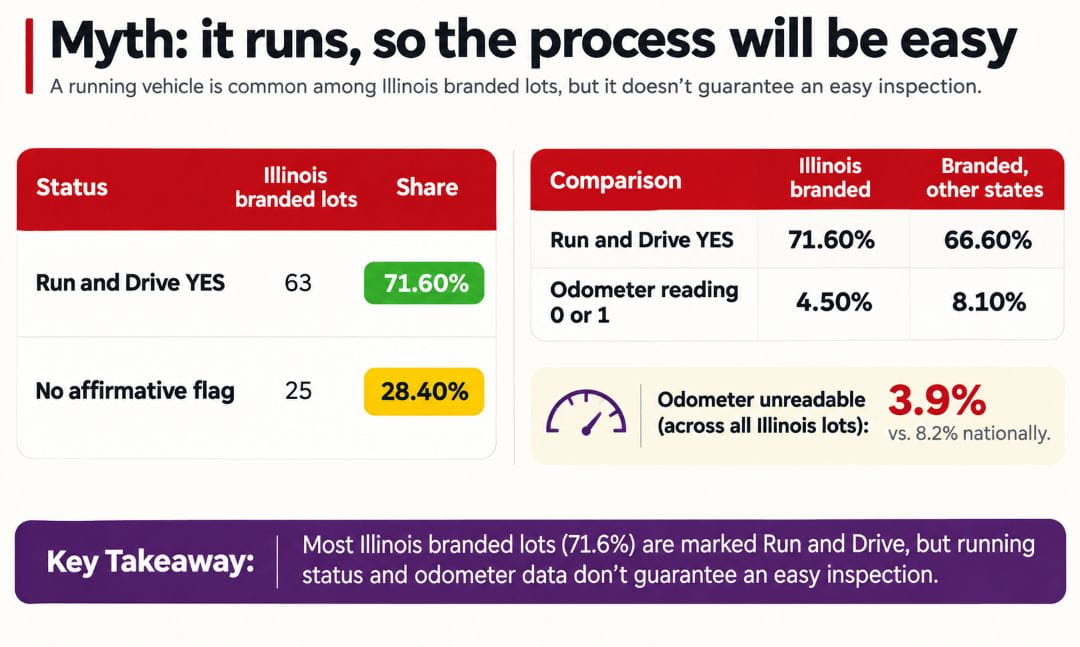
Among 88 Illinois-branded lots, 63 were marked Run and Drive YES (71.6%); 25 had no affirmative flag (28.4%), compared with 66.6% YES for branded lots in other states. Odometer readings of zero or one appeared in 4.5% of Illinois-branded lots versus 8.1% elsewhere; unreadable readings affected 3.9% of all Illinois lots versus 8.2% nationally. A running flag cannot replace a vehicle inspection. Likewise, an odometer field showing zero or one may reflect incomplete auction data. Investigate records instead of treating that number as mileage.
Ask for evidence of:
- Documentation that the engine starts and the vehicle moves.
- Dashboard and diagnostic warnings.
- Steering, braking, and suspension damage.
- Keys and electronic modules.
How Much Does It Really Cost to Get an Illinois Rebuilt Title?
Beyond the hammer price, buyers of salvage cars in Illinois can use SCA’s Illinois listings to compare condition and bids. Include:
- Transport.
- Storage.
- Fees.
- Labor.
- Parts.
- Taxes.
- Contingency.
An insurer’s pre-damage estimate is not a guaranteed resale price. Ask the rebuilder for separate estimates. Calculate structural labor, parts, electronic calibration, and any work that cannot be priced until disassembly.
What Are the Illinois Salvage Inspection, Title and Registration Fees?
The state police inspection brochure lists a $94 inspection fee and $165 title fee.
The standard passenger registration charge is $151 under the Illinois fee schedule. Together, those charges total $410 where the police check applies, before IDOT testing and tax. Pay each police-station charge by separate check or money order.
| Cost | Published amount |
| Police inspection, when required | $94 |
| Title issuance | $165 |
| Standard passenger registration | $151 |
| Additional expenses | IDOT testing, taxes, towing, parts and labor |
Older vehicles may not need that police check. A vehicle owner needs a rebuilt title issued before ordinary registration can begin.
How Do You Calculate the Maximum Bid Before Buying a Salvage Car?
Calculate backward from a conservative sale price: maximum bid = expected rebuilt selling price − all costs − contingency − desired margin.
For example, assume a $9,000 resale estimate. Subtract $3,200 for parts and labor, $650 for transport, $700 for auction fees, $410 for state charges, and a $1,000 contingency. Maximum bid: $3,040, before additional taxes or financing. The ceiling is the vehicle’s value after reconstruction, not its pre-damage sticker price. If that cannot win, walk away. Use a realistic selling price. An unsold advertisement proves only what a seller wants.
Are Salvage Cars Always Cheaper Than Clean-Title Auction Vehicles?
No. A newer damaged SUV may outbid an older car with a clean title. Age and mileage matter.
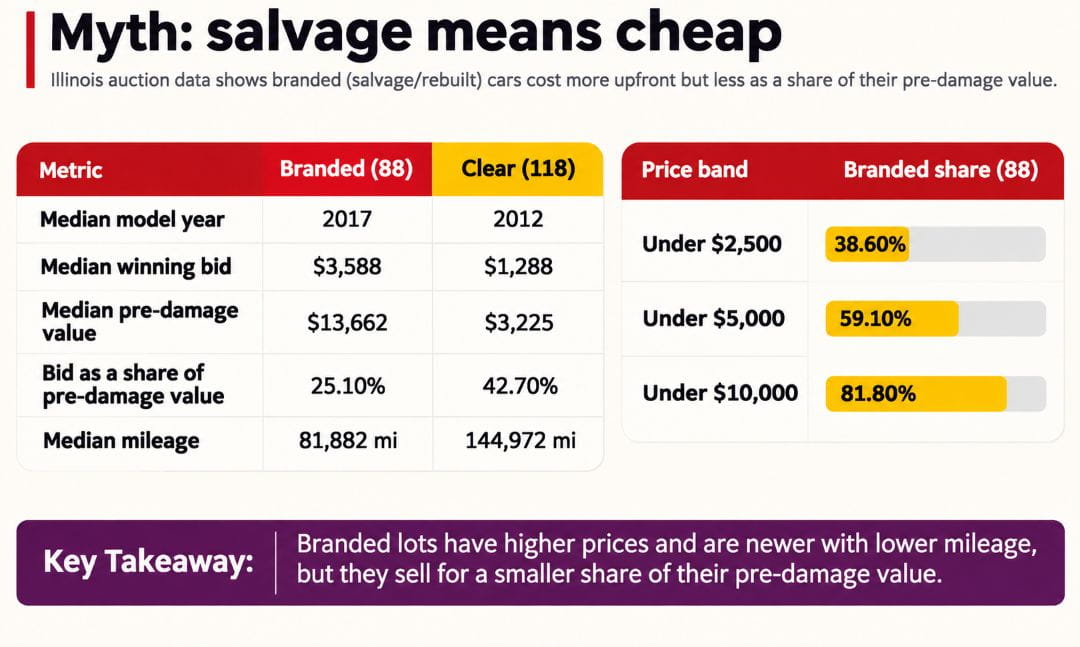
The 88 branded lots had a median model year of 2017, a $3,588 winning bid, $13,662 pre-damage value, and 81,882 miles. The 118 Clear lots had 2012, $1,288, $3,225, and 144,972 miles. Winning bids represented 25.1% versus 42.7% of stated pre-damage values, while 38.6%, 59.1%, and 81.8% of branded lots sold under $2,500, $5,000, and $10,000, respectively. Branded lots cost more outright but less proportionally.
Why Are Newer Illinois Salvage Vehicles Riskier Financially?
Higher market value brings higher risk. Newer vehicles may need costly sensors, lighting, modules, and driver-assistance calibration. One missed part can wipe out the contingency. Price components individually before bidding. A cheap-looking front-end collision can become expensive when multiple systems need recalibration.
How Much of Pre-Damage Value Are Buyers Paying by Model Year?
The Illinois auction data shows how both winning bids and the share of pre-damage value paid increase across newer model-year groups.
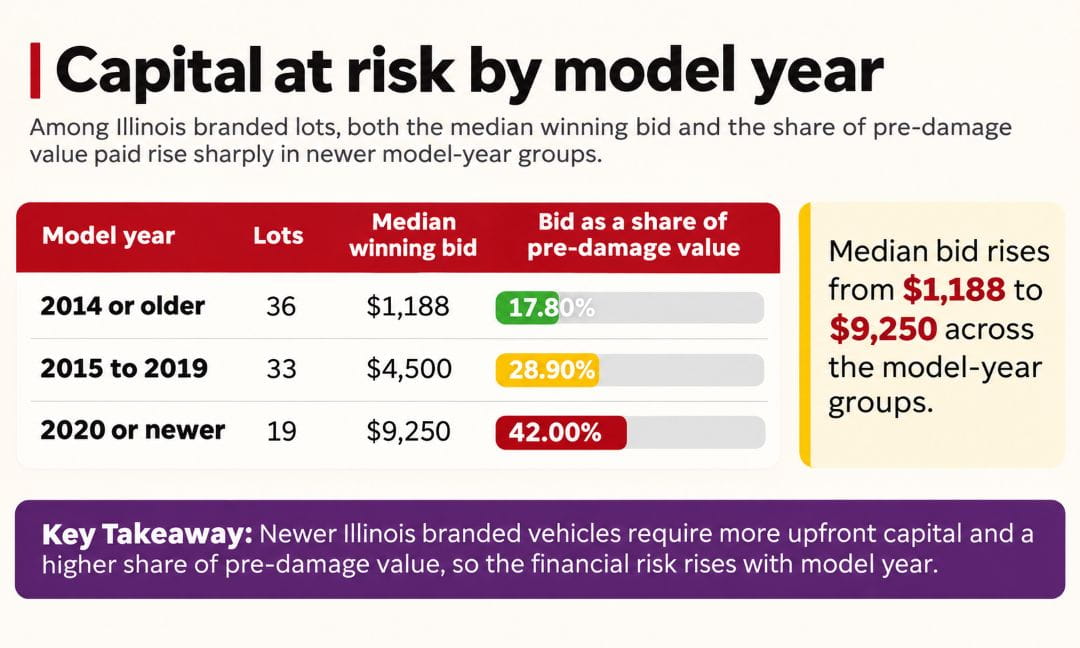
Among Illinois-branded lots, 36 vehicles from 2014 or earlier had a $1,188 median bid, equal to 17.8% of pre-damage value. The 33 vehicles from 2015–2019 reached $4,500 and 28.9%. The 19 from 2020 or newer reached $9,250 and 42.0%. Newer projects tie up more capital before rebuilding.
Consider hidden costs by age:
- Older: Corrosion, parts scarcity, limited resale.
- Middle-age: Donor-parts availability and mileage.
- Newer: Sensor calibration and programming.
What Are the Steps to Get a Rebuilt Title in Illinois?
The salvage vs rebuilt title distinction reflects a legal process. Illinois requires licensed rebuilders to return vehicles from salvage. Private owners must contract with a licensed rebuilder.
To apply for a rebuilt title, follow the Illinois Secretary of State’s instructions:
- Confirm eligibility and assigned salvage paperwork.
- Use a licensed Illinois professional for repair and parts records.
- Pass an Illinois Department of Transportation safety inspection.
- Arrange the state police check.
- Submit rebuilt title application, tax forms, documents, and fees.
- Arrange insurance and registration.
Send rebuilt salvage applications to Springfield, not a local DMV. Retain copies. Before work begins, have the shop verify ownership transfers and replacement-part sources. Passing a mechanical test cannot cure missing paperwork.
Which Inspections Are Required for an Illinois Rebuilt Title?
An Illinois rebuilt title inspection involves distinct checks. The IDOT test covers operating condition. A Secretary of State Police examination for vehicles eight model years old or newer examines identity, documents, and parts. A documented flood-only exception exists. Confirm eligibility before booking. Even when an age-based police inspection is not required, do not mistake that exemption for permission to skip the IDOT test or the rest of the title paperwork.
In 2026, a 2018 model is eight model years old. A 2017 model is nine. Use a VIN decoder against SCA listing details. Records must agree during rebuilt vehicle inspections.
What Documents Do You Need for an Illinois Rebuilt Title?
The Secretary of State requests VSD 190, the assigned ownership document, RT 11, IDOT report, taxes, and fees. Nonlicensed applicants also need SOS DOP 246. Keep documents consistent.
Prepare a documentation checklist:
- Ownership: Certificate, proof of ownership, lien release.
- Work: RT 11 and rebuilder’s signature.
- Parts: Invoices or receipts for essential replacements.
- Testing: Signed IDOT report, under six months old.
- Application: VSD 190, tax paperwork, payment.
RT 11 has a box for no essential-part replacements; be accurate. For parts taken from donor vehicles, the inspection brochure also describes source-title or uniform-invoice documentation. Untraceable critical parts can derail approval even when installed correctly.
What Can Actually Go Wrong During an Illinois Salvage Rebuild?
A salvage title vehicle may run yet have undocumented parts or hidden damage. Common failures include:
- Hidden damage: Bent mounts or damaged electronics.
- Parts problems: Missing records or mismatched numbers.
- Failed tests: Further work, towing, second inspection.
- Budget overruns: Storage or programming costs.
“Declared a total loss by an insurance company” describes a claims decision. If identification markings appear altered, police may impound the vehicle or components. Agree in writing who pays for retesting, transport, and extra labor before the shop begins work.
Will an Illinois Rebuilt Title Affect the Car’s Future Resale Value?
Yes, although there is no universal discount. Cars with rebuilt titles attract fewer buyers, lenders, and insurers. Insurance companies may limit collision or comprehensive coverage. Obtain quotes before bidding.
To estimate rebuilt car value, compare SCA auction bids with branded retail listings of similar mileage and damage. Documented reconstruction supports buyer confidence. However, it does not remove the discount. Keep repair invoices and pre-work photographs
Under the Illinois disclosure law, a rebuilt vehicle disclosure form must accompany qualifying sales of previously salvaged cars. Keep photographs and invoices as part of the rebuilt title documentation. Disclosure supports trust, not an unbranded price.
Should You Bid on This Illinois Salvage Vehicle?
Before bidding, confirm:
- Salvage or rebuilt paperwork allows the intended transaction.
- A qualified shop and timeline are available.
- Parts, inspections, and taxes fit the budget.
- The finished value exceeds total cost.
- A delay or additional repair is affordable.
Illinois dealers need rebuilt status before selling currently salvaged vehicles to the public. Walk away when costs or documents remain unclear.
Key Takeaways
- An IL rebuilt title normally retains the REBUILT brand. A clean certificate is not the usual outcome.
- An Illinois junk title does not provide a path to ordinary road registration.
- Run and Drive is a limited auction status, not proof of inspection readiness.
- Newer damaged cars require more upfront cash and potentially costly electronics.
- Check licenses, required testing, documents, and taxes before setting a maximum bid.
- Strong reconstruction records and a realistic resale discount matter when buying a rebuilt car.
The right project is one whose legal path, physical condition, and financial margin are all clear.
FAQ
Can a Salvage Car Be Driven to an Inspection Station in Illinois?
Not with ordinary plates. An authorized professional may use appropriate dealer plates or a temporary inspection permit. It’s suitable only for a trip to and from an inspection location.
Can an Illinois Salvage Car Be Rebuilt If It Has Already Been Declared Junked?
No. A junking certificate prevents issuance of an ordinary road title. Such a vehicle is limited to lawful parts or scrap use and cannot enter the normal rebuilding process.
How Long Does the Illinois Rebuilt Title Process Take?
No statewide completion time is guaranteed. Some factors can extend the project. These may be parts sourcing, IDOT testing appointments, any police inspection, document corrections, and state processing.
Who Pays for Additional Inspections If the Vehicle Fails Its First Inspection?
Payment depends on the agreement between the buyer and the rebuilding shop. Specify responsibility for corrective work. Plan transportation, additional testing, and repeat inspection charges.
What Types of Replacement Parts Require Proof of Purchase During an Inspection?
Essential replacement components require traceable invoices or supporting source documents. These may include major body components, engines, and transmissions.