Contents
Among hail, theft recovery, front-end, and flood salvage cars, hail is generally the easiest damage type to evaluate before bidding, while flood carries the most hidden repair risk. In SCA’s review of 8,769 auction lots, 72.7% of hail vehicles were recorded as Run and Drive versus just 10.9% of flood vehicles, making the information gap between them especially clear.
Which Salvage Damage Type Is Easiest to Evaluate Before Bidding?
In the SCA dataset, there are four main damage categories:
| Damage type | Main advantage | Main uncertainty |
| Hail | Visible exterior damage | Panel/paint repair scope |
| Front-end | Often visible in photos | Structural and ADAS damage |
| Theft recovery | May have little collision damage | Missing parts and wiring |
| Flood | Low auction pricing | Electrical and corrosion damage |
Hail damage car repair cost is usually the easiest of these four common types of vehicle damage to evaluate. Flood sits at the opposite end.
Before treating any category as “easy,” check three things:
- Visibility.
- Parts scope.
- Worst-case cost.
Scratch or dent repairs can look dramatic. However, they remain easy to price. Don’t forget that issues that look mild can hide major damage.
When Should You Ignore the Damage Category and Judge the Individual Car?
Ignore the category when vehicle-specific evidence is stronger. A light front-end hit can be easier than car hail damage across every aluminum panel. A complete theft recovery can be easier to evaluate than one stripped for airbags and modules.
To protect your vehicle, a useful individual-car review should cover:
- Title and ownership document.
- Keys and Run and Drive status.
- Odometer and history.
- Exterior, interior, and underbody photos.
- Mechanical damage.
- Repair shop labor.
The label is a starting point, not the estimate.
How Common Is Each Damage Type at Salvage Auctions?
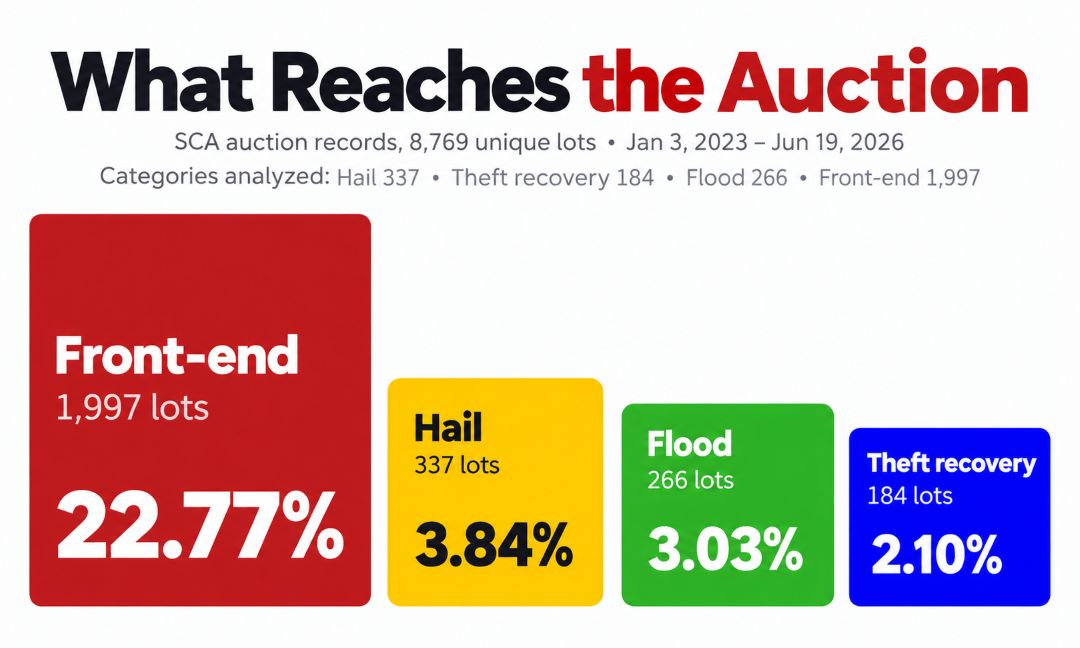
SCA analyzed 8,769 unique auction lots sold from January 3, 2023, through June 19, 2026. Front-end damage accounts for 1,997 lots, or 22.77% of the sample. Hail damage accounts for 337 lots, or 3.84%. Flood damage accounts for 266 lots, or 3.03%. Theft recovery accounts for 184 lots, or 2.10%. The three specialty categories together account for less than 9%.
For a bidder, those shares mean different things:
- Front-end: the broadest pool across makes and values.
- Hail: less common and often storm-driven.
- Flood: scarce and geographically concentrated.
- Theft recovery: the smallest of these four groups.
Does a Run and Drive Flag Mean the Salvage Car Actually Runs Well?
No. A Run and Drive flag is a narrow observation, not a mechanical inspection. It is also not proof that the car is drivable.
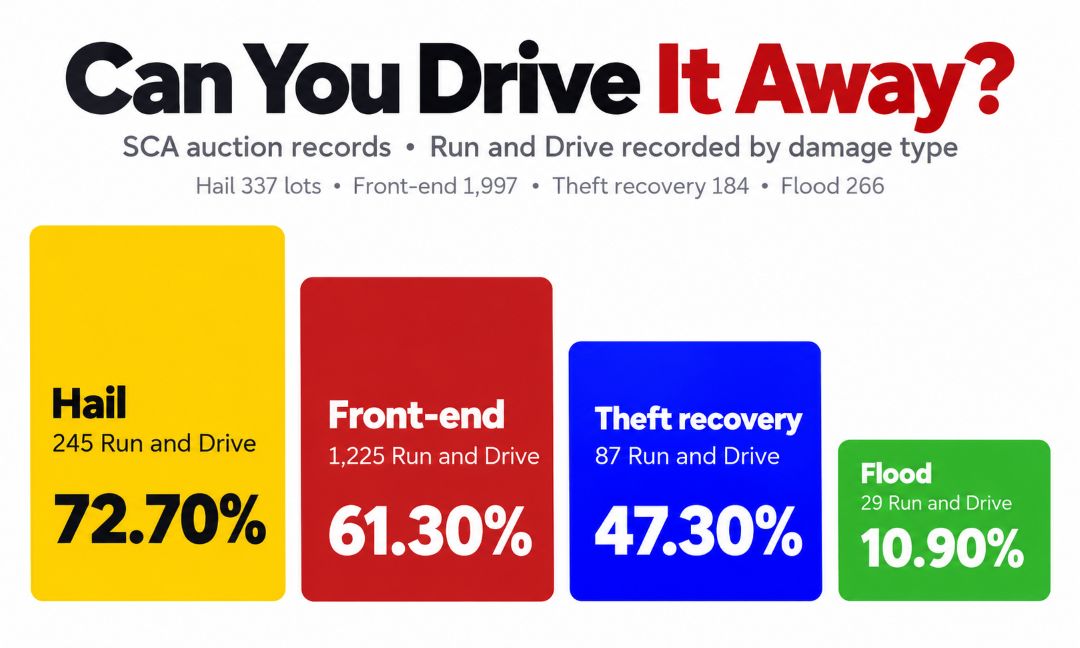
Among the four groups, 245 of 337 hail lots are recorded as Run and Drive, or 72.7%. Front-end follows at 1,225 of 1,997, or 61.3%. Theft recovery is at 87 of 184, or 47.3%. Flood is at 29 of 266, or 10.9%. An absent flag does not prove failure because no Run and Drive check was recorded for 41% of all lots in the dataset.
How Does Bid-to-ACV Ratio Help Compare Salvage Damage Types?
Winning bid alone is a poor comparison. Dividing bid by actual cash value puts differently priced vehicles on one scale.
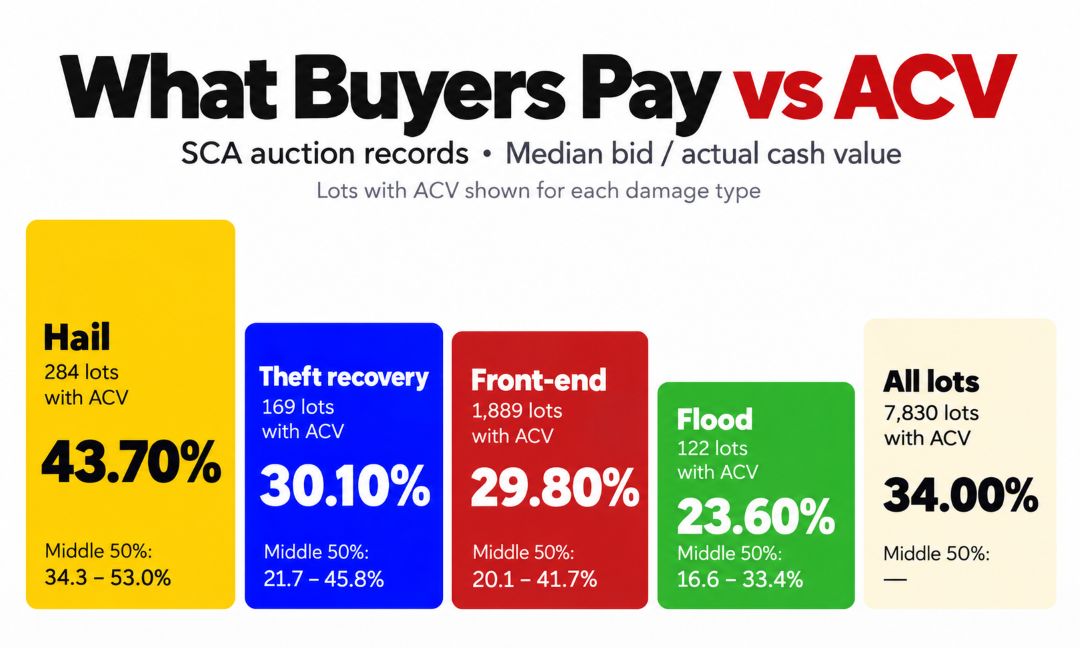
For lots with ACV, hail lots have a median bid-to-ACV ratio of 43.7% across 284 vehicles, with the middle 50% at 34.3%-53.0%. Theft recovery is 30.1% across 169 lots, front-end 29.8% across 1,889, and flood 23.6% across 122; all 7,830 lots have a 34.0% median. Hail has the highest median bid-to-ACV ratio and flood the lowest.
SCA’s guide to salvage vs rebuilt title separates a salvage designation from a vehicle that has completed repairs and the required state process, helping motorists factor title status into the bid separately.
How Is Bid-to-ACV Different From Winning Bid or Repair Cost?
Bid-to-ACV measures purchase price against pre-damage value, not the cost of repairs.
Keep the three numbers separate:
- Winning bid. It is what the buyer paid at auction.
- Bid-to-ACV. It is the bid as a share of the vehicle’s pre-loss value.
- Repair cost. It includes parts, labor, diagnostics, paint, calibration, and hidden issues.
Car flood damage repair cost can rise after electrical modules are opened. Hail repair costs can climb when hundreds of dents require PDR or panel replacement.
What Changes After Controlling for Make, Model, Age, and Value?
The make, model, age, and value are held constant in 1,213 observations. Hail lots command 42.4% more of pre-damage value than comparable front-end lots (p<0.0001). Theft recovery is 13.2% higher (p=0.029). Flood is 17.4% lower (p=0.0056).
This adjustment removes much of the price difference caused simply by one group containing newer, more valuable, or different models. In other words, the remaining gap is associated with damage category after comparable vehicles are put on a more equal footing.
Why Flood Damage Creates the Largest Information Gap Before Bidding
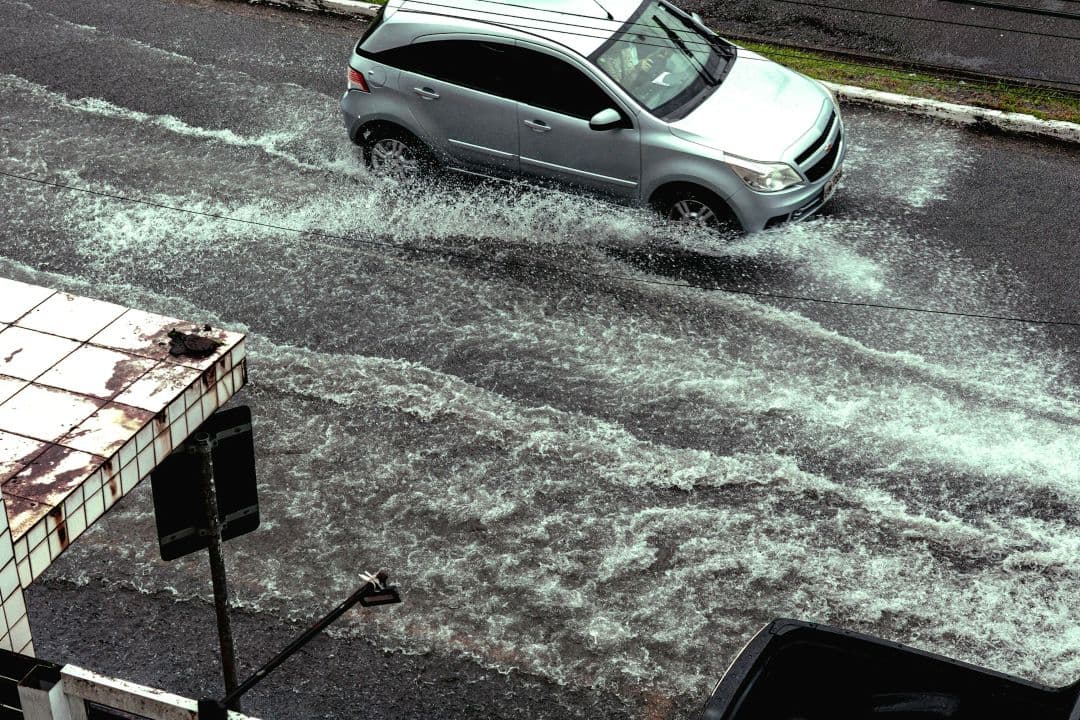
Flood damage on a car is difficult to price. A waterline does not show:
- How long the vehicle was exposed.
- Whether the water was fresh or salt.
- Which circuits were submerged.
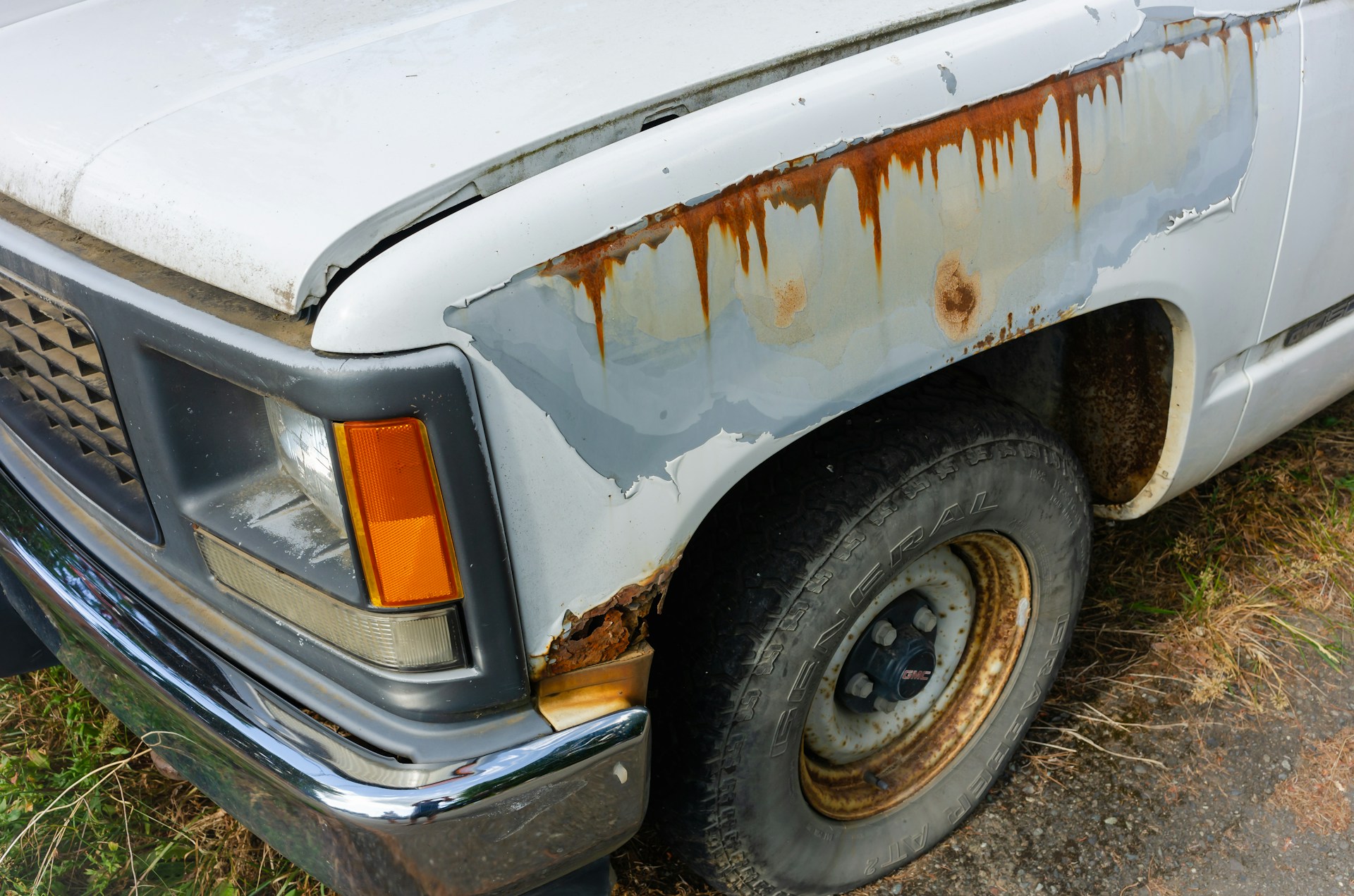
NHTSA warns that effects can persist. Check for rust, corrosion, dirt, and waterlines.
Inspect wiring connectors, seat tracks, and restraints. Check HVAC ducts and insulation. Review the engine, transmission, differential fluids, bearings, starter, alternator, electric motors, and corrosion under hidden trim.
A flood damage car title helps identify documented water damage. However, a clean title does not prove the vehicle was never flooded.
What Does Water Exposure Damage Beyond the Interior?
Water reaches:
- Wiring.
- Modules.
- Bearings.
- Restraint connectors.
- HVAC ducts.
- Fluids.
Saltwater accelerates corrosion. Trapped moisture can create intermittent faults.
Think of flood exposure as a chain of possible failures:
- Moisture enters connectors or modules.
- Corrosion raises resistance.
- Intermittent faults appear.
- Unrelated systems begin generating codes.
- Diagnosis consumes labor before the failed part is even identified.
How Much Hidden Risk Can Front-End Damage Conceal?
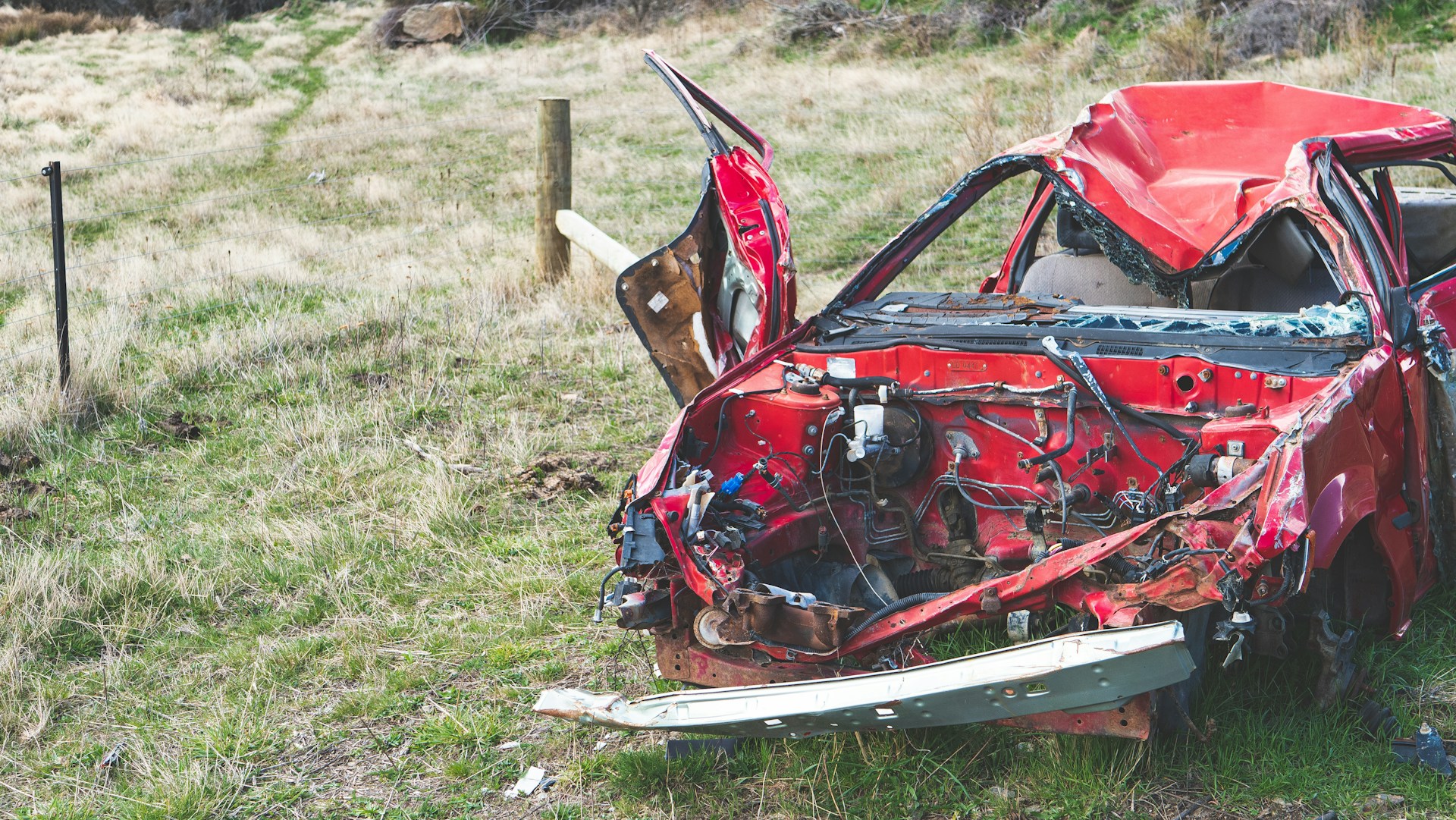
Front-end damage is different. This can be a hit requiring straightforward auto body repairs. Collision damage may affect crash boxes, cooling packs, radar sensors, suspension points, and rails.
Review the photos from the outside in:
- Bumper, lamps, and hood.
- Radiator support and cooling stack.
- Apron, rail ends, and strut towers.
- Wheel and suspension position.
- Airbags, belts, and dashboard warnings.
When Does Front-End Damage Become Structural?
This happens when load-bearing areas are bent, torn, buckled, or shifted.
Frame damage on a car can alter suspension geometry. It may affect crash performance even when panel gaps look acceptable.
A professional auto body technician should measure rails and mounting points. Include major structural movement, deployed restraints, and sensor damage in the estimated cost of repairing the car.
What Makes Theft Recovery Different From Collision Damage?
Theft recovery is event-based. A stolen car may be recovered intact, stripped, or crash-damaged.
NICB reported 659,880 U.S. vehicle thefts in 2025. The figure is down 23% from 2024. The recovery condition still depends on what happened while the car was missing.
A theft-recovery inspection should answer four questions:
- Are the keys and immobilizer complete?
- Are airbags, wheels, lights, and cameras present?
- Has wiring been cut?
- Is there additional damage from a separate car crash?
For a car with a theft-recovered title, SCA brings everything in one place:
- Listing photos.
- Title documents.
- Auction condition.
A salvage title due to theft recovery can reflect an insurer settlement as much as physical destruction.
Which Parts Are Most Often Missing on Theft Recovery Cars?
First, check for airbags, catalytic converters, wheels, headlights, infotainment units, seats, cameras, keys, and electronic modules. Trim pieces may be inexpensive. However, they are slow to source. Cut wiring can add considerable diagnostic labor.
Before bidding, compare the listing with factory equipment. Confirm:
- Keys.
- Major interior pieces.
- Correct lamps and cameras for that trim.
- Whether cut harnesses or missing modules are visible.
Why Is Hail Damage Often Easier to Price, but Not Automatically Cheap?
Hail-damaged cars are easier to estimate. Dents and scratches are usually visible. Triple-I reports 5,432 U.S. hail events of at least one inch in 2025, with Texas leading at 902.
A hail damage salvage title still needs a document check. A salvage title due to hail damage does not show whether damaged parts will make repairs costly.
Check the Title Before You Price the Repair
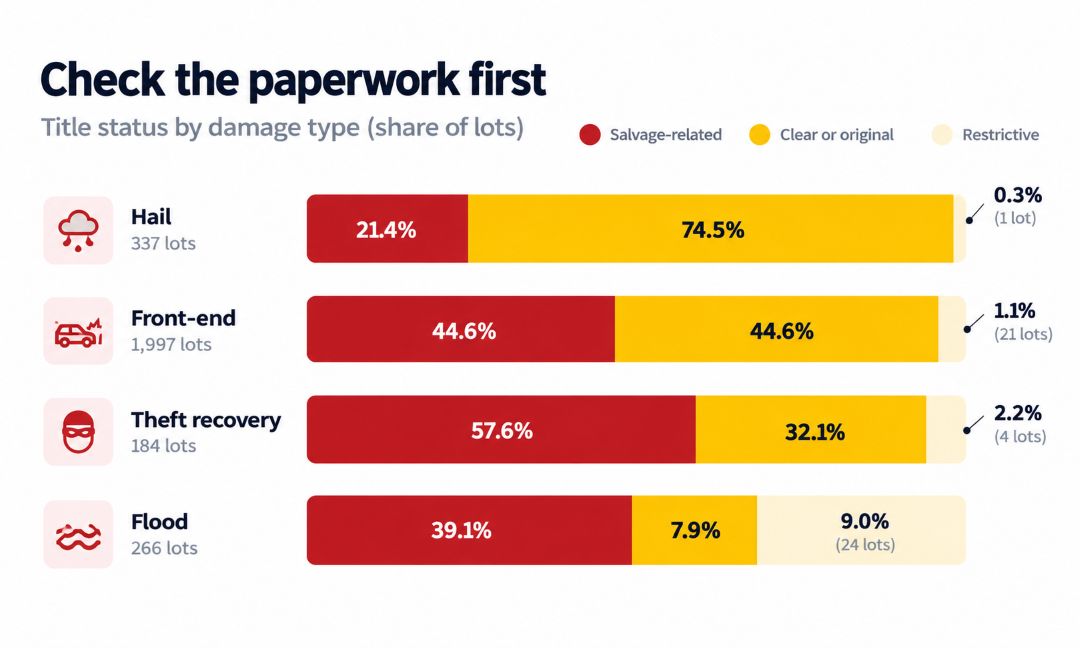
Title records split the categories sharply. Among hail lots, 21.4% are salvage-related, 74.5% are clear/original, and 0.3% are restrictive (just 1 lot); front-end is 44.6%, 44.6%, and 1.1%, or 21 restrictive lots. Theft recovery is 57.6%, 32.1%, and 2.2%, or 4 restrictive lots. Flood is 39.1%, 7.9%, and 9.0%, or 24 restrictive lots.
Start with the document. A non-repairable title may prevent the vehicle from being registered for normal road use.
According to NMVTIS consumer guidance, junk, salvage, and flood brands remain in the history, while state title rules vary.
What Does the Damage Label Not Tell You?
A type of damage label does not explain the accident scene, who caused the accident, whether a police report exists, or who was responsible for paying. It also omits the claims process, insurance information, liability coverage, collision coverage, and the car insurance company’s fair settlement.
If you are involved in an accident, structural damage to your car follows another process. After a minor car accident, you may need to:
- File a property damage claim.
- Work with your insurance company.
- Compare repair estimates with the value of your car.
The insurance claim does not define title status.
Labels also omit rental car use, old paint damage, a scratch, and minor damage. These records describe different stages of a vehicle’s history. Car damage after an accident and damage after a car accident refer to the loss event, while salvage car damage before repair describes the vehicle’s later condition at auction.
What Should You Check Before Bidding on Any Salvage Car?
Use the following sequence:
- Match the VIN. SCA’s VIN decoder helps confirm the vehicle’s factory specifications and identity before deeper history checks.
- Read the title and destination-state requirements.
- Check photos for visible damage.
- Confirm keys, odometer, and Run and Drive status.
- Get cost estimates.
- Add fees and taxes.
- Stop when the numbers no longer work.
How Do You Calculate the Real Cost of a Salvage Car?
Add buyer fees. Moreover, consider transport, tax, storage, parts, labor, calibration, inspection, title work, and contingency to the winning bid.
CCC reported an average total repair cost of $4,768 through Q3 2025. Its 2026 Crash Course report later put the share of claims flagged as total losses at 23.1%.
The budget must cover getting the car back on the road. Leave room for lower resale value.
Use that average only as context, not as a repair budget for a specific lot. The real cost depends on the individual vehicle: damage depth, parts availability, diagnostic work, required calibrations, title requirements, and any problems discovered after teardown can move the final total far above or below an industry average. For bidding purposes, the useful number is the vehicle-specific all-in cost, not the headline auction price or a national repair average.
Which States Supply the Most Hail, Flood and Theft Recovery Salvage Cars?
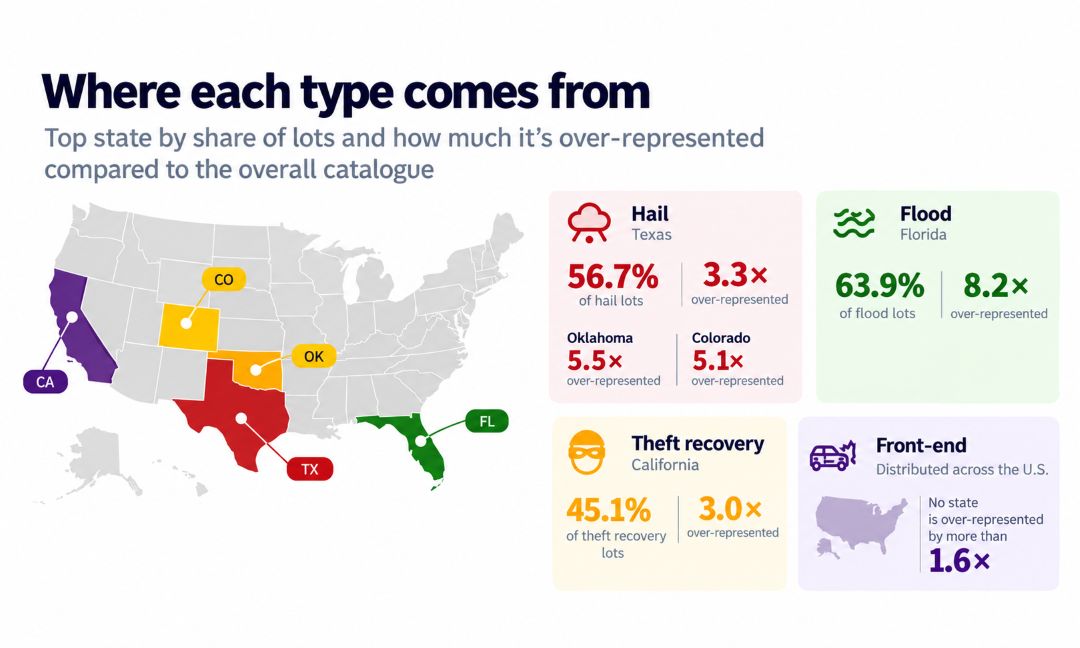
Three of the four categories are strongly regional. Texas supplies 56.7% of hail lots, 3.3 times its overall catalogue share; Oklahoma is overrepresented 5.5 times and Colorado 5.1 times. Florida supplies 63.9% of flood lots, 8.2 times its catalogue share. California supplies 45.1% of theft recovery, three times its overall share.
Front-end lots roughly mirror the overall catalog, with no state overrepresented by more than 1.6 times. Weather and theft concentrate sourcing. Therefore, include transport costs in the bid calculation.
Key Takeaways
- Hail is easier to price. Flood has the widest information gap.
- Run and Drive rates range from 72.7% for hail to 10.9% for flood and are not a roadworthiness test.
- Median bid-to-ACV ranges from 43.7% for hail to 23.6% for flood.
- Restrictive titles appear on 9.0% of flood lots versus 0.3% of hail lots.
- Front-end projects may require structural measurement.
- Theft recovery requires a parts inventory.
The best project is the one whose condition and repair budget you can define before bidding.
FAQ
Can Two Cars with the Same Damage Type Have Completely Different Risk Levels?
Yes. One front-end vehicle may need bolt-on panels. Another has rail movement, airbag deployment, and cooling damage. The shared category does not define repair depth.
Can I Finance a Salvage Auction Car?
Sometimes. However, many lenders restrict financing for vehicles with active salvage titles. Rebuilt vehicles may have more options after inspection and retitling.
Will a Flood Brand Disappear When the Car Is Retitled in Another State?
Not from NMVTIS brand history. A state may use different paperwork or terminology, but prior reported flood, salvage, or junk brands remain part of the vehicle’s NMVTIS record.
Do I Have to Tell the Next Buyer About Hail Damage After Repairing It?
State law and title status determine disclosure duties. Never hide a known branded history. Check your state’s seller-disclosure rules and provide repair records when required.
Does a Salvage Car’s Model Year Change How Risky a Repair Is?
Yes. Newer cars can add sensors, calibrations, and complex electronics, while older cars may have scarce parts, corrosion, or low market values that make otherwise simple repairs uneconomic.