Contents
A flood-damaged car can be reliable after repair, but only under three specific conditions: the waterline stayed below the dashboard, the vehicle was in freshwater for less than 48 hours, and a professional dry-out and component replacement followed within days of the flood event.
To understand how flood-damaged cars are priced and documented, we reviewed 120 sold water-damage auto lots. The data shows three things buyers should check before price: the discount to ACV, title type, and state.
How Much Cheaper Are Flood-Damaged Cars?
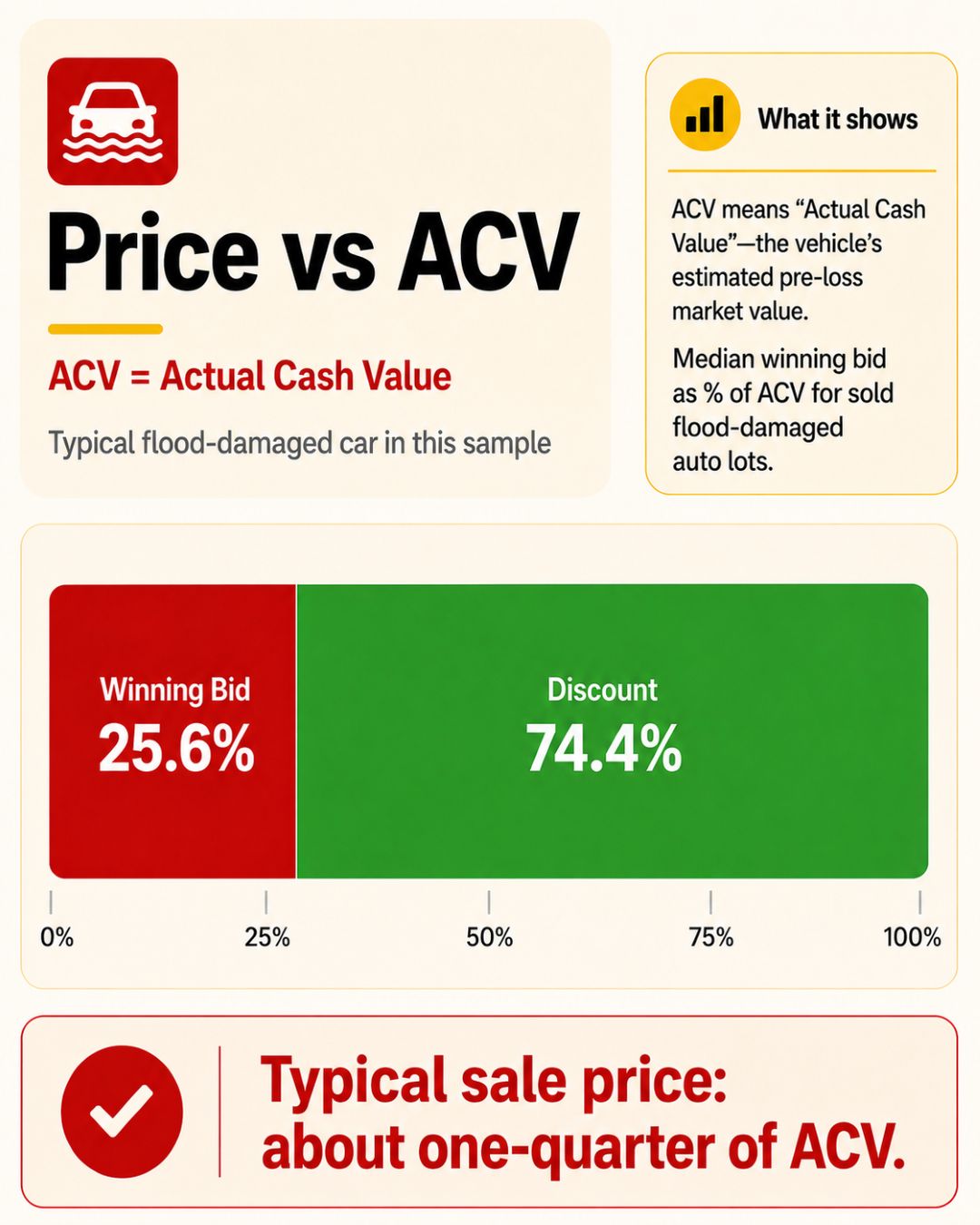
Flood-damaged cars often look attractive because the winning bid can be much lower than the vehicle’s pre-loss value. The typical flood-damaged car is sold for 25.6% of ACV, which means a median discount of 74.4% below ACV.
What Does Flood Damage Do to a Car Over Time?
Flood-damaged cars rarely fail immediately. Problems appear as moisture dries, reappears, or spreads into low areas. Floodwater carries contaminants into foam, wiring, ducts, and trim. Flooded cars can look clean after auction prep. The real concern is what happens over time during normal use. Here is what usually follows:
- White or green residue on terminals, grounds, or fuse boxes.
- Flickering lights or sensor warnings.
- Musty odor from foam, ducts, or seat tracks.
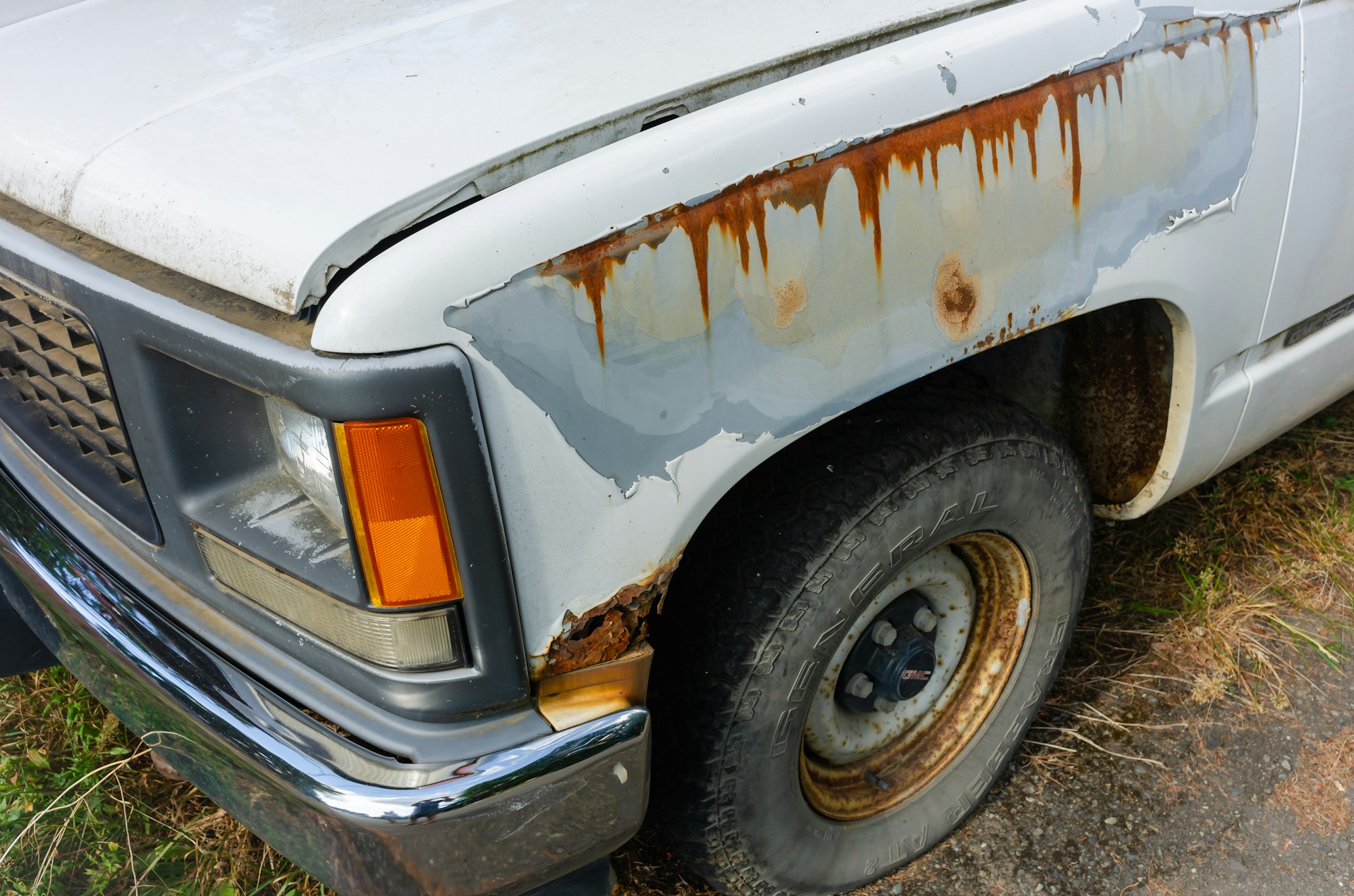
- Rust on brackets, brake hardware, or seat rails.
- Milky or dirty fluids that may signal contamination.
Freshwater vs. Saltwater Damage
Freshwater is not harmless, but saltwater is more aggressive. Minerals can keep attacking metal after the cabin looks dry. The electrical system may work during preview, then fail after humidity or load. Compare the exposure types before placing a bid.
| Factor | Freshwater | Saltwater |
| Corrosion speed | Slower if dried fast | Faster on bare steel and aluminum |
| Electrical system risk | High when modules sit wet | Very high; residue can conduct current |
| Wiring harness expected lifespan post-flood | Uncertain, often months to years | Poor unless replaced or opened fully |
| Brake line failure timeline | Gradual, but serious | Can shorten sharply after storage |
| Mold risk | High if padding stays damp | High, with a stronger odor risk |
| Insurer total loss likelihood | Depends on depth and value | Higher on late-model units |
| Rebuilder recommendation | Buy only with proof of drying | Avoid unless the parts value supports the price |
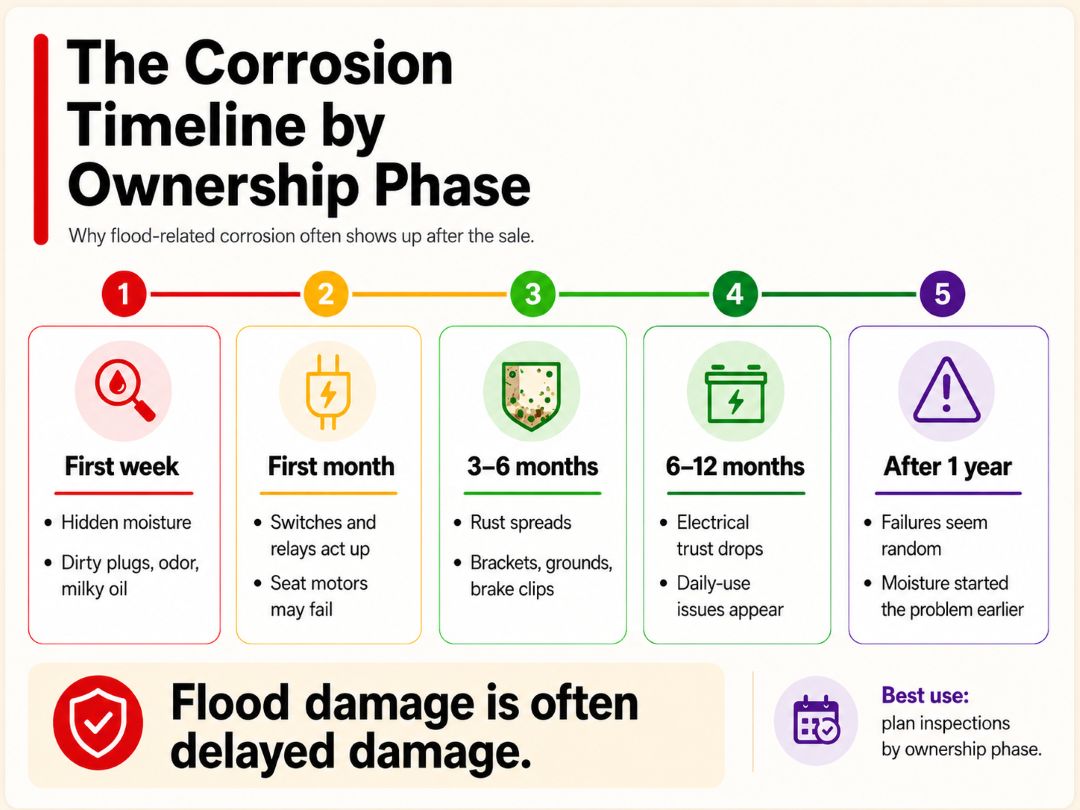
The Corrosion Timeline by Ownership Phase
This timeline is useful because rust does not follow the sale date. A clean photo can hide damp padding. Heat cycles and vibration can expose underlying weaknesses. Use the timeline below to plan post-purchase testing.
Which Parts Must Be Replaced and Which Can Be Saved
Safety parts need stricter rules than trim. Some parts clean up well, but sealed electronics and restraint parts are poor bets. A shortcut can eliminate any cost advantage. Use the table below.
| Component | Typical Replacement Cost Range | Consequence of Skipping |
| Airbag module and crash sensors | $600-$2,500 | Non-deployment risk |
| Seat belts with pretensioners | $300-$1,200 | Weak restraint performance |
| Body control module | $500-$2,000 | No-starts |
| Carpet, pad, and insulation | $500-$1,800 | Mold |
| Brake pads, rotors, and calipers | $400-$1,500 | Pulling or seizure |
| Driveline fluids | $250-$900 | Engine wear |
How to Read a Flood Car Listing Before You Bid
A listing should be treated as evidence, not advertising. Start with photos, title notes, location, seller type, and yard comments. Then use a VIN decoder to confirm trim, engine, airbags, and value. SCA helps, in this case, because the platform shows a wide range of available flood cars, from parts units to projects that otherwise may be repairable. Selection makes it easier to avoid poor bids.
Before bidding, use this order:
- Compare interior photos with exterior marks.
- Check whether the title brand matches the description.
- Look for mud near seat rails, spare-tire wells, and low trim.
- Review any insurance claim photos or seller notes.
- Add transport, taxes, fees, parts, labor, and inspection to the bid.
- Leave a reserve for key electrical systems and brake work.
How to Tell If a Car Has Been in a Flood
Checking a flood-damaged car is not just a physical inspection. A clean interior or a clean-looking history report can still miss the bigger risk picture. To understand whether a vehicle may have flood history, buyers should look at four things together: where the lot is located, what the title says, what the body shows, and whether the listing has risk patterns that do not line up with the price.
Where Flood-Damage Lots Show Up Most
State matters when evaluating a flood-damaged vehicle because title branding, inspection rules, registration requirements, and resale expectations can vary by location. In SCA’s 120 sold water-damage auto lots, flood-damage inventory was concentrated in a small group of states. The top seven states accounted for 85.0% of the sample, with Florida alone representing 33.3%.
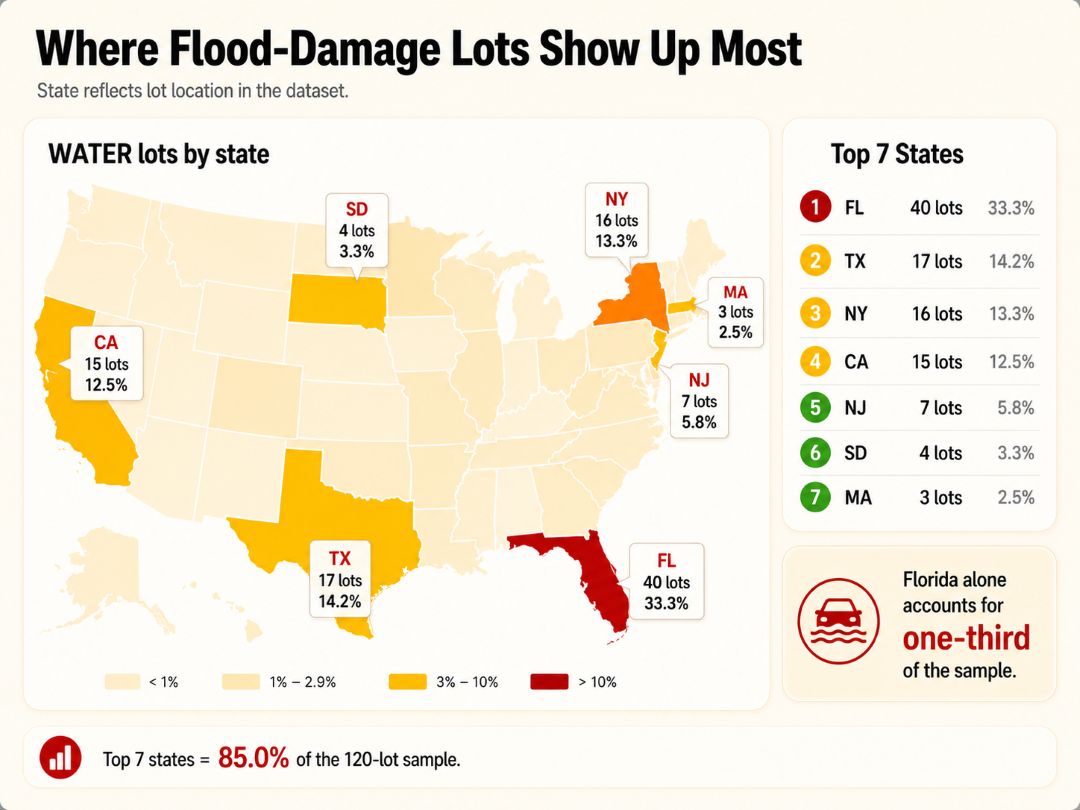
The state shown in the listing should be treated as the lot location in the dataset, not necessarily the place where the flooding happened. This is why registration should be checked before transport or payment. A flood-damaged vehicle bought in one state may require additional inspection, repair documentation, receipts, or rebuilt-title processing.
Title Type Is the First Red Flag
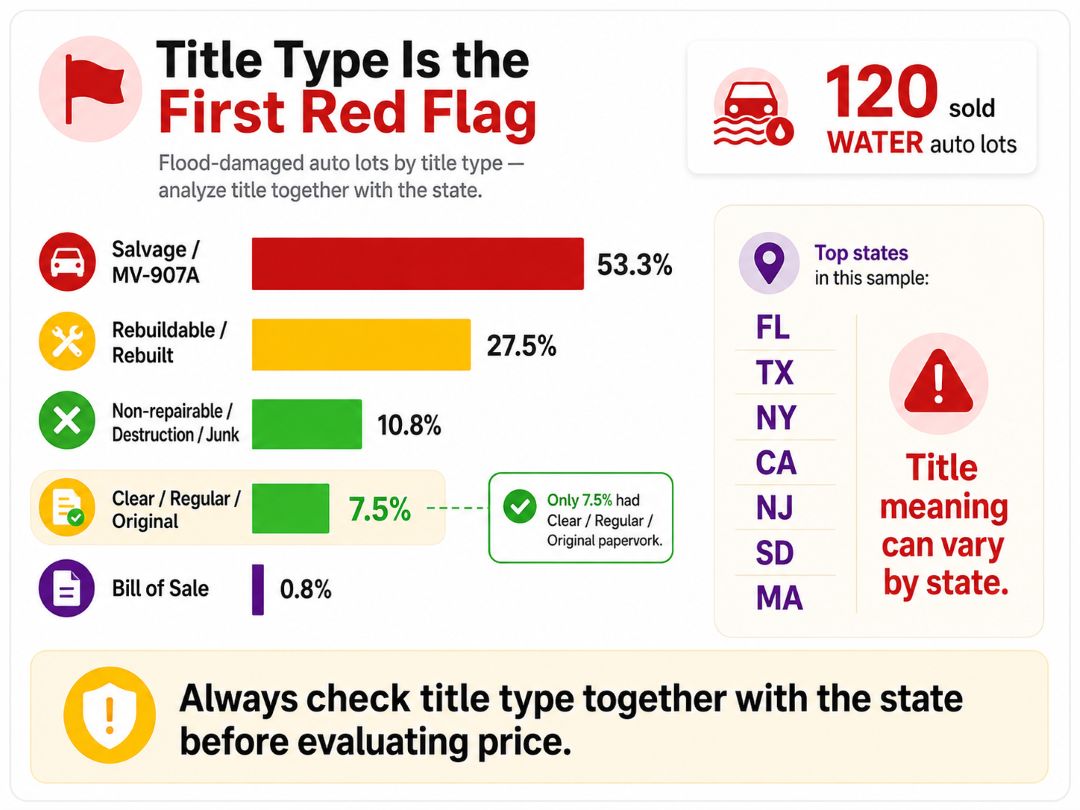
For flood-damaged cars, title type is one of the first signals to check. Most water-damage lots carry branded or restricted paperwork, such as salvage, rebuilt, non-repairable, or bill of sale documents.
Only a small share had Clear / Regular / Original paperwork, but that does not automatically make the vehicle safe. A clean-looking title can still require extra verification, especially when the listing shows flood damage. Title type should also be read together with the state. Registration rules, rebuilt inspections, insurance acceptance, and resale expectations can vary by location.
Physical Signs of a Washed-Title Flood Car
Title jumping can hide the path between a storm area, an auction, and a retail ad. If you want to avoid flood-damaged cars, begin with the body, not the report. The VIN may look clean while the vehicle tells another story. If anything appears inconsistent, look for these indicators:
- Sand or silt behind kick panels.
- New carpet with old seat bolts.
- Rust on seat frames, pedals, or brackets.
- Discolored speaker cones or door insulation.
- Fogged lamps or beads inside lenses.
- Heavy perfume covering a musty cabin.
- Residue under fuses, relays, or ground straps.
- Debris in the bottom of the doors.
Listing and Paperwork Risk Patterns to Check
Physical signs are only one part of flood detection. A listing can also show risk through the combination of title type, state, vehicle segment, and price-to-ACV ratio. SCA reviewed its auction data for a cleaned sample of 120 sold WATER-damage auto lots and grouped recurring warning patterns buyers should check before bidding.
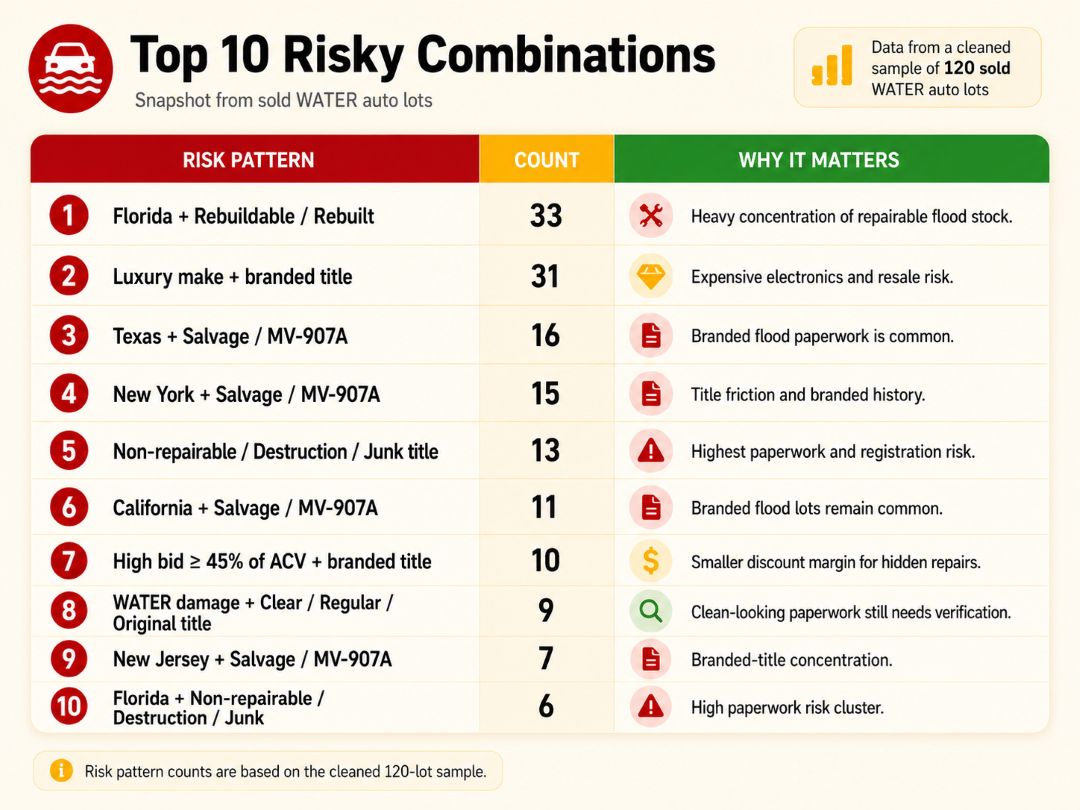
These are not automatic deal-breakers. They are risk signals: if a vehicle matches one of these patterns, buyers should verify the title history, state rules, auction photos, repair records, waterline evidence, and expected resale value before treating the price as a bargain.
How to Calculate Whether the Deal Makes Financial Sense
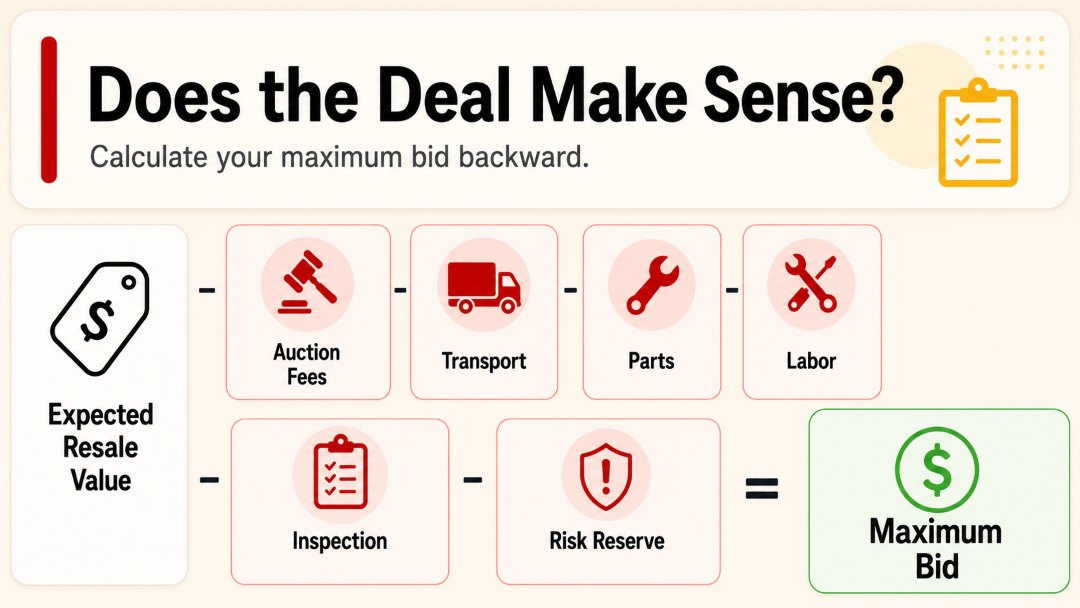
Two vehicles with identical damage can have very different outcomes depending on demand, seasonality, and parts availability. A flood-damaged pickup, work van, or popular SUV may recover more value than a niche luxury model with expensive electronics and limited buyer interest.
How to Estimate Post-Repair ACV on a Flooded Vehicle
ACV, or Actual Cash Value, is the vehicle’s estimated market value before the damage. To understand how the market prices flood risk, SCA analyzed 120 sold water-damage auto lots with valid ACV data. The data showed that the typical winning bid ranged from 19.7% to 28.7% of ACV, depending on title type. In other words, even after grouping by paperwork status, flood-damaged vehicles in this sample sold far below their estimated pre-loss market value.
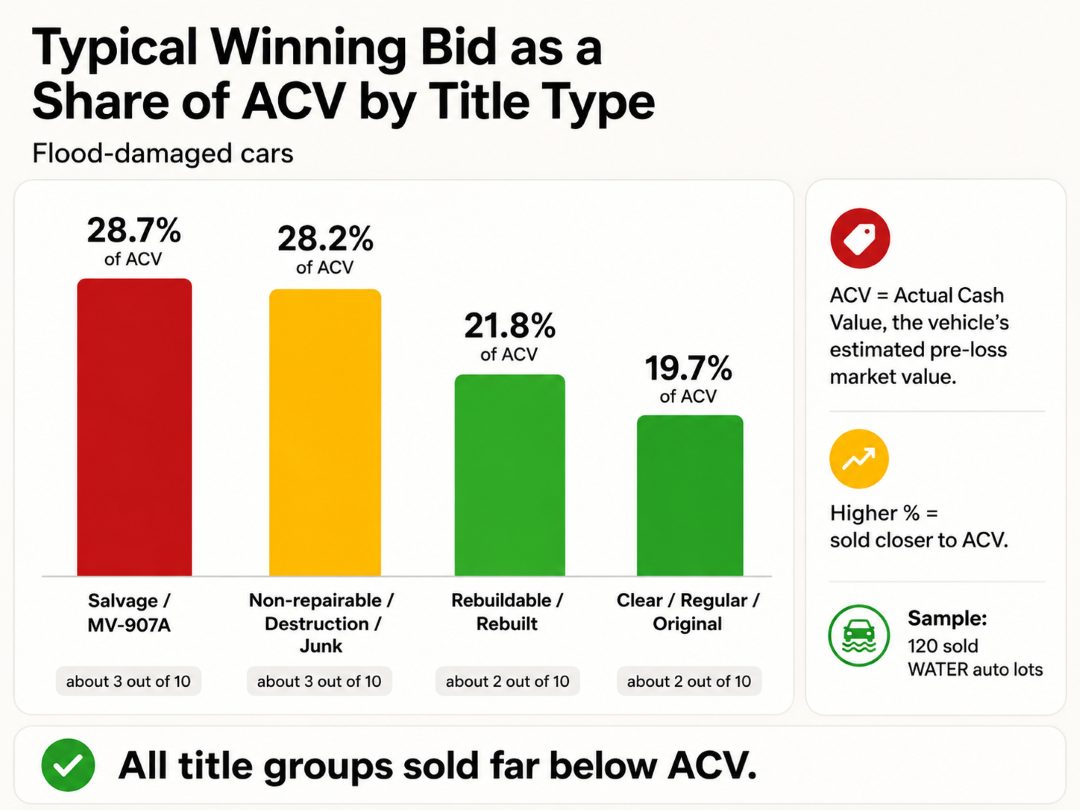
A practical way to estimate post-repair value:
- Start with the clean-title retail value for the same year, trim, mileage, and options.
- Subtract a flood/title discount for market resistance and resale risk.
- Subtract known mechanical, interior, electrical, and corrosion-related repairs.
- Add back only documented parts and professional labor that clearly improve the vehicle’s condition.
- Keep a reserve for delayed issues, especially connectors, modules, brakes, sensors, HVAC, mold, and odor treatment.
- Compare your expected total cost with similar sold water-damage lots before assuming the project is a bargain.
The key point is simple: a flooded car can be cheap at auction and still be expensive after repair. The winning bid only makes sense if the discount is large enough to cover repairs, title friction, state-specific paperwork, and lower resale value.
Hidden Costs Buyers Miss in Their Budget
Most buyers remember the winning bid. They forget to test after the vehicle is driven. Storage, towing, fluids, mold work, and rejected inspections change the math fast. Review these common extras before you buy.
| Hidden cost | Why it matters | Typical range |
| Transport | Non-runners need hauling | $300-$1,500 |
| Diagnostics | Intermittent faults take time | $150-$1,000 |
| Interior removal | Padding hides moisture | $400-$1,500 |
| Brake service | Rust may not show | $300-$1,800 |
| Title and inspection fees | State rules vary | $100-$700 |
What Happens When You Register a Flooded Car Bought in Another State?
Registration depends on several factors. These are the title brand, inspection rules, and prior paperwork. You may need receipts and photos. Also, you need proof that the vehicle is roadworthy. Confirm DMV rules before transport or payment. Do not assume you can get a salvage title cleared just because another state issued cleaner documents.
For example, a vehicle purchased with a flood or salvage brand in Florida may require a rebuilt inspection before it can be issued a road-use title in another state. A buyer moving the same vehicle to Virginia may need photographs of the repair process, major parts receipts, and a state examination before registration approval.
Virginia DMV states that a rebuilt vehicle must pass an examination before being titled for highway use.
Who Should and Shouldn’t Buy Flood-Damaged Cars at Auction?
Repairing a flooded car is not for every buyer. The right person has tools, space, patience, and service data. A commuter who needs dependable transport tomorrow should be cautious. Passenger vehicles aren’t designed to submerge, so the type of damage matters more than paint. The table below shows who fits the risk.
| Buyer type | Fit | Reason |
| Licensed rebuilder | Good | Can document parts and labor |
| DIY mechanic with backup transportation | Possible | Can wait for testing and parts |
| Parts buyer | Good | Value is not tied to road use |
| First-time auction buyer | Risky | Easy to underestimate hidden faults |
| Daily commuter buyer | Poor | Reliability is too uncertain |
| Buyer after a hurricane | Possible | Only if pricing reflects regional risk |
SCA is practical because its inventory spans titles, makes, conditions, and price levels. That range helps disciplined bidders avoid forcing one risky deal.
Key Takeaways
- Car water damage is a long-term reliability question.
- Flooding could happen far from the coast, but coastal exposure is usually harsher.
- Insurance companies may call deep exposure a total loss when future faults are hard to predict.
- A disclosure obligation may apply when selling, especially if records show branded history.
- The safest bids leave money for testing, drying, parts, and lower resale value.
- Title history matters, but the physical condition matters more.
A flooded car can be worth buying only when the price, records, teardown, and future risk all make sense.
FAQ
Can Flood-Damaged Cars Pass Emissions Tests?
Yes, they can. It’s possible if sensors, catalysts, wiring, and readiness monitors work correctly. Moisture-related faults may still appear later. They can cause a failed retest after normal driving.
Does Water Damage Total a Car Automatically?
No. The decision depends on value, repair cost, depth, contamination, and state rules. Insurance companies may total it when future reliability is too uncertain for safe resale.
Can Flood Damage Affect Vehicle Safety Systems Years Later?
Yes. Wet connectors, sensors, seat belts, or airbag modules can fail later.
Can You Sell a Flood Car Without Disclosing the Damage in a Private Sale?
Rules vary by state. However, hiding known history can create legal risk. Be honest. Keep records, and disclose known flood history.
Does Flood Damage Affect a Car’s Towing or Payload Capacity?
Not directly on paper. Nonetheless, brake issues, drivetrain contamination, sensor faults, and weak electronics can make towing unsafe unless the vehicle is fully tested under load.
Is a Rebuilt Flood Title Safer Than a Salvage Flood Title?
Sometimes, but not automatically. A rebuilt title means the car was repaired and passed a state inspection, but flood damage can still cause delayed electrical issues, corrosion, mold, and resale problems.
When Do Flood-Damaged Cars Usually Appear at Auction?
Often weeks or months after the flood event. In SCA’s research, flood-damaged lots were most common from September through December.