Contents
A rebuilt-title car is generally safer to buy than an unrepaired salvage car because it has completed the required repair and state title process. But a rebuilt title does not guarantee safe or high-quality repairs. Before buying, verify the vehicle’s history, repair documentation, inspection requirements, insurance availability, and eligibility for registration in your state.
What Is a Salvage Title on a Car?
A salvage title means the vehicle has crossed a legal or financial threshold. This happens after serious damage, theft, flood, fire, or another qualifying loss. It is not a diagnosis of every defect. The key distinction in total loss vs salvage title is timing: the total-loss decision comes first; the state document records the vehicle’s status afterward.
Title requirements differ. The New York DMV examination program uses a 75% repair-cost threshold in the situations covered by New York law. Florida allows certain owner/self-insured vehicles that are seven model years old or newer and valued at least $7,500 to receive a rebuildable certificate when estimated repair costs equal 80%–89% of retail value.
What Triggers a Salvage Declaration?
A car may enter this category after collision damage, water exposure, fire, vandalism, or theft recovery. If an insurance company declares the vehicle a total loss, the next paperwork step depends on state law and who retains the vehicle.
A typical sequence is:
- The insurer estimates pre-loss value and damage.
- The vehicle is deemed a total loss under the policy and applicable rules.
- A total-loss determination by an insurance company may trigger a salvage certificate or another branded title.
- The owner, insurer, or buyer chooses dismantling, export, or a legal rebuild path.
Once declared a total loss, a running vehicle can still receive restricted paperwork. That is why buying a car with a salvage title starts with the document, not with whether the engine starts.
What Is a Rebuilt Title on a Car?
A rebuilt title usually identifies a previously damaged vehicle that completed the state’s restoration process. The car has been repaired and approved for registration under that state’s rules. Arizona, for example, requires a Level III examination of major components and highway equipment.
Buying a car with a rebuilt title avoids the ‘unfinished project’ stage but does not prove factory-quality work. A vehicle with a rebuilt title still deserves independent checks.
What Is a Non-Repairable Car, and Can It Ever Return to the Road?
A non-repairable title or destruction certificate generally limits the vehicle to parts, scrap, or another use outside normal registration. New York says it will not examine or register an out-of-state rebuilt vehicle marked “parts only,” “non-rebuildable,” or “non-repairable.”
This is where the distinction between a branded title and a salvage title matters. “Branded” is the broad category; the specific wording tells you what legal path, if any, remains.
Non-Repairable vs Salvage vs Junk Vehicle
Compare the exact document with the destination state’s rules before spending on transport or repair:
| Document Type | What Caused It | Path Back to the Road | Typical Buyer Use Case |
| Non-repairable/ destruction | Severe damage, owner surrender for parts, or an irreversible state classification | None under the normal process | Parts, scrap, limited export |
| Salvage | Total-loss threshold, theft recovery, collision, flood, or fire | State-dependent standard rebuild process | Rebuild project, parts, export |
| Junk | Dismantling, scrap designation, or end-of-life classification | Usually none; terminology varies | Parts and scrap |
| Rebuilt/restored title | Prior loss followed by documented work and state approval | Registration generally possible | Road use, resale, personal ownership |
A salvage title cannot be treated as “parts only” by default, and a junk document should not be treated as an ordinary project.
Salvage vs Rebuilt Title: What Changes After a Vehicle Is Restored?
The difference between rebuilt and salvage is completed work plus legal eligibility. After repair and the required state inspection, the car may receive a rebuilt title and qualify for registration.
A rebuilt brand generally remains part of the vehicle’s title history where permanent branding is required. Title washing tries to hide an unfavorable brand through transfers or misleading paperwork, so a current document alone is not enough after interstate moves.
Rebuildable Does Not Mean “Almost Fixed”
In the 9,093-lot SCA dataset, five mutually exclusive title categories, plus 1,026 unclassified records, were included. The groups contained 3,184 Salvage lots, 235 Rebuildable, 42 Rebuilt, 100 Destruction, 4,506 Clean, and 1,026 unclassified records. Price-to-ACV calculations use the 2,983 lots with both a positive winning bid and positive ACV (actual cash value). The Rebuilt group included Restored (13), Rebuilt (8), Reconstructed (7), Prior salvage (6), Previous salvage (4), Salvage rebuilt (2), and Original – reconstructed (2).
Among priced Salvage vehicles, the median winning-bid-to-ACV ratio was 27.8%, compared with 28.5% for Rebuildable vehicles.
Despite the different paperwork, Salvage and Rebuildable vehicles were priced almost identically in the SCA sample. Both represent the same practical situation: a vehicle that still needs restoration, inspection, and re-titling.
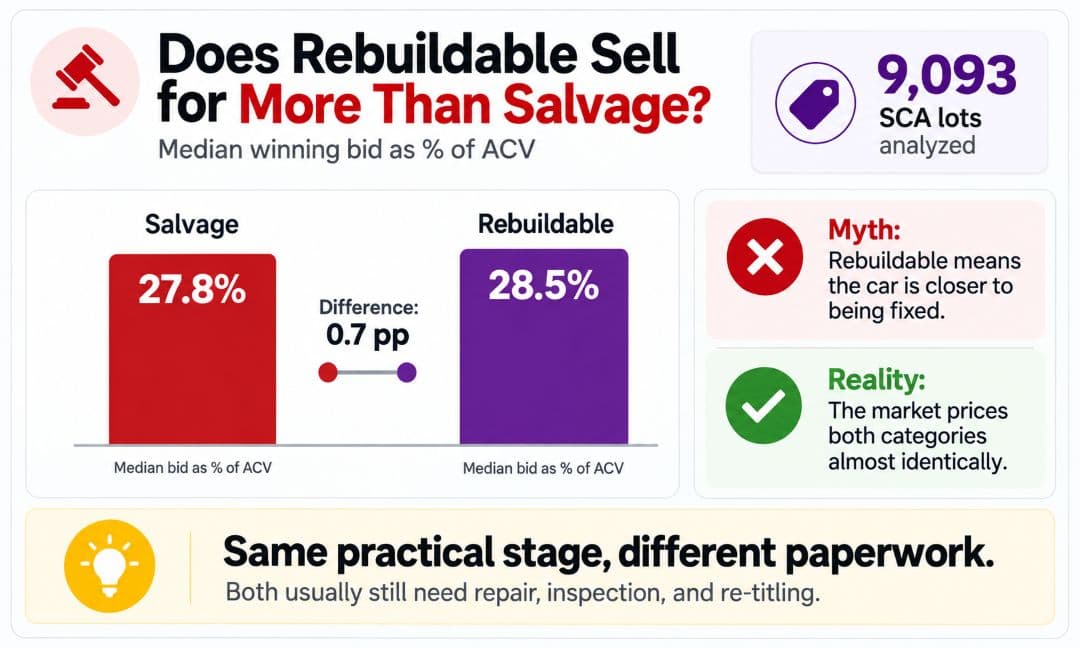
The chart shows 27.8% versus 28.5%, only 0.7 percentage points apart. “Rebuildable” should not justify a higher bid or imply the car is closer to completion.
How Much Is a Salvage or Rebuilt Vehicle Actually Worth?
Among 2,983 SCA lots with positive winning bids and positive ACV values, the individual bid-to-ACV ratios were:
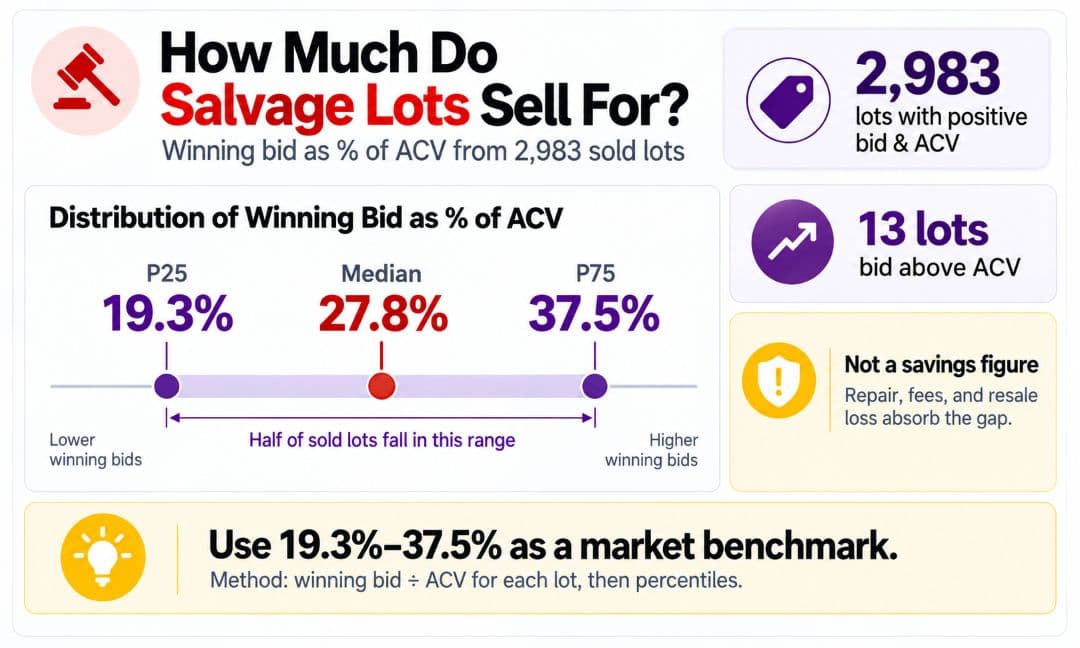
The chart places P25, median, and P75 at 19.3%, 27.8%, and 37.5%. Half the observations fall inside that band, making it a useful market check. Method: calculate bid/ACV for each lot first, then take the median and percentiles.
The 27.8% median is not “72.2% savings.” The gap between the winning bid and ACV must absorb:
- Repair.
- Fees.
- Transport.
- Taxes.
- Inspection.
- Uncertainty.
- Lower resale value.
SCA warns against relying solely on listing information. ACV is a reference point, not a guarantee.
Does a Rebuilt Title Recover Lost Value Compared With a Clean Title?
SCA’s priced sample suggests that completion closes much of the gap.
Completing the rebuild process closes most of the gap. Most of the observed value recovery appears after the vehicle has been rebuilt.
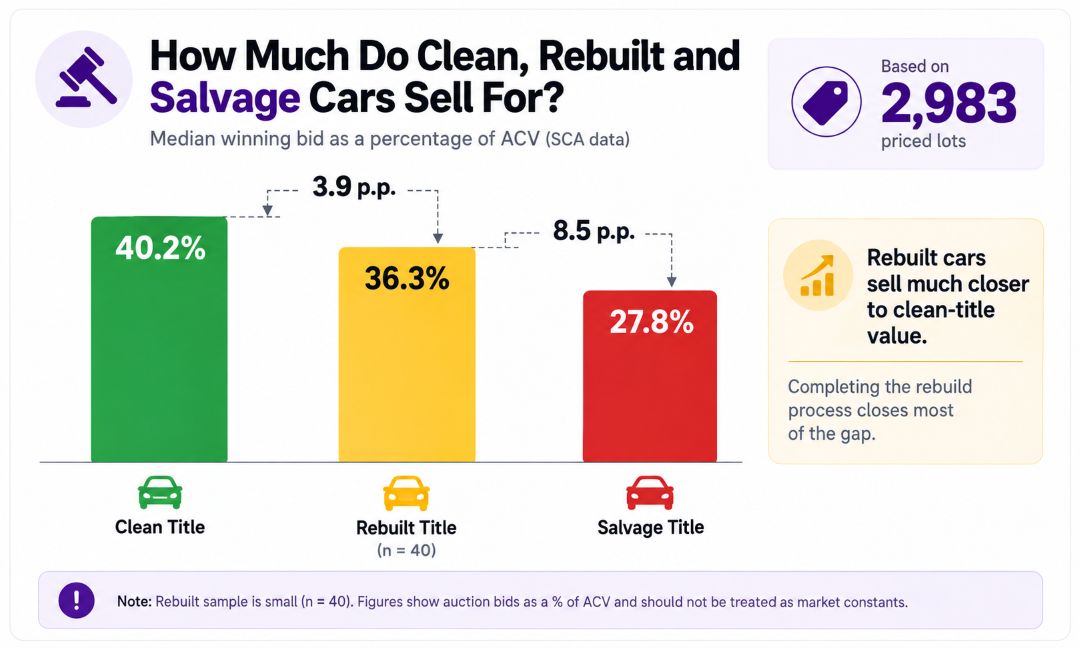
Median bid-to-ACV was 40.2% for Clean, 36.3% for Rebuilt, and 27.8% for Salvage. The gaps were 3.9 percentage points to Clean and 8.5 percentage points to the unrepaired group. That supports the view that completed restoration is associated with most of the observed value recovery, but n=40 is too small to treat 36.3% as a market constant. SCA’s priced data offers a useful auction benchmark for a rebuilt car’s value.
Why a Running Car Can Still Be a Risk: Run & Drive Does Not Mean Rebuilt
A running engine does not confirm straight rails, working airbags, dry modules, correct calibrations, or roadworthiness. A salvage car may move under its own power and still need necessary repairs.
Likewise, a car with a clean title is not guaranteed to have never been in an accident. Operating condition and title status are separate. That matters because “Run & Drive” answers only a narrow question: did the vehicle start, engage gear, and move when it was listed? It does not answer the buyer’s real questions: whether the airbags are functional, whether the frame is straight, whether water reached electrical modules, whether ADAS sensors need calibration, or whether the title can be converted into legal registration.
Run & Drive Status Across Title Categories
The SCA sample makes that separation visible:
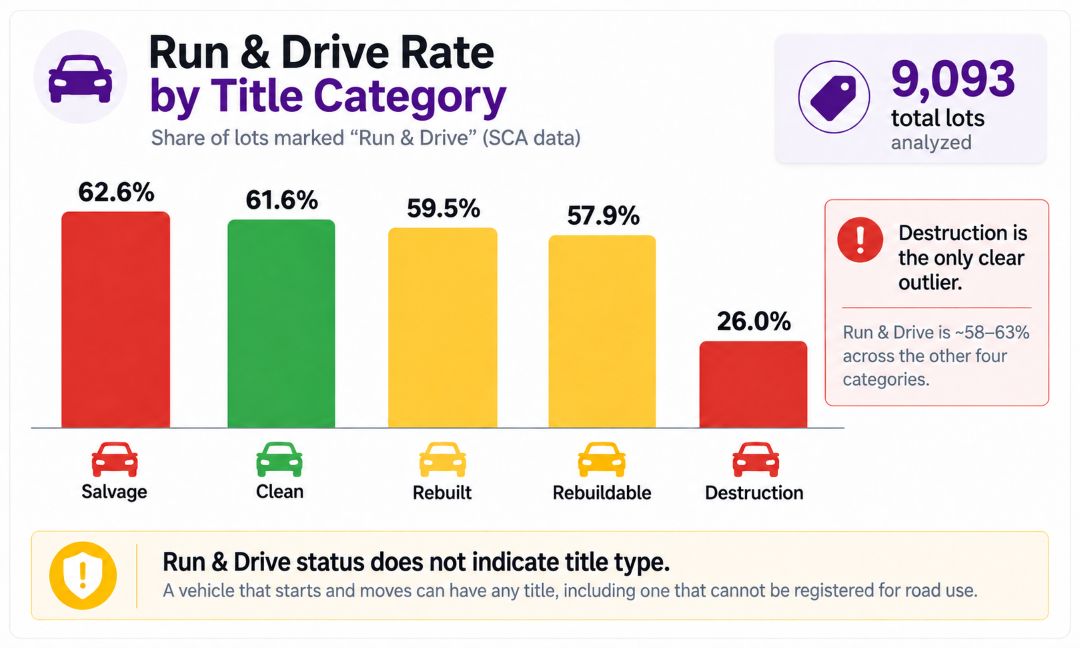
Run & Drive is:
- 62.6% for Salvage.
- 61.6% for Clean.
- 59.5% for Rebuilt.
- 57.9% for Rebuildable.
- 26.0% for Destruction.
The 4.7-point spread across the first four groups is too small to treat the flag as a title indicator.
The chart cannot tell whether a car was rebuilt and inspected, is eligible for road use, or is safe to drive. Blank fields were not treated as “NO,” and the export contains no diagnostic results.
Do not skip inspection because a listing is marked YES. SCA states that a purchased vehicle cannot be driven from the lot regardless of condition and must be collected by a licensed, insured carrier.
Hidden Repair Costs: Why Small Damage Can Create Large Bills
Small-looking damage can hide radar brackets, cooling hardware, sensors, harnesses, impact absorbers, structural movement, or delayed water-related corrosion.
Build the estimate in layers. First, visible body repair. Second, mechanical, electrical, restraint, and calibration work found after teardown. Then towing, paperwork, taxes, and administrative fees. Include contingency instead of treating the first estimate as final. For auction buyers, the costly part is often the gap between what is visible in listing photos and what appears after teardown. A cracked bumper may also mean damaged brackets, sensor alignment work, or hidden wiring issues.
State Rules Can Decide Whether Your Vehicle Returns to the Road
Where a vehicle is titled can strongly influence the terminology used and the process required to return it to the road.
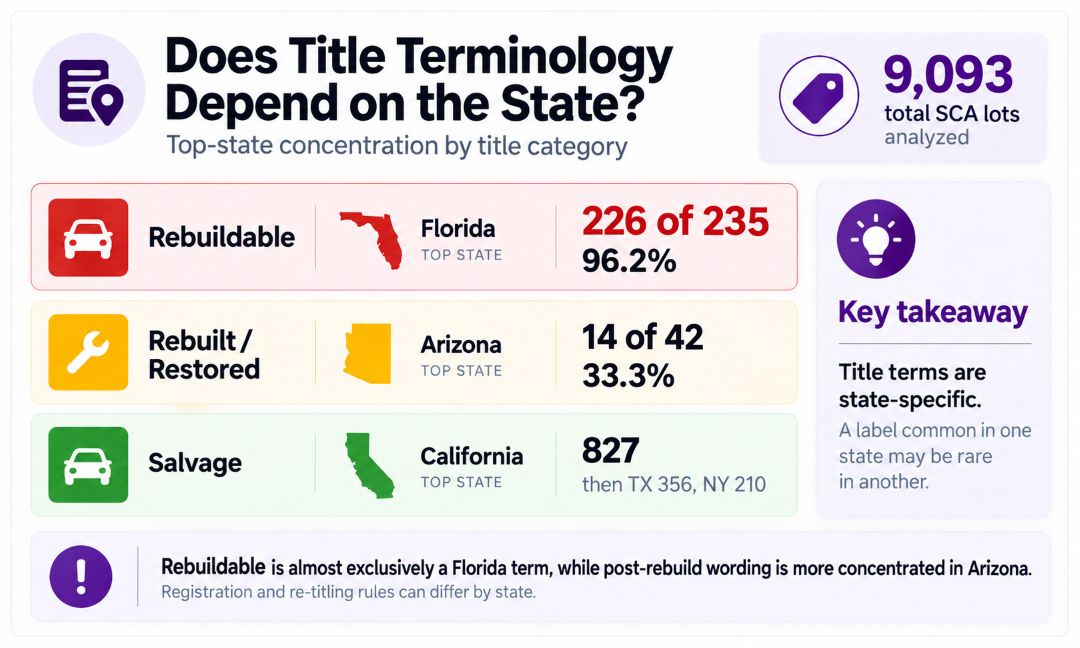
The chart makes the geography clear: Florida accounts for 226 of 235 Rebuildable records (96.2%), while Arizona has 14 of 42 Rebuilt/Restored records (33.3%). Among Salvage lots, California leads with 827 lots, followed by Texas at 356 and New York at 210. This shows why document wording and registration rules must be checked state by state.
Florida uses “salvage rebuildable” terminology and specific supporting documents. A clean title vs salvage title comparison from one state may not map neatly onto another state’s labels.
How Do Salvage Vehicle Examinations Work?
A state examination is mainly a legal and anti-fraud checkpoint. New York DMV says its process is separate from safety, emissions, and insurance checks and is intended to detect stolen vehicles or stolen parts.
| Step Number | What Happens | What’s Verified | What’s Not Verified |
| 1 | Ownership papers are submitted | Document, applicant, VIN | Repair quality |
| 2 | Parts paperwork is reviewed | Receipts and stolen-parts check | Long-term reliability |
| 3 | Vehicle is examined | VIN, major components, required documentation | Complete mechanical condition |
| 4 | The examination result and title application are processed | Eligibility for the next title step | A warranty of drivability |
This distinction matters for theft prevention: a state inspection can establish identity and eligibility, while an independent inspection asks whether the repair is acceptable.
Before bidding, use SCA’s VIN decoder to confirm basic identity and specifications, then obtain a vehicle history report and reconcile it with visible VINs, state papers, repair records, and the physical car. One check should never substitute for the others.
Damage Type Matters More Than the Title Label
The legal label tells you the paperwork path; the damage mix tells you what may need attention:
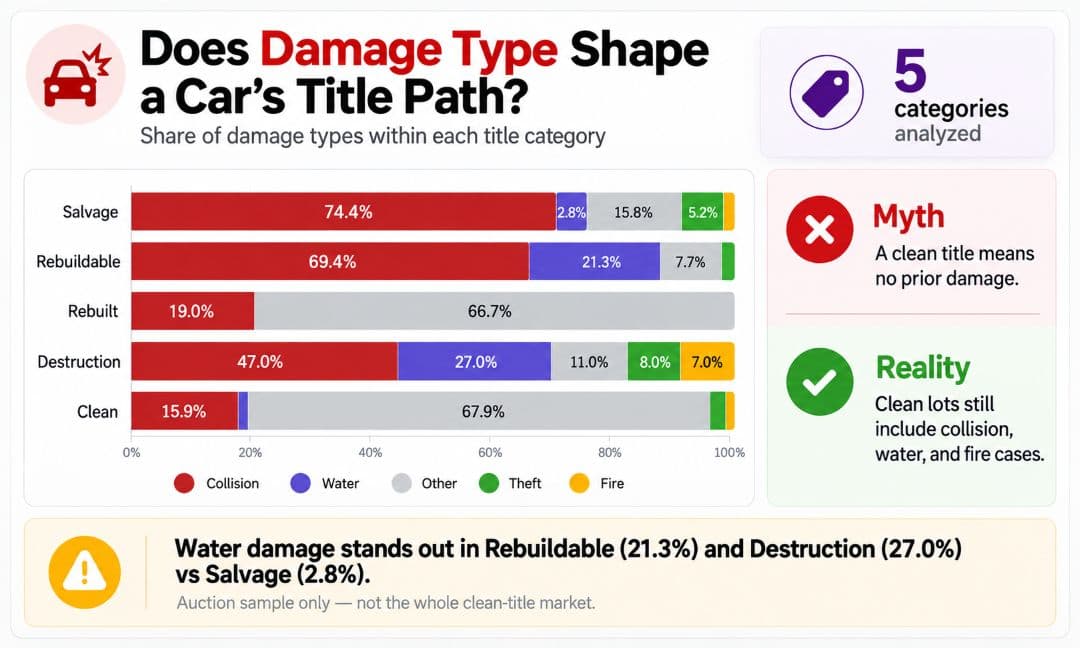
The stacked chart shows water damage in 21.3% of Rebuildable and 27.0% of Destruction lots, versus 2.8% of Salvage. Water exposure is therefore disproportionately associated with a special rebuild path or blocked normal road use.
The Clean group also included 15.9% collision-damage lots, 0.6% Water, and 0.2% Fire. Myth: a clean document means no prior damage. Reality: this auction sample includes damaged clean-title vehicles. The absence of a damage code does not prove that no prior damage occurred.
Can You Insure or Finance a Salvage or Rebuilt Title Vehicle?
Financing and insurance depend on legal status, valuation, and underwriting. Some lenders avoid cars with salvage titles. SCA’s auction data helps answer the following question: Is a salvage title car worth rebuilding? This data gives a real bid-to-ACV benchmark.
Another essential question: How does a rebuilt title affect lending? It can reduce collateral value and make a later sale less predictable.
AAA’s total-loss guidance says insurability varies by state and underwriting rules and notes that prior loss history can affect actual cash value in a later claim. Ask insurance companies for quotes before bidding and compare insurance options, including whether only liability or broader coverage is available.
For SCA buyers, include premiums, deductibles, financing costs, transport, and realistic exit value – not just the winning bid.
How to Check a Salvage or Rebuilt Vehicle Before You Bid
The main trade-off with a salvage title is lower purchase price versus greater uncertainty. It can be ok to buy a salvage title car when reconstruction is legal, damage is understood, and the finished budget works. When shopping for a used car in this category, use a repeatable checklist:
- Confirm the title brand and the destination state’s rules for salvage-to-rebuilt conversion.
- Match visible VINs to paperwork. Inspect any unexplained state change or replacement document.
- Inspect structure, airbags, seatbelts, wiring, cooling, brakes, tires, ADAS hardware, and water traces.
- Price parts, labor, calibration, fees, transport, tax, and contingency before you buy a vehicle.
- Confirm what must be repaired and inspected before the vehicle qualifies for rebuilt paperwork and can be legally driven.
- Arrange insurance before purchase if you plan to keep the car.
- Compare finished costs. The damaged-history vehicle should normally cost less than the same model with a clean title.
Do not attempt to remove a salvage brand through interstate title transfers. The legitimate route is disclosure, compliant repair, required review, and the proper documentation when the title is issued.
Key Takeaways
- Salvage and rebuilt car titles describe different stages: unfinished/restricted versus completed and state-approved.
- Rebuildable carried almost no pricing premium in the SCA sample: 28.5% of ACV versus 27.8% for the unrepaired group.
- Rebuilt pricing sat closer to Clean, but the priced Rebuilt sample was only n=40.
- Run & Drive was 57.9%–62.6% across the main four categories, so movement does not prove legality or condition.
- Water damage reached 21.3% in Rebuildable and 27.0% in Destruction, versus 2.8% in the Salvage group.
- State law determines access to public roads; condition checks determine whether the project is sensible.
Judge legal eligibility, damage, documented repair, inspection evidence, financing, insurance, and final cost.
FAQ
Is Buying a Rebuilt Vehicle Safer Than Rebuilding a Salvage Vehicle Myself?
Usually, a completed rebuilt car reduces project uncertainty. However, safety still depends on workmanship and documentation. Have it checked independently after it is issued a rebuilt title.
How Can I Tell If a Title Was Washed Instead of Legitimately Rebuilt?
Compare current paperwork with prior state records, ownership dates, title brands, mileage, and prior losses. Legitimate vehicles with rebuilt titles should show a traceable prior salvage status, not an unexplained clean document.
Can I Drive a Salvage Vehicle Immediately After Buying It?
Usually no. A vehicle with a salvage document must normally complete the required repairs and inspections, obtain the proper title and registration, and secure insurance coverage before it can be driven on public roads.
Is a Vehicle Inspection Enough Before Buying a Salvage Car?
No. An inspection cannot establish the complete legal history. Check ownership, prior losses, parts paperwork, registration eligibility, state rules, and physical condition.
Is There a Waiting Period Before a Rebuilt Title Car Can Be Resold?
There is no universal national waiting period. Resale rules vary by state, so verify local disclosure, transfer, and registration requirements before selling.