Contents
You cannot clear a salvage title to obtain a clean title in Florida. However, you can repair an eligible Salvage Rebuildable vehicle, pass the required inspection, and obtain a Florida Rebuilt title. The salvage history remains permanent. A Certificate of Destruction cannot be converted into a road-use title, regardless of repair quality.
Can You Legally Remove a Salvage Title Brand in Florida?
No. An FL salvage title may lead to rebuilt status. However, a Florida certificate of destruction cannot become a road-use title.
First, an insurance company declares your vehicle a total loss. After that, Florida salvage title law governs its classification. An insurance company may pay a total-loss claim after a vehicle is wrecked or stolen.
An uninsured motor vehicle can qualify as a total loss when repair costs reach 80% of its replacement cost. Late-model cars worth at least $7,500 generally receive a Certificate of Destruction when estimated repairs reach 90% of retail value. Insurers may also declare a loss after theft. A repair agreement can trigger other branding rules. The owner or insurer may need to submit the required paperwork within 72 hours. “Florida destruction title” is not another registration category.
How Can You Verify a Florida Salvage Vehicle Before Bidding?
Check the title classification. Buying a salvage-title vehicle becomes a serious risk if the vehicle cannot qualify for rebuilding. The car may also need major structural work.
Before bidding:
- Confirm the exact brand, issuing state, and lien status.
- Match the VIN and specifications.
- Check mileage, airbags, flood exposure, and missing components.
- Budget for transport, repair, inspection, and resale risk.
How Do You Verify a Vehicle’s VIN Against Its Ownership Document?
Match the 17-character vehicle identification number on the dashboard with the VIN on the door label and ownership document. Check an accessible chassis stamp if possible. Altered plates or conflicting model years should pause the transaction until the issue is resolved.
SCA’s free VIN decoder helps verify specifications when exploring auction listings. It does not certify legal ownership.
Check three additional details before title transfer:
- Any lien can be properly released.
- The title record matches the actual vehicle.
- The identification plates show no tampering.
Can You Trust a Run and Drive Listing with an Unreadable Odometer?
No. Run and Drive describes reported auction operation, not road safety. A displayed zero or one may indicate an unreadable odometer or a data placeholder, rather than genuinely low mileage.
Data: SCA auction records, January 3, 2023, to June 19, 2026, covering 558 Florida passenger-vehicle lots versus 8,506 nationwide. These are auction observations, not statewide rates.
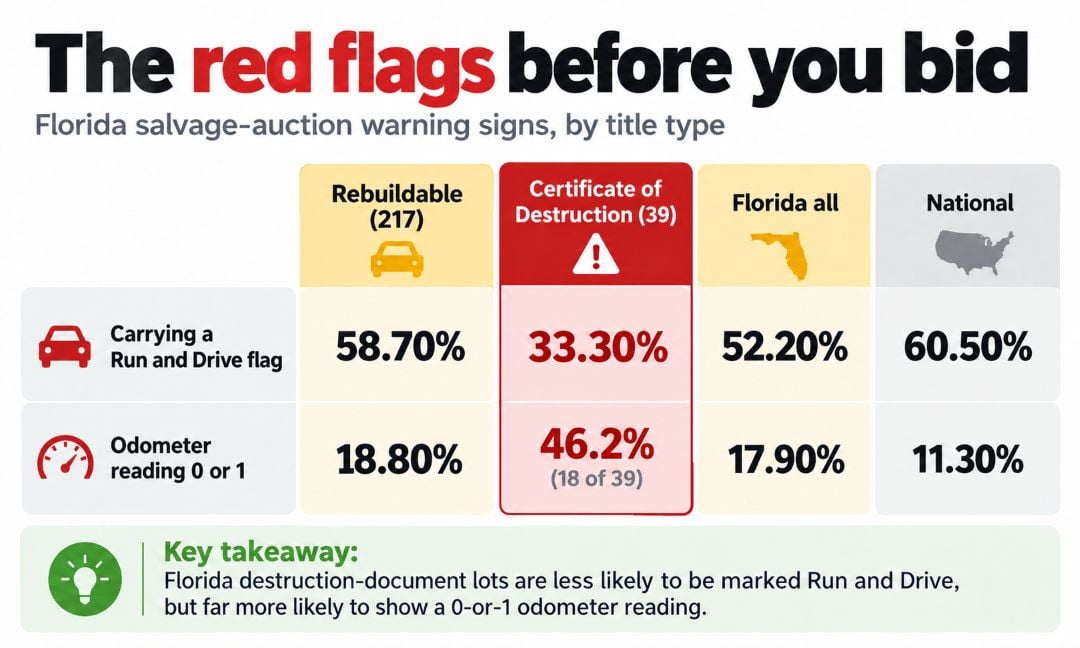
Run and Drive appeared on 58.7% of 217 Florida rebuildables versus 33.3% of 39 destruction lots. Across all Florida lots, the rate was 52.2%, compared with 60.5% nationally. Zero-or-one mileage appeared on 18.8% of rebuildables and 46.2% of destruction lots (18 of 39), versus 17.9% in Florida overall and 11.3% nationally. Operating flags and recorded mileage therefore require independent verification.
Request dated mileage records. Ask for a dashboard video. Have a mechanic inspect fluids, fault codes, transmission engagement, and signs of extensive damage. Even a salvage title car that starts may need costly work.
Is a Flood-Damaged Florida Car Automatically Destruction-Only?
No. A damaged vehicle with flood exposure can be rebuildable. However, salt corrosion, soaked wiring, and compromised safety systems can make repair uneconomical. Its classification, not the damage label alone, determines legal eligibility.
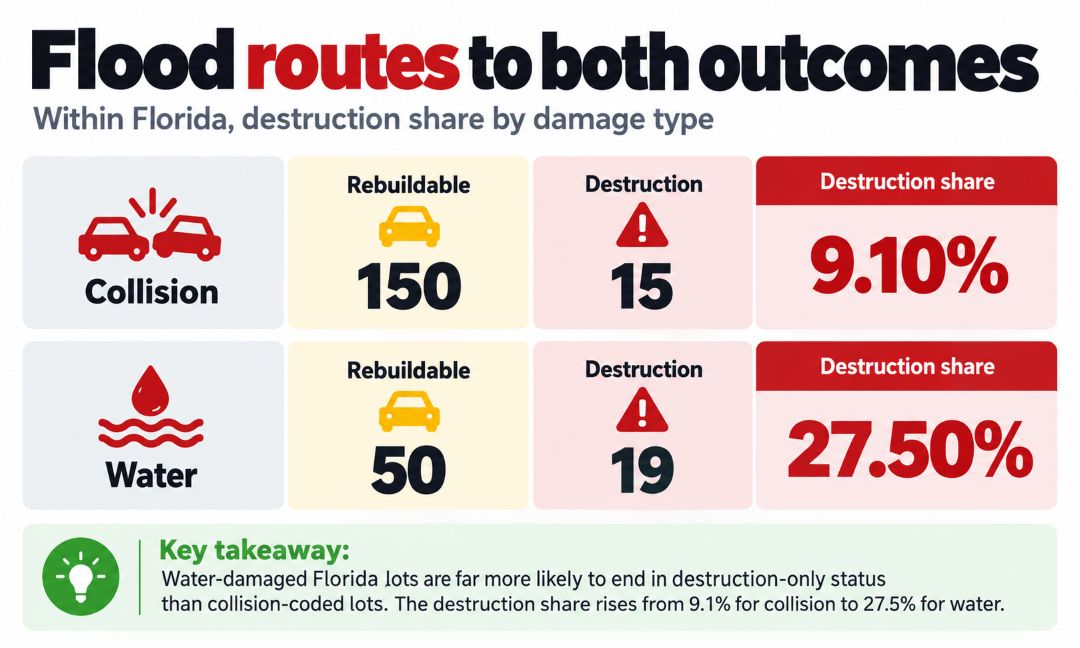
Collision-coded lots comprised 150 rebuildables and 15 destruction cases, a 9.1% destruction share. Water-coded lots comprised 50 rebuildables and 19 destruction cases, a 27.5% share. Flood exposure was associated with roughly three times the destruction proportion in this Florida sample, but was not automatically disqualifying.
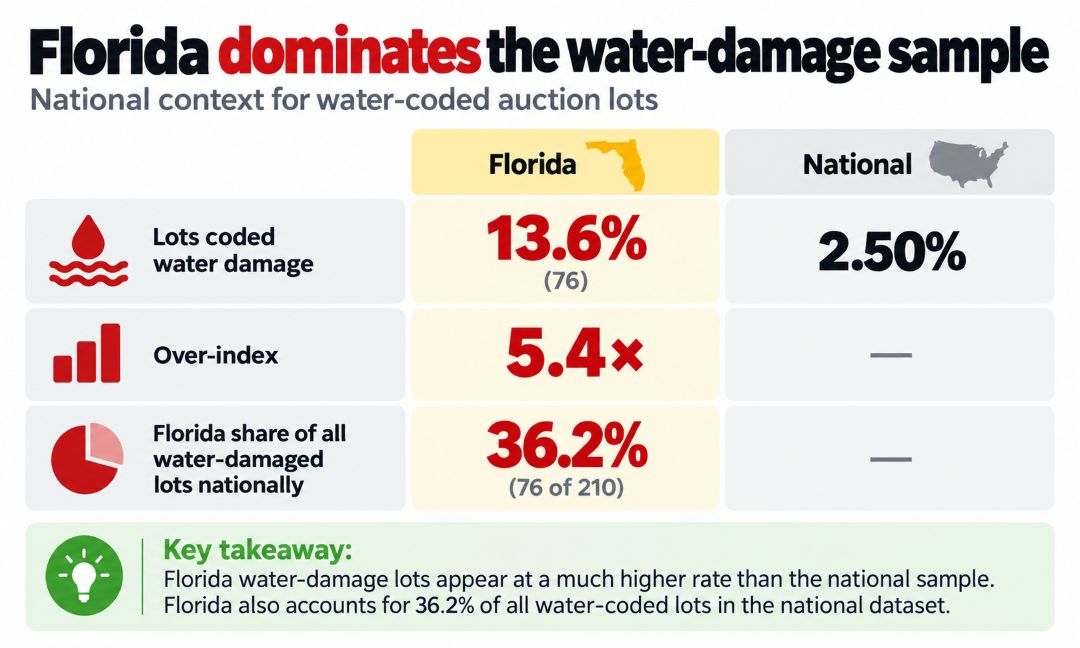
Water was recorded on 76 of 558 Florida lots (13.6%), compared with 2.5% nationally, a rate 5.4 times the national figure. Florida contributed 76 of the 210 nationally sampled water lots, or 36.2%. These figures describe SCA inventory rather than all registered vehicles.
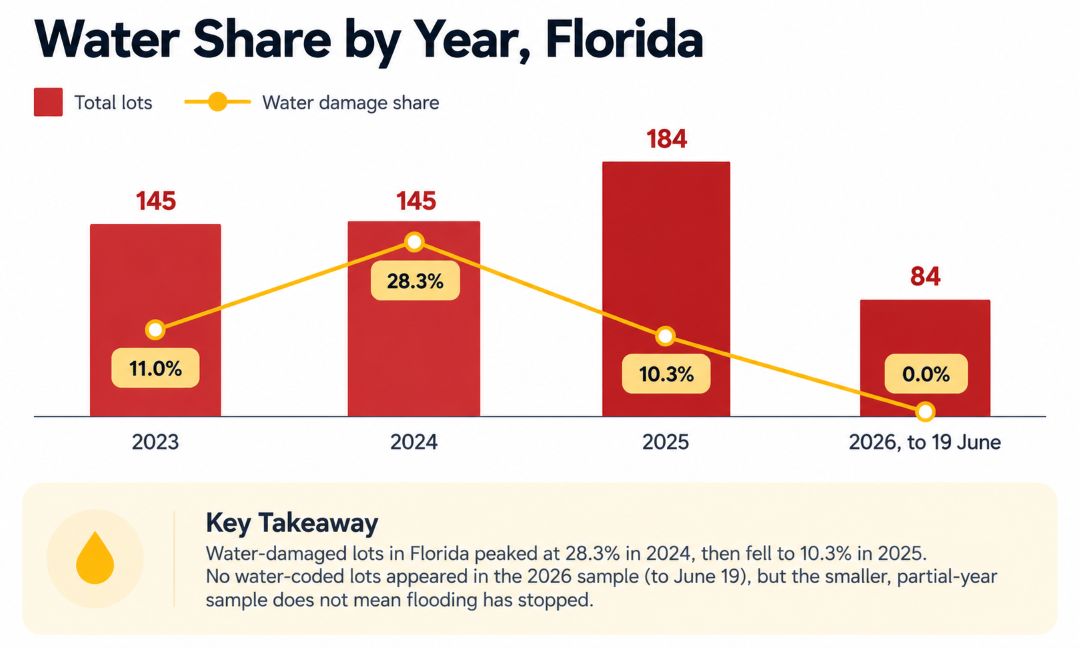
Annual water shares were 11.0% of 145 Florida lots in 2023, 28.3% of 145 in 2024, and 10.3% of 184 in 2025. No water-coded lots appeared among 84 through June 19, 2026 (0.0%). The smaller, incomplete 2026 sample does not establish that flooding stopped.
When a Destruction Document Changes the Buying Decision
Destruction-only paperwork makes a vehicle suitable for lawful parts recovery or dismantling.
The difference matters before placing a bid:
- Rebuildable: Consider repairs and an inspection if the budget works.
- Destruction-only: Buy for components or scrap, subject to restrictions.
- Unclear brand: Get confirmation from the issuing agency first.
An out-of-state transfer cannot legitimately remove the restriction imposed by the Florida law. A salvage certificate of title identifies a different legal status. A collector should also confirm bidding and transport requirements.
The financial calculation changes when the vehicle is intended for parts rather than restoration. Estimate the resale value of usable components, then subtract dismantling labor, storage, transportation, disposal costs, and any applicable fees. Some components may be damaged, incompatible with other models, or difficult to sell.
How Do You Get a Rebuilt Title in Florida After Buying a Salvage Car?
Complete repairs on an eligible vehicle. Pass a rebuilt inspection. Apply for the branded title. The inspection does not erase its total loss history.
Follow this sequence:
- Obtain transferable paperwork and clear liens.
- Photograph the wrecked condition before repair begins.
- Keep parts invoices and complete the builder statement.
- Submit the inspection application, then visit a license plate agent to retitle.
The Florida Department rebuilt-title procedure explains inspection and retitling.
SCA’s inventory of salvage electric cars helps compare EV projects. However, check the specific brand and battery condition. High-voltage systems require qualified technicians.
What Paperwork, Photos and Parts Receipts Are Required for Rebuilt Inspection?
Florida salvage title requirements include:
- Title paperwork.
- Builder statement.
- Pre-repair photos.
- Evidence of major components.
Incomplete documentation can delay approval even when the car looks finished.
Prepare these materials:
- HSMV 82040 MV and VIN/odometer verification, using HSMV 82042 where applicable.
- HSMV 84490, the Statement of Builder.
- Two clear photographs of the entire wrecked vehicle.
- Original signed receipts or invoices for major replacement parts.
- Applicable payment details.
Bring originals and copies. If airbags deployed, retain interior photographs and replacement evidence. A dealer rebuilding for resale must generally obtain rebuilt branding in its own name first.
Does Passing a Florida Rebuilt Inspection Guarantee the Car Is Safe to Drive?
No. The inspection verifies the motor vehicle’s identity and major components.
Have a specialist inspect:
- Frame alignment and warning systems.
- Brakes, steering, suspension, tires, and electrical functions.
- Open recalls through NHTSA’s VIN recall search.
Pay particular attention to previously damaged safety equipment. Airbags, seat belt pretensioners, and electronic stability control systems may appear functional without operating correctly during an emergency. Modern vehicles may also require advanced driver-assistance system (ADAS) calibration after windshield replacement, structural repairs, or work involving cameras and radar sensors.
Passing an identity check alone does not authorize road use.
What If a Florida Rebuilt Title Application Is Delayed, Rejected or Incomplete?
Request the specific rejection reason. Fix it before rescheduling. Frequent problems include:
- Mismatched VIN information.
- Missing photos.
- Undocumented components.
- Unresolved liens.
Choose the remedy based on the problem:
- Missing evidence: Supply the original invoices or photographs requested.
- Identity conflict: Ask the relevant agency to correct its record.
- Inspection failure: Address the defect and arrange a permitted reinspection.
A replacement title cannot erase an accurate brand. A legitimate clerical issue may be corrected through supporting records. However, an examiner cannot deem a destruction-only car roadworthy through the rebuilt process.
How Much Does It Cost to Get a Salvage Vehicle Rebuilt and Retitled in FL?
Florida’s initial rebuilt inspection fee is $40. Each reinspection costs $20. Title fees, sales tax, transport, mechanical labor, and insurance add to the purchase price. Total spending can easily surpass a cheap winning bid.
Build a four-part budget:
- Purchase. Auction charges, towing, storage, and delivery.
- Repair. Structural work, mechanical parts, airbags, and diagnostics.
- Administration. Inspection, registration, and required taxes.
- Contingency. Hidden water damage, parts delays, and value loss.
Ask an insurance company whether it will insure a salvage title car in Florida after rebuilding. You normally cannot register a salvage title in Florida before inspection approval. Auto insurance options vary.
How Do You Calculate a Maximum Bid for a Florida Rebuildable Auction Car?
Subtract all repair expenses from a realistic rebuilt resale estimate. Do not treat pre-damage value as guaranteed resale revenue.
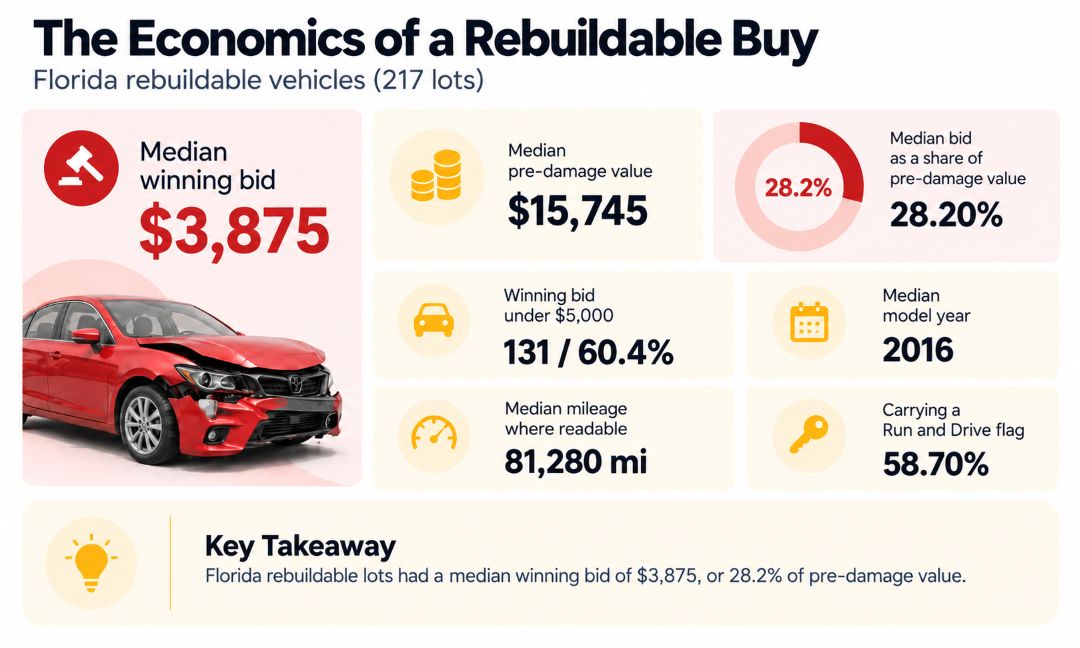
Among 217 rebuildables, the median winning bid was $3,875, the median pre-damage value $15,745, and the median bid-to-value ratio 28.2%. The median model year was 2016, and median mileage among vehicles with readable odometers was 81,280 miles. Run and Drive prevalence was 58.7%.
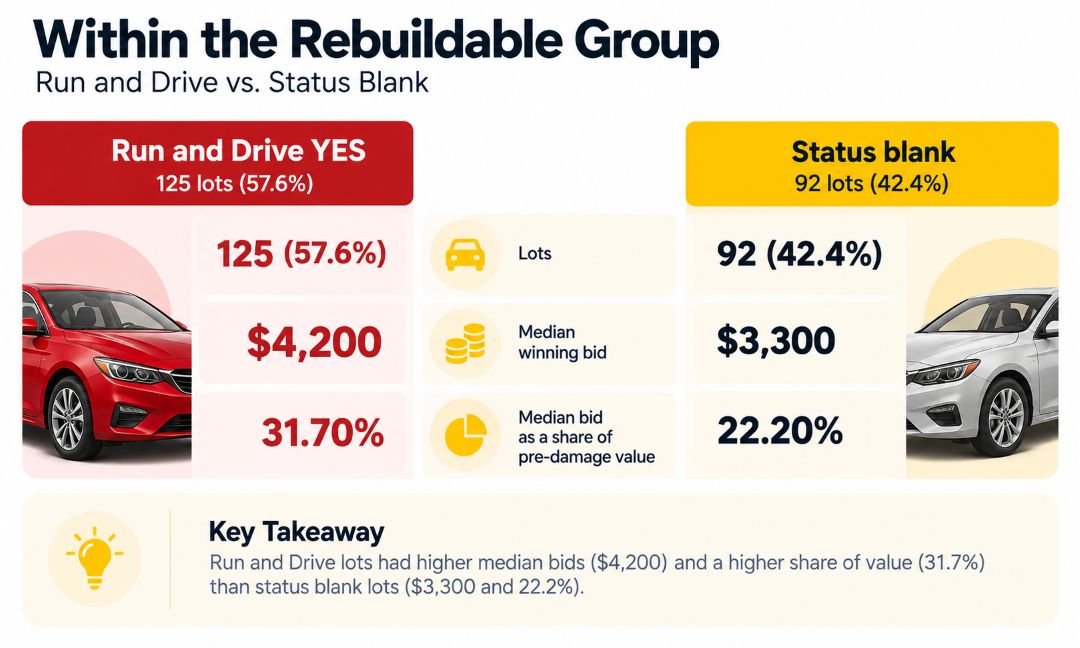
Lots marked Run and Drive had a median winning bid of $4,200 and a 31.7% bid-to-value ratio, against $3,300 and 22.2% with blank status. The reported 125 YES lots were 57.6%, and 92 blank lots were 42.4%.
A hypothetical maximum-bid calculation illustrates the decision:
| Budget item | Amount |
| Expected rebuilt resale value | $11,000 |
| Repairs and parts | −$3,600 |
| Auction, hauling, paperwork, and tax | −$1,400 |
| Contingency and target margin | −$2,000 |
| Maximum bid | $4,000 |
If hidden structural or battery problems exceed your reserve, lower the offer.
What Happens to a Florida Vehicle Title and Resale Value After Rebuilding?
The vehicle can receive a rebuilt title. Nevertheless, the brand follows future owners. Expect questions about:
- Safety.
- Insurance eligibility.
- Financing.
- Repair quality.
Keep inspection results, photographs, and service history to support resale. A new paint job cannot erase a past insurance settlement. Future buyers may apply their own discounts.
The biggest resale challenge is proving that the vehicle’s current condition justifies its asking price. Two cars with the same model year, mileage, and equipment may attract different offers when one carries a Rebuilt brand.
Does a Rebuilt Title Reduce a Car’s Value Even After Successful Repairs?
Usually. Buyers may pay less for uncertain repair quality, undisclosed damage, and weaker future resale demand, even when a rebuilt car drives normally.
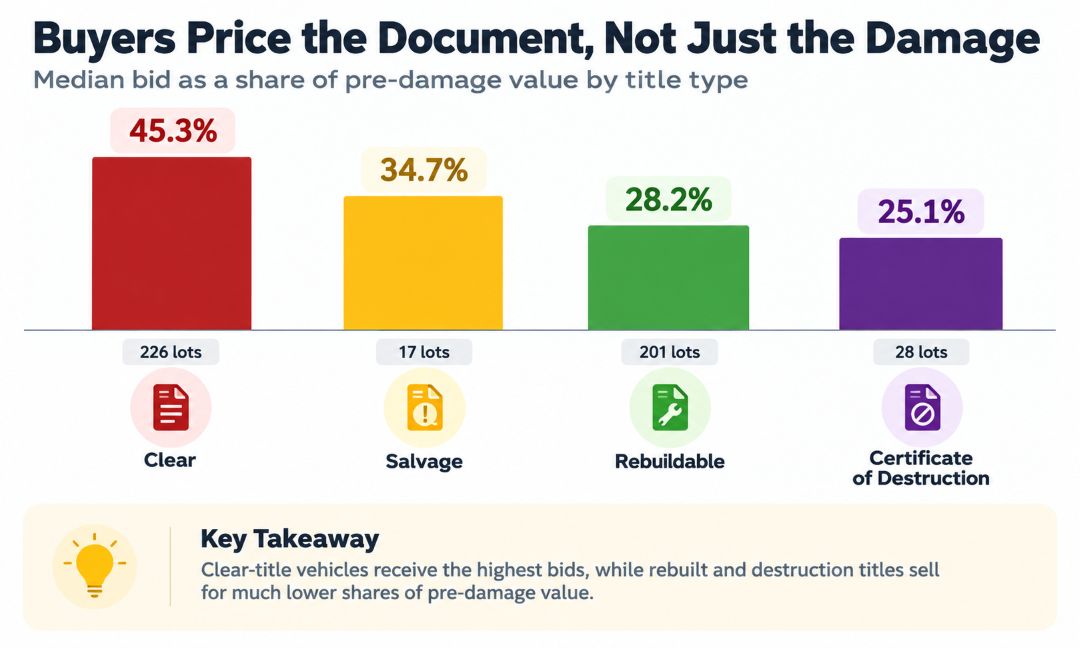
Clear-title lots numbered 226, with a 45.3% median bid-to-pre-damage-value ratio. The salvage group included 17 lots at 34.7%, while the rebuildable group included 201 lots at 28.2%. Destruction-designated: 28 lots at 25.1%. These auction ratios are not retail depreciation rates. Differences in vehicle mix may also matter.
Review the inspection photos. Ask how damaged areas were repaired. A low bid is not automatically a bargain.
Should You Buy a Clear-Title Car Instead of a Florida Rebuildable?
Choose clear title if:
- Savings are small.
- Financing is important.
- Repair history is uncertain.
A rebuilt car may be worthwhile for experienced buyers with reliable shops.
Compare three practical factors:
- Total cost. Purchase, transport, repairs, insurance, and future resale.
- Risk. Whether you can fund unexpected mechanical problems.
- Evidence. Pre-repair photos, inspection results, and an independent check.
Your personal vehicle threshold for risk should be lower for essential daily transportation than for a project car.
What Must You Disclose When Selling a Rebuilt Vehicle in Florida?
Florida requires written resale disclosure before completing a transaction. Rebuilt status must appear in advertisements. Private sellers and dealers cannot market branded cars as clean-title vehicles.
Under Florida’s rebuilt-vehicle disclosure rules, tell the buyer about the brand in writing. Altering a required decal or concealing history can be illegal. If the state’s information is wrong, pursue an official correction. The insurer’s settlement and your own replacement-part records can help explain the history. However, they do not remove a valid brand.
Key Takeaways
- A salvage title cannot become clean through repairs.
- Check VIN, brand, lien status, and title history before bidding.
- Run and Drive does not prove road safety or accurate mileage.
- Flood damage raises the risk of hidden problems.
- Rebuilt inspection requires photos, parts evidence, and correct forms.
- Budget for restoration, inspection, resale discounts, and insurance.
A Florida salvage car can sometimes return to the road as rebuilt. However, buyers must verify legal eligibility, condition, and total ownership costs before bidding.
FAQ
Can You Get a Florida Title for a Salvage Car Purchased in Another State?
Yes. Florida may require VIN verification, a rebuilt application, major-parts evidence, and inspection. Destruction-only classifications normally prevent ordinary road retitling.
Does the Same Inspection Process Apply to Salvage Motorcycles?
Generally, yes. Florida’s rebuilt procedure covers motorcycles. However, component rules and supporting paperwork can differ. Check the requirements for your specific motorcycle.
Can You Obtain a Clean Title for a Recovered Stolen Car in Florida?
Sometimes. A substantially intact recovered stolen car may qualify for an unbranded title. Existing legitimate brands or significant damage can change that determination.
How Can You Correct an Error on a Florida Salvage Vehicle Title?
Contact the issuing agency. Provide earlier records showing the mistake. The agency can correct a clerical error. However, it cannot simply delete legitimate salvage branding.
Can a Florida Salvage Vehicle Be Titled in Two People’s Names?
Yes. An eligible vehicle may have joint owners. They should both be properly identified in the application and transfer paperwork. Joint ownership does not change general requirements.