Contents
Maximum bid = conservative rebuilt value − repairs − auction fees − transport − taxes and registration − contingency.
A used EV from an auction can be worth buying only when its all-in cost stays well below its realistic rebuilt-title value. The winning bid alone does not determine whether the vehicle is a bargain. The following issues can quickly erase the discount:
- Battery damage.
- Structural repairs.
- Missing charging proof.
- Title restrictions.
Are Used Electric Cars Worth It at Current Auction Prices?
Sometimes, but only with a wide safety margin. We analyzed 224 EV lots and 6,526 gasoline lots from SCA Auctions. The sample covered bids, ACV, mileage, damage, location, and Run & Drive status, framing used EV prices, and the used EV market.
When you buy a car at auction, the invoice is only the beginning. Buying a used electric car works only when the completed cost stays below the realistic post-repair value.
What Is Actual Cash Value (ACV) and Why Does It Matter for Used EVs?
Actual cash value is estimated market value before a loss. The California Department of Insurance generally defines ACV as fair market value. Auction ACV may be seller-supplied. It is not a repair estimate or guaranteed resale price. A used electric vehicle or other used car can be worth far less after a salvage brand.
Verify these points:
- Prices for vehicles with the same model year, trim, and battery capacity.
- Mileage, options, keys, and charge equipment.
- Pre-loss condition and damage.
- Clean-title versus rebuilt-title value.
- Missing included parts.
Why Your Bid-to-ACV Ratio Should Guide Your Maximum Bid
The bid-to-ACV ratio shows how much pre-loss value you pay before other costs. A lower ratio leaves repair room. A high ratio offers less protection against battery, structural, calibration, storage, and transport surprises. Reduce ACV for title and damage. Subtract every known cost and a contingency reserve. The remainder is your maximum bid.
The following figures show how far winning bids fell below the stated ACV across the 224 electric-vehicle lots analyzed:
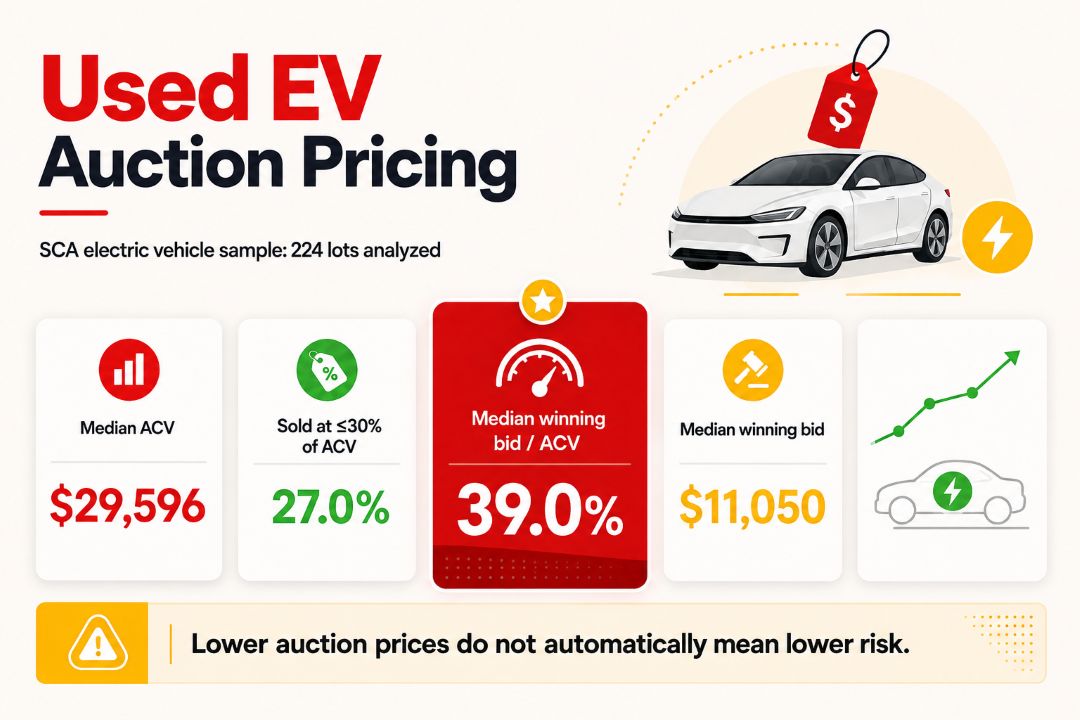
Chart summary: Across 224 electric-vehicle lots, the median ACV was $29,596 and the median winning bid was $11,050, or 39% of ACV. 27% of vehicles sold at 30% of ACV or less. A lower bid-to-ACV ratio provides more room for repair and other unexpected EV costs.
The price looks attractive, but the discount must cover EV risks. Even 30% of ACV can be excessive when the car cannot charge or needs high-voltage work.
How Do You Calculate the True Cost of Purchasing a Used EV?
Add the bid, fees, tax, transport, inspection, repairs, registration, charging equipment, and a reserve. Compare the sum with rebuilt-title value, not clean-title ACV. This total cost of ownership test is essential when purchasing a used electric car or buying a used electric vehicle. Separate every expense into three categories: confirmed, estimated, and unresolved. Then calculate both a likely-cost scenario and a conservative-cost scenario. The purchase is financially defensible only if the conservative total still leaves a meaningful margin below the vehicle’s realistic rebuilt-title value.
Which Costs Must Be Added to the Winning Bid?
Auction charges can increase the invoice. Transport costs rise when a vehicle will not roll, steer, brake, or enter neutral. A VIN decoder confirms specifications. Additionally, check warranty transfer, keys, cables, adapters, and loose parts.
Include these costs:
- Buyer, broker, document, and payment fees.
- Tax, title, inspection, and registration.
- Storage, loading, and late pickup.
- Inoperable transport.
- High-voltage scans and a battery health report.
- Body, cooling, restraint, and calibration.
- Tires, 12-volt battery, keys, and cables.
- Home equipment or fast charger adapters.
- A fault reserve.
Does the Auction’s Location Change the Real Price You Pay?
Yes. Distance can erase a discount. Carriers may charge more for non-running vehicles, remote yards, loading, or urgent pickup. Battery damage can limit transport. Quote the exact lot before bidding. Buyers without nearby access to EV service must include delivery to a qualified repairer.
The state breakdown below shows how strongly the sampled EV inventory was concentrated in California:
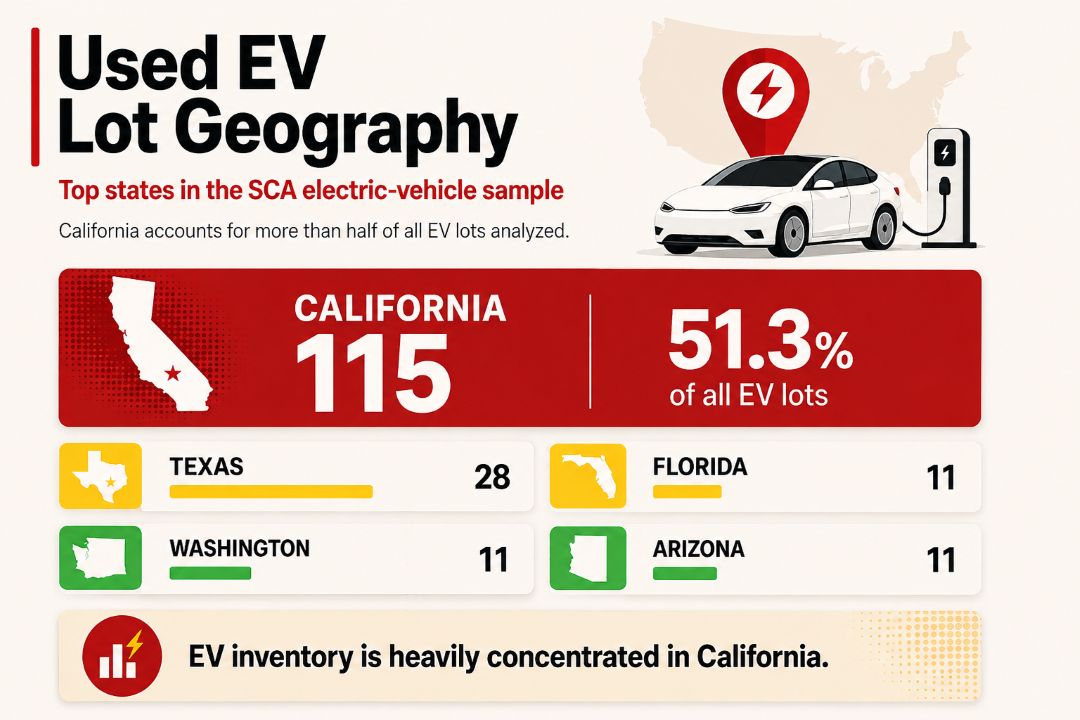
Buyers outside the West Coast should factor transport distance and cost into their total budget before bidding.
What Should You Check Before Buying a Used EV?
Before buying a used auction vehicle, remember that photos and listing labels cannot replace an inspection. Check the underbody, cooling, charge system, battery data, title, keys, parts, and transport. The goal is not merely to buy used cheaply, but to find a repairable car with a defensible final cost. Start by separating what the listing confirms from what still requires independent verification. Prioritize checks that can change the entire economics of the purchase.
Physical and Mechanical Checks
EV drivetrains are simpler than a gas-powered vehicle. Collision repair remains specialized. The battery pack often sits below the cabin. Underfloor damage matters even when panels look repairable. Confirm AC and DC charge operation where supported.
A trained technician should inspect:
- Battery-case dents, punctures, leaks, and corrosion.
- Rails, rockers, floor, mounts, and alignment.
- Cooling lines, pumps, and reservoirs.
- Airbags, belts, cameras, and radar.
- Charge port, charger, and fast-charge function.
- Codes, locks, and 12-volt power.
Documentation Checks
Paperwork can make a repairable car unusable. Match the VIN on the lot, body, title, and invoice. Review every brand, not only the current paper. Check whether salvage history affects the warranty.
For a lease return or buyback, verify:
- Title, state, lien, and ownership chain.
- Salvage, junk, and loss records.
- Odometer and service-history consistency.
- Trim, battery capacity, and equipment.
- Open recalls through NHTSA.
- Warranty dates, exclusions, and transfer.
- Battery invoices and programming.
- Keys, adapters, and disclosures.
Does Battery Health Determine Whether a Used EV Is Actually Worth It?
Usually, the battery condition affects range, power, charge speed, resale, and repair exposure. EV batteries may show normal capacity loss, physical damage, internal faults, or sensor errors. Know before you buy whether degradation still supports electric driving and how much range you need, or whether a failure could require you to replace the battery.
Battery Degradation vs Battery Fault vs Sensor Fault
These conditions have different costs. Degradation is gradual capacity loss. A battery fault can stop starting or charging. Sensor or software errors may imitate failure. A weak 12-volt battery can create many codes. When shopping for a used EV, request full-charge range, state of health, cell balance, isolation data, and codes.
The table below separates common battery-related conditions by cause, warning signs, and potential effect on the purchase decision:
| Condition | Meaning | Clues | Buying Impact |
| Degradation | Capacity loss | Lower range | Accept if measured |
| Battery fault | Cell, cooling, or isolation problem | No-start, limited power | Specialist diagnosis |
| Sensor/software fault | Reading/control error | Inconsistent warnings | Test first |
| 12-volt fault | Car cannot wake | Dead screens, many codes | May hide faults |
The U.S. Department of Energy says manufacturers typically offer battery coverage around eight years or 100,000 miles. Terms vary, and reliability cannot be inferred from mileage.
Why Battery Condition Should Be the First Thing You Verify, Not the Last
About one in five electric vehicles in SCA Auction’s sample had less than 10,000 miles on the odometer. Thus, a meaningful share of salvage electric cars are barely used cars, not aging ones. The median model year for this group was 2023. How long EV batteries last still matters when you plan to keep the car, because collision, flood, or floor damage can affect a newer EV.
The following data profiles the low-mileage EV lots in the sample and shows that many were recent, relatively high-value vehicles:
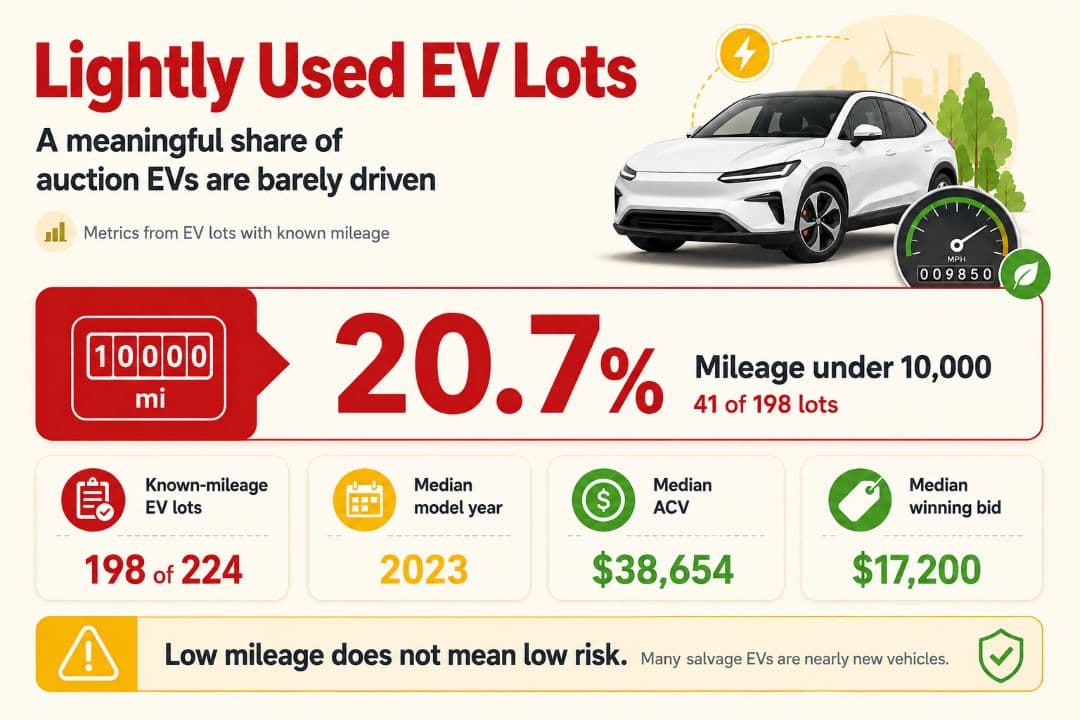
Chart summary: Of the 224 EV lots analyzed, 198 had known mileage. Among those, 41 vehicles (20.7%) had fewer than 10,000 miles. These low-mileage EVs had a median model year of 2023, a median ACV of $38,654, and a median winning bid of $17,200. Low mileage can indicate limited use, but it does not guarantee battery or high-voltage system condition.
A lightly used pre-owned EV can still have a disabled high-voltage system. Newer EVs may require costly sensors, software, and calibration. Low mileage proves limited use, not battery safety.
What Does Run & Drive Status Mean for a Used EV?
Run & Drive normally means the vehicle started, selected a drive gear, and moved during a brief yard check. It does not prove roadworthiness. It does not confirm range, braking, battery health, or power intake. Condition can change before pickup. An EV may move with reduced power or active faults. Treat the label as an observation, not a warranty.
The figure below shows how many sampled EV lots had a confirmed Run & Drive label and how many had no clear status:
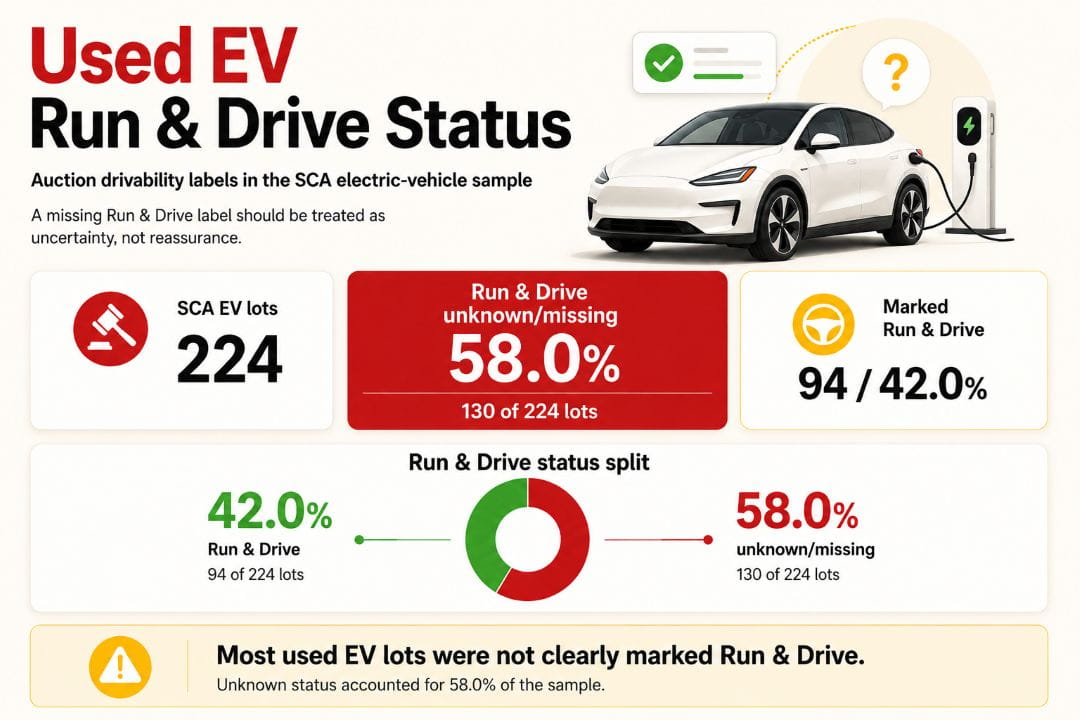
Only 42.0% were marked Run & Drive. Missing status should lower the bid rather than invite an optimistic assumption.
How Do Salvage, Rebuilt, and Branded Titles Affect an Electric Car?
Title rules differ by state. A salvage title usually follows severe damage or an insurer’s uneconomical-repair decision; New Jersey MVC uses that definition. A rebuilt title follows repair and state review. Inspection does not guarantee long-term safety. Brands can restrict registration, insurance, financing, and resale. Check for title jumping, missing signatures, and ownership gaps.
The following comparison explains how major title types affect road eligibility, reinspection requirements, insurance access, and resale value:
| Title Type | Definition | Reinspection Required Before Road Use? | Typical Insurance/Resale Impact |
| Clean | No salvage/rebuilt brand | Usually no | Best access; history matters |
| Salvage | Severe or uneconomical damage | Usually yes | Road and financing limits |
| Rebuilt | Repaired former salvage | Initial review | Limited coverage; lower resale |
| Junk/nonrepairable | Parts or scrap | Generally impossible | Minimal road value |
| Other brand | Flood, fire, buyback, odometer | State-specific | Impact varies |
Are EVs More Prone to Fire or Flood Damage Than Gas Cars?
The sample does not prove that electric cars are more likely to burn. Fire-related damage appeared in 0.9% of EV lots versus 0.3% of gasoline lots, though with only two fire-damage EV lots in the sample, this is directional, not a precise rate. Flood damage, by contrast, was actually less common among EVs (0.9%) than gasoline vehicles (1.7%). This is a useful counterpoint to the assumption that EVs are uniquely vulnerable to water damage.
The data below compares the observed shares of fire- and water-damaged lots in the EV and gasoline samples:
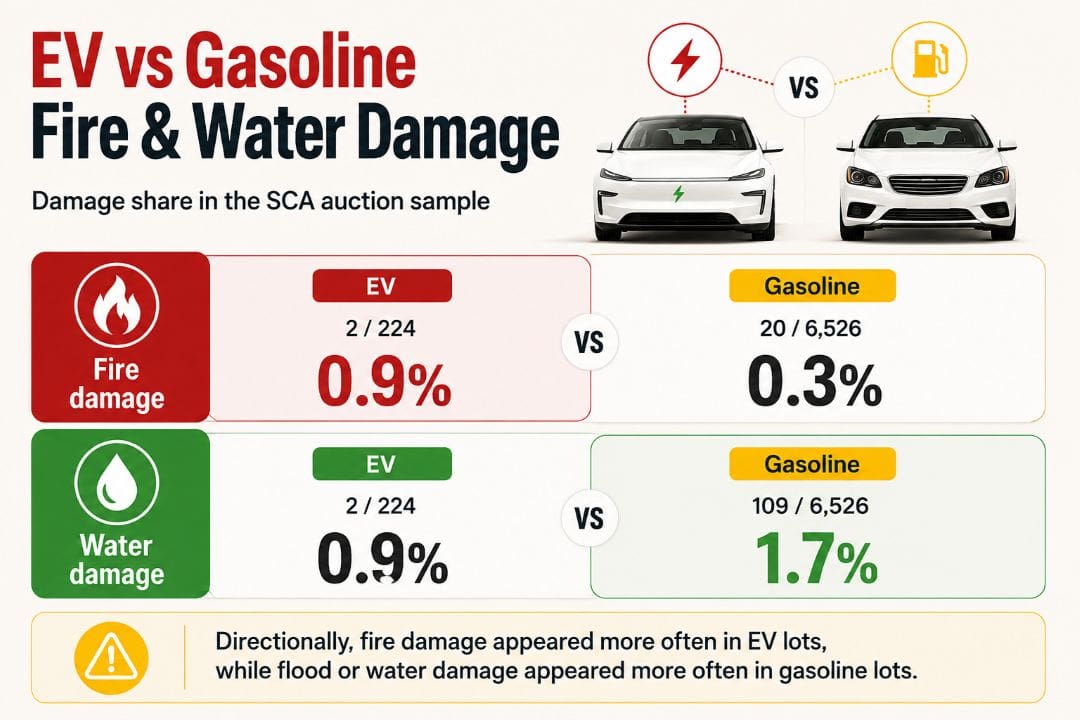
Chart summary: In the auction sample, fire damage appeared in 2 of 224 EV lots (0.9%), compared with 20 of 6,526 gasoline lots (0.3%). Water damage appeared in 2 EV lots (0.9%) versus 109 gasoline lots (1.7%). In this sample, fire damage was proportionally more common among EVs, while water damage was more common among gasoline vehicles. Because the EV counts are very small, these figures should be treated as directional rather than conclusive.
Flood exposure remains serious. NHTSA warns that flooded EV batteries can create shock and fire hazards. Never begin charging an EV after submersion before isolation testing.
Which Used EV Models Offer the Best Risk-Adjusted Value?
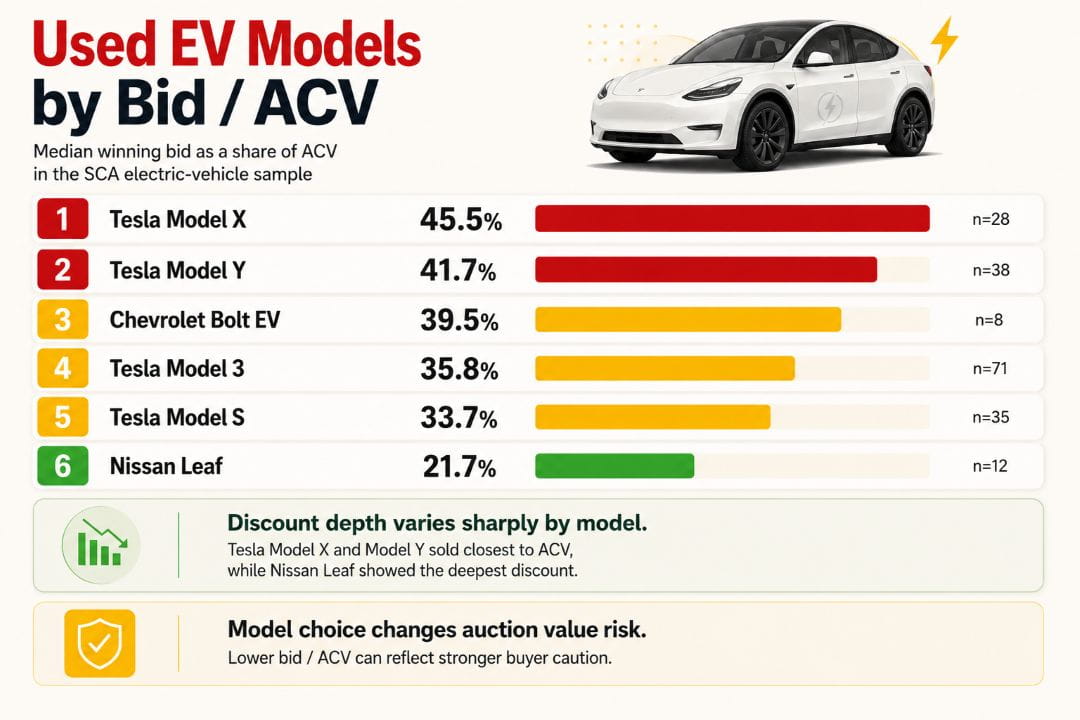
Discount size varies sharply by model. Tesla Model X and Model Y lots were sold closest to their ACV (45.5% and 41.7% respectively), while the Nissan Leaf was sold for just 21.7% of ACV. This reflects buyer concern about battery degradation in older EV platforms and thinner parts availability. EV buyers should compare range, port, service, parts, EV sales trends, and current EV values before choosing cars to consider.
The model comparison below ranks six EVs by their median winning-bid-to-ACV ratio and includes the number of lots analyzed for each model:
Older models can be cheap because demand for used EVs is weak. Newer electric vehicles can offer better range, but electronics may cost more. Compare the pre-owned electric vehicle with a similar used gas-powered car and with a new version of the same model. A new electric model or new EV can have stronger support; new EVs cost more.
When Should You Walk Away from a Used EV?
Walk away when uncertainty exceeds the discount. How a car is considered a total loss varies by state and insurer; Iowa DOT uses a 70% threshold for certain vehicles. Buyers need a stricter limit. Battery, transport, and calibration may remain unknown.
Stop bidding when:
- Battery case is dented, punctured, burned, wet, or displaced.
- No keys, power, or charging proof.
- Title, VIN history, or ownership is unclear.
- Damage reaches floor, rails, rockers, or battery mounts.
- Parts, software, or OEM access is uncertain.
- Fees and transport consume the discount.
- Worst-case cost exceeds rebuilt-title value.
Key Takeaways
- We analyzed 224 EV and 6,526 gas-powered lots.
- Median EV bid was 39.0% of ACV, not completed value.
- EVs have fewer moving parts, yet collision and battery work need specialists.
- EV owners and EV drivers should verify title, warranty, fees, transport, and charging capability.
- EVs are more affordable only when total cost stays below rebuilt-title value.
- To buy an EV safely, buy a used model only with verified condition and a reserve.
The right pre-owned car has manageable risk and support.
FAQ
Should You Avoid EVs That Have Been Parked Unused for Long Periods?
Not automatically. Check state of charge, 12-volt condition, tire damage, codes, and temperature history. Long storage at extremely high or low charge can accelerate degradation.
Should Your Maximum Bid Include a Worst-Case Battery Repair Estimate?
Yes. Include a model-specific worst-case allowance unless testing confirms battery condition. Buy a used EV only when one high-voltage fault will not destroy the budget.
Are Manufacturer Buyback EVs Worth Considering at Auction?
Sometimes. A buyback may work when the defect, repair history, warranty status, and current diagnosis are documented. Avoid repeated unresolved battery, software, or charge faults.
Does a Replacement Battery Increase the Value of a Used Electric Car?
Usually, if capacity and installation are documented, confirm the part number, usable capacity, warranty, software pairing, and qualified installer before assuming the replacement increases value.
Can a Used EV Bought at a Salvage Auction Qualify for Any Tax Credit?
No. The clean vehicle credit, often called the used EV tax credit, ended for vehicles acquired after September 30, 2025, so buyers cannot get a tax credit through that federal tax credit program.