Contents
A wrecked Tesla is worth bidding on only when visible damage, unresolved battery risks, and estimated repair costs leave a defensible financial margin. Auction photos can reveal underbody and battery-enclosure damage, but cannot confirm Tesla battery health or high-voltage safety. Before bidding, check damage signs, verify the Run and Drive status, and calculate a maximum bid that includes a high-voltage contingency.
Can Auction Photos Tell You If a Wrecked Tesla Is Worth Bidding On?
Auction photos reveal impact direction but cannot certify a pack or expose all potential issues. In the auction sample, 144 of 175 Teslas (82.3%) carried a Collision label, versus 181 of 224 electric lots (80.8%) and 38.2% of combustion lots. The impact path matters more than the category.
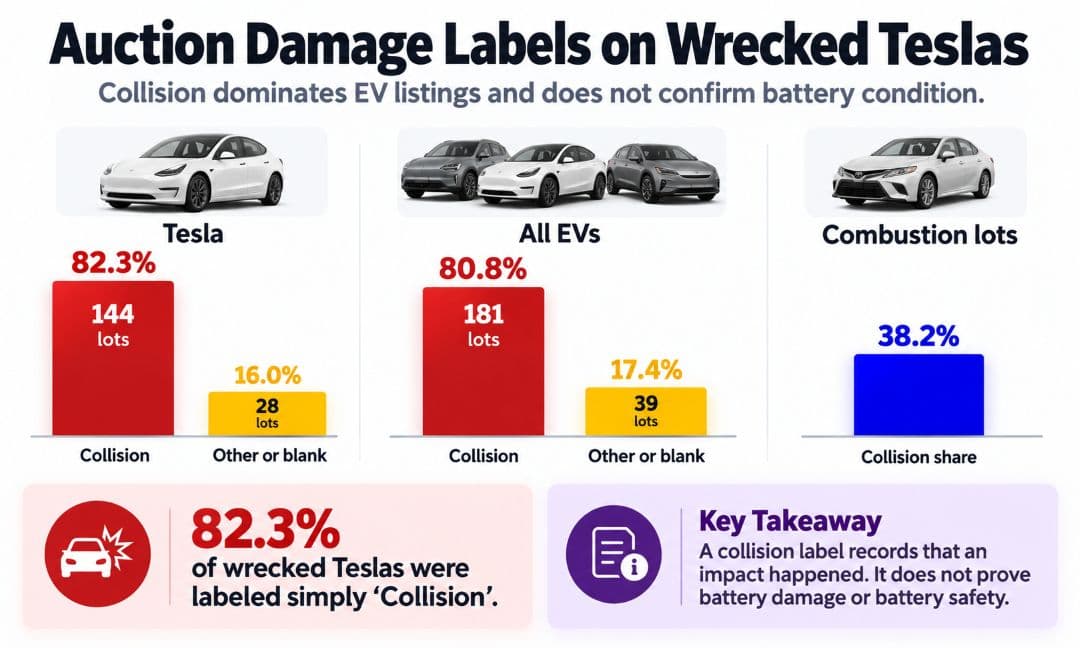
Collision covered 144 Teslas (82.3%) and 181 EVs (80.8%). It is more than twice the combustion share of 38.2%. Other or blank appeared on 28 Teslas (16.0%) and 39 EVs (17.4%). Neither label establishes pack condition.
Only two EV lots had Water labels, both Teslas; Fire appeared on two EV lots, including one Tesla. Those counts cannot establish a Tesla battery failure rate. Collision proves neither Tesla battery problems nor safety.
Consider three possible decisions:
- Inspect further. Clear underside photos show no obvious intrusion, but pack condition is still unverified.
- Lower your bid ceiling. Impact reaches the rocker or floor, and repair costs remain uncertain.
- Walk away. Visible pack deformation or leaks cannot be assessed safely before purchase.
Battery Damage Signs to Look for in Auction Photos
A scuffed shield may be cosmetic. However, crushed mounts, fluid traces, or wheel displacement deserve specialist review. Photos cannot confirm internal sealing after moisture exposure. Request these angles before setting a bid:
| Photo angle | What to examine |
| Underside and pack edge | Dents, punctures, missing shields, fluid |
| Rockers and lift points | Crushed sills or distorted mounts |
| Wheel wells and suspension | Impact paths toward the floor |
| Charge port and dashboard | Connector damage and displayed alerts |
Missing underside photos mean unknown pack condition. NHTSA’s battery safety guidance explains shock and delayed-fire hazards.
Which Photo Angles Matter Most on a Collision-Damaged Tesla Model Y?
Model Y pack designs vary. Tesla’s structural-pack service instructions show why a structural battery pack requires its own inspection procedure, not a generic checklist.
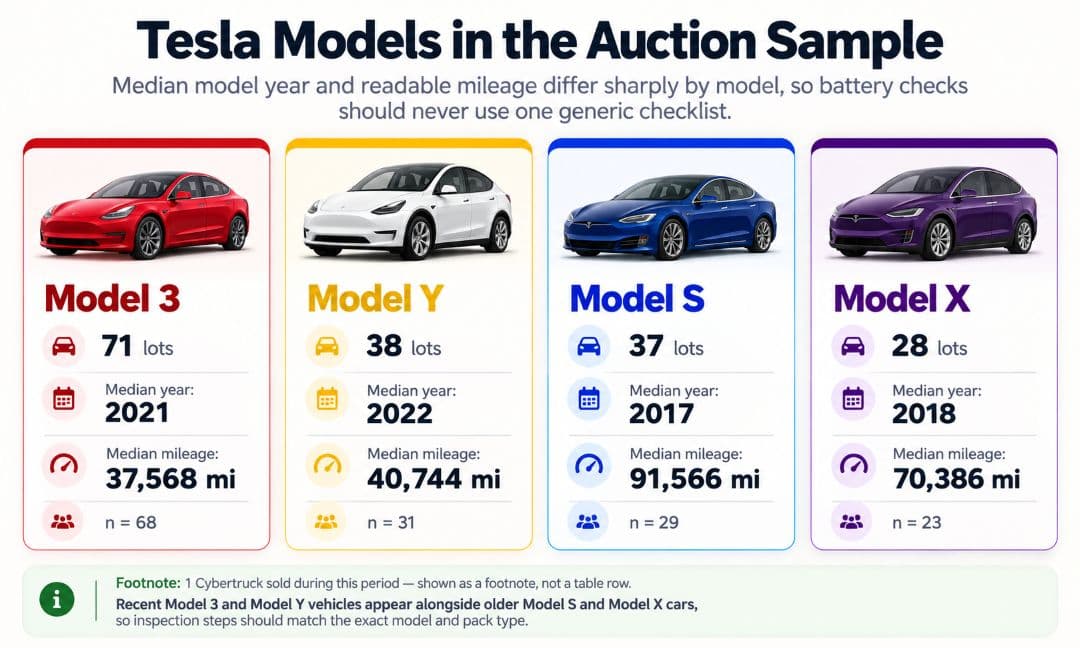
Model 3 (71 lots) had a median model year of 2021 and 37,568 miles (n=68). Model Y (38) – 2022 and 40,744 (n=31). Model S (37) had 2017 and 91,566 (n=29), while Model X (28) had 2018 and 70,386 (n=23); these are not pack-health measurements.
For a Tesla Model 3 Long Range, inspect sill and pack-perimeter photos after a side impact. For Model Y, request lift-point and attachment-area images. Confirm pack configuration by VIN and manufacturer documentation.
Battery State of Health vs. Collision Damage: What’s the Difference?
State of health compares usable energy with original battery capacity, not enclosure integrity. Published original capacity figures may use different test conditions. Tesla battery degradation is usually gradual battery capacity loss. A crushed casing is different. A car considered a total loss can retain energy yet have an unsafe pack.
These checks answer different questions:
| Check | What it can tell you | What it cannot prove |
| Battery health test | Remaining usable capacity | Crash safety |
| Auction photos | Visible impact damage | Hidden electrical faults |
| Qualified HV inspection | Documented physical and electrical condition | A guarantee against future failures |
On eligible vehicles, Tesla’s owner guidance says a capacity test may need AC charging and up to 24 hours. An electric vehicle battery test cannot replace impact inspection. Displayed range, range estimate, range drop, and battery percentage can shift with temperature or calibration. The battery management system cannot reveal every hidden impact.
Can Run and Drive Confirm Battery Safety or Charging Performance?
No. “Run and Drive” is an auction observation, not an EV and battery safety testing certificate. It confirms neither electrical isolation nor charging performance. Moreover, it does not establish whether a test drive is safe. Blank means unrecorded, not failed.
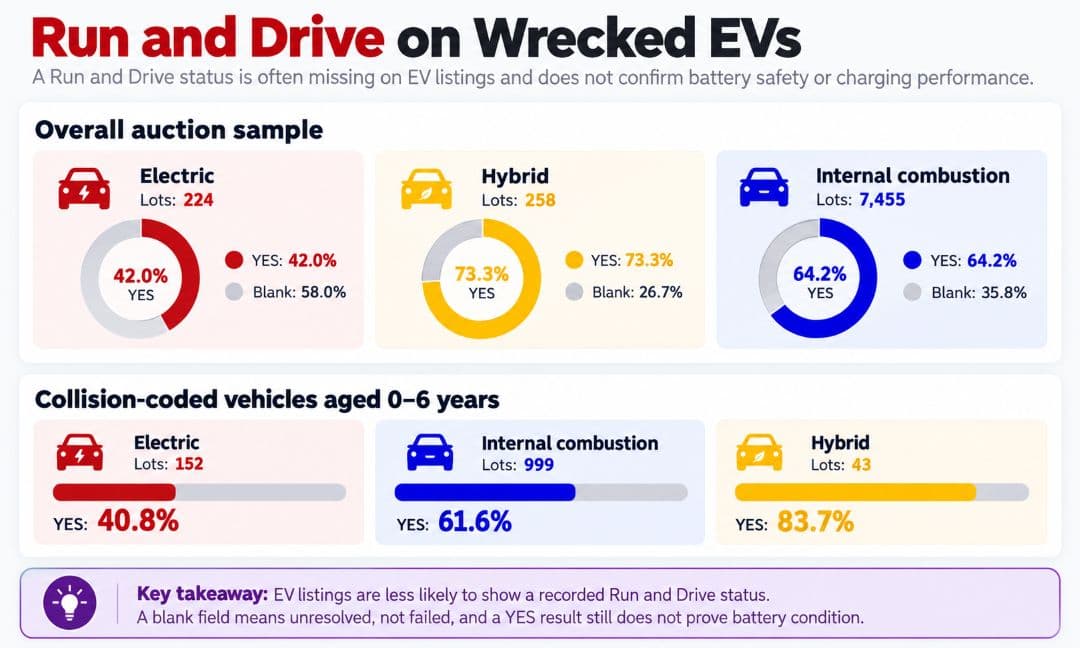
Of 224 EV lots, 42.0% carried YES, and 58.0% were blank. Among 258 hybrids, the split was 73.3%/26.7%. Among 7,455 combustion lots, 64.2%/35.8%. Among collision-damaged vehicles aged six years or younger, YES was 40.8% for 152 EVs, 61.6% for 999 combustion cars, and 83.7% for 43 hybrids.
Of 175 Teslas, 70 had YES and 105 were blank. Adjusting for age and damage, EV lots had 0.37 times the YES odds of combustion lots (95% CI 0.28–0.49; p<0.0001). Hybrids had 1.62 times the odds. That concerns recording, not reliability or slower charging. Check Tesla’s thermal management system separately.
Which Battery Checks Require a Qualified EV Technician?
Buyers can review photos to check the battery visually. However, only trained professionals should probe the HV battery system. Tesla’s HV repair procedures require specialist precautions. Damaged EV batteries must not be energized casually.
Have the technician document:
- Enclosure, mounting, and coolant-line condition, including leak evidence.
- Isolation faults, contactor status, and stored alerts using approved equipment.
- Pack communications, cell imbalance, and cooling behavior where accessible.
- Charging eligibility and safe charging behavior only after safety clearance.
For a compatible vehicle, service mode may offer an advanced battery assessment. EV battery testing must follow the exact configuration; technicians can measure battery isolation and internal resistance only with suitable approved methods. Do not charge your Tesla after suspected pack penetration.
How Much Should You Bid on a Wrecked Tesla When Battery Condition Is Unknown?
The cost of a used EV includes:
- Transport.
- Fees.
- Repairs.
- Uncertain battery work.
Tesla auction listings show photos, mileage, damage, and titles. Listings do not certify battery safety.
The challenge is determining how much of the vehicle’s remaining value you can afford to risk. A low winning bid does not automatically mean a profitable purchase, especially when the battery pack could require costly repairs or replacement.
What Is a Risk-Adjusted Maximum Bid and How Is It Calculated?
Subtract total costs and margin from expected resale value. For personal builds, use your maximum valuation, not new Tesla prices.
Maximum hammer bid = repaired value − repairs − fees − transport − tax/title − high-voltage contingency − required margin.
If your ceiling is too low, walk away.
How to Calculate a Maximum Bid with a High-Voltage Contingency
A battery diagnostic may uncover electrical faults. Nonetheless, it cannot eliminate uncertainty about hidden pack damage or repair costs.
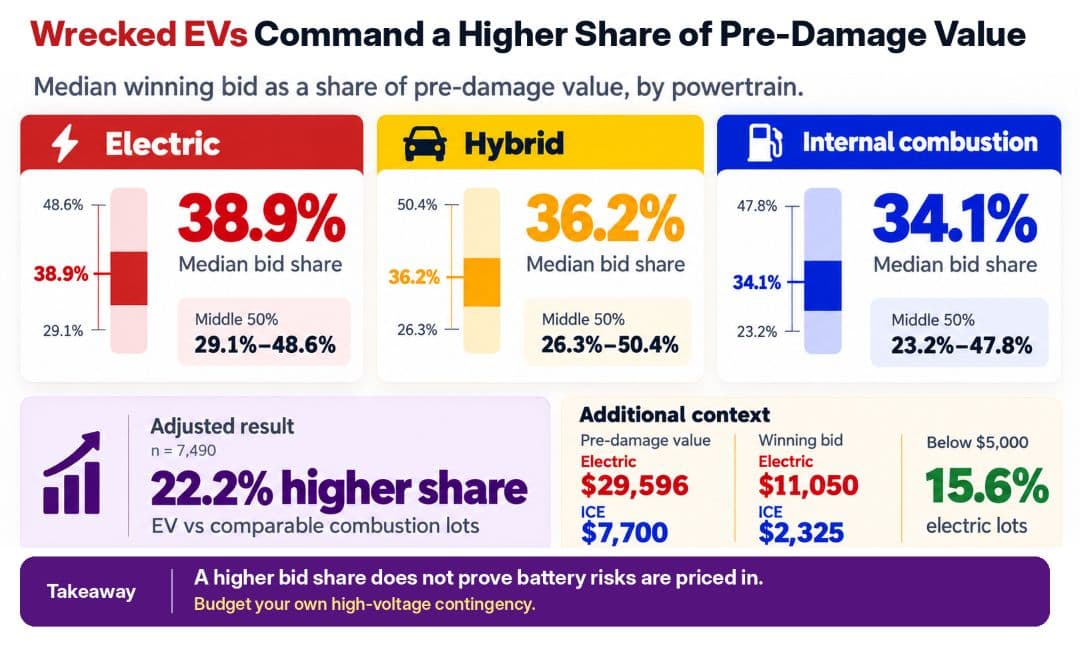
Electric lots sold at a median 38.9% of pre-damage value (middle 50%: 29.1–48.6%), against 36.2% for hybrids (26.3–50.4%) and 34.1% for combustion (23.2–47.8%). Adjusting for age, valuation, and damage across 7,490 lots, the EV bid share remained 22.2% higher (p<0.0001).
Median intact valuations were $29,596 for electric versus $7,700 for combustion, with median bids of $11,050 versus $2,325. Only 15.6% of electric lots sold below $5,000. The market may not discount unknown battery condition.
How Much Should You Reserve for Battery Diagnostics and Unexpected Repairs?
Obtain a written estimate before bidding. Separate:
- Evaluation labor.
- Underbody removal.
- Coolant components.
- Freight.
- Possible battery replacement.
A used or new battery may differ in price, availability, and battery warranty. Unverifiable estimates are worthless.
For example:
A $24,000 repaired-value estimate – $7,000 body work, $2,000 fees and transport, $4,000 pack reserve, and $3,000 margin = an $8,000 maximum bid.
Adjust each number to your actual case. These are illustrative amounts, not market prices.
Is a Low-Mileage Wrecked Tesla Safer Than a Higher-Mileage One?
Low mileage may reduce expected degradation over time. However, it cannot prevent collision damage. Among 152 Teslas with readable odometers, 26 (17.1%) had fewer than 10,000 miles. 23 of those 26 (88.5%) were collision-coded.
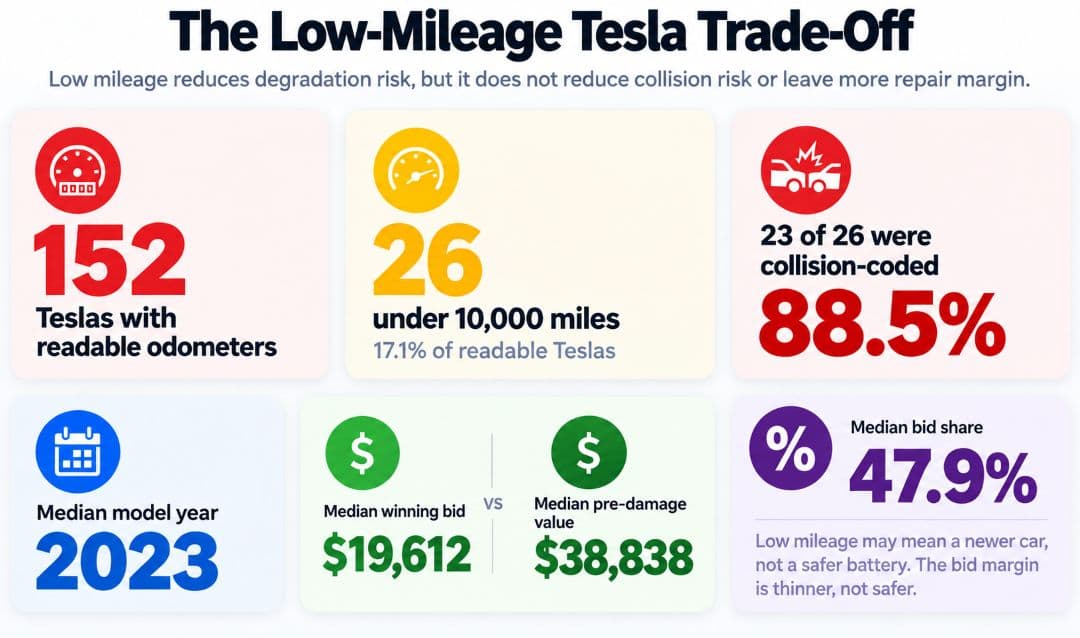
Among 152 Teslas with readable odometers, 26 (17.1%) were under 10,000 miles; 23 of those (88.5%) were collision-coded, with a median model year of 2023. These vehicles had a median winning bid of $19,612 and a median pre-damage value of $38,838. The median bid-to-value ratio across individual lots was 47.9%, leaving buyers with less room for unexpected repair costs.
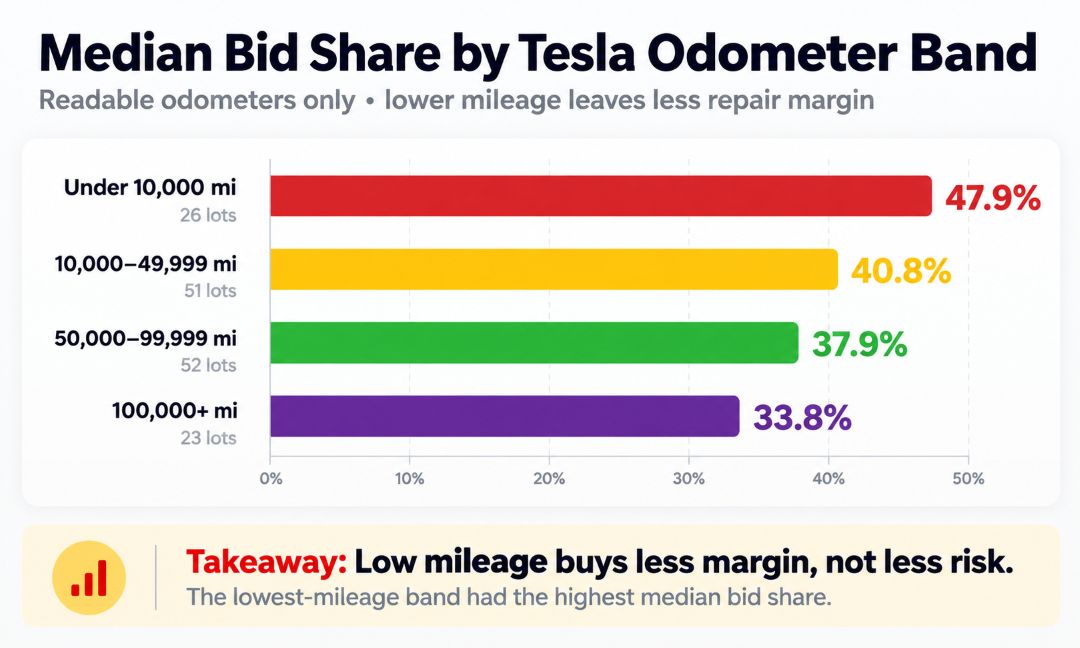
Median bid shares were 47.9% for 26 cars under 10,000 miles; 40.8% for 51 at 10,000–49,999; 37.9% for 52 at 50,000–99,999; and 33.8% for 23 above 100,000. Different models and conditions make this association, not causation or proof of safety.
When buying a used Tesla, ask about driving habits. Also, verify charging habits. Even batteries lasting hundreds of thousands of miles cannot be presumed undamaged. A low odometer should never cancel an underside inspection.
Does Tesla Model or Battery Pack Type Change the Inspection Checklist?
Yes. Not every Tesla uses the same pack. To check Tesla battery condition, identify:
- VIN.
- Configuration.
- Repair procedure.
Cooling, chemistry, and packaging affect inspection procedures.
The best ways to check battery health depend on access:
- Owner-screen results for compatible cars.
- Documented service measurements.
- Qualified evaluation.
A Tesla owner can request a battery health check. To check your Tesla, use available menus. However, never mistake capacity measurements for crash clearance.
The vehicle’s range also depends on temperature. Rated range differs from real-world driving range. Tesla’s battery can retain miles of range even after mechanical damage. Similarly, a degraded battery might still operate while having reduced battery performance. Neither conclusion resolves the enclosure question.
Does a Clear or Salvage Title Mean a Wrecked Tesla Battery Is Safe?
No. Title classification reflects a vehicle’s documented ownership and damage history, not whether pack mounting, insulation, and cooling are safe. That distinction matters for salvage electric cars. SCA helps buyers compare title documents and damage photos before choosing a candidate for rebuilding.
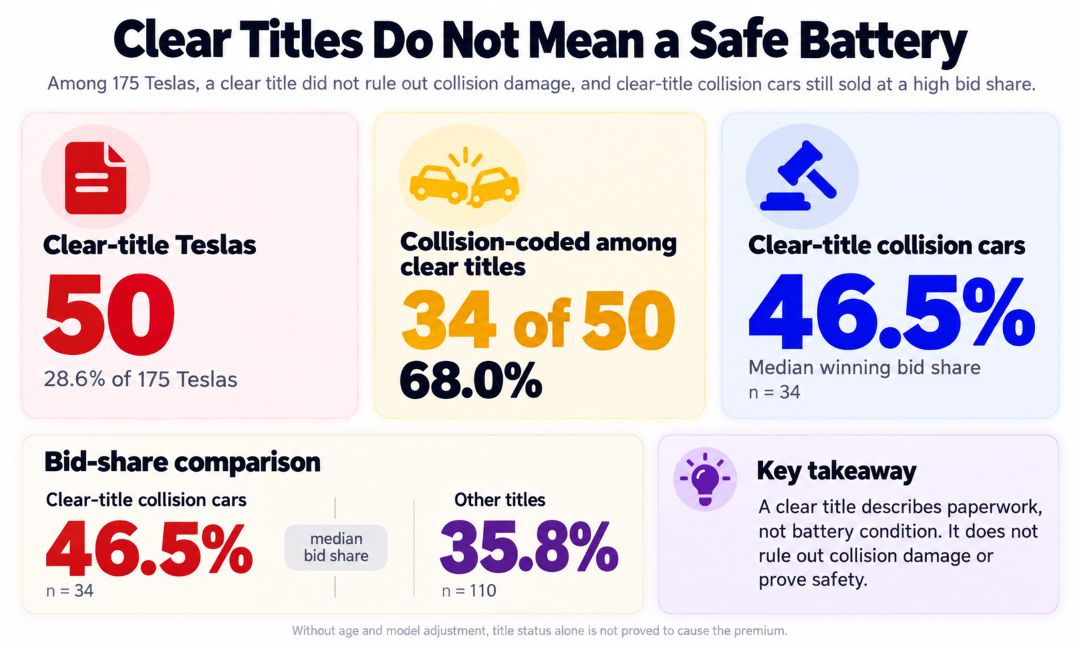
Of 175 Teslas, 50 (28.6%) had CLEAR titles, but 34 of those 50 (68.0%) were collision-coded. Clear-title collision cars had a 46.5% median bid share (n=34), versus 35.8% for other titles (n=110); without age and model adjustment, title is not proven to cause the premium.
How Do Clear, Salvage, Rebuilt and Unsupported Status Differ?
State titles govern registration. Tesla’s classification affects service and charging. Neither proves the vehicle is safe to handle, especially when high voltage is involved.
- Clear: No salvage brand currently shown on that specific document; not a guarantee of no crashes.
- Salvage: A state-designated damage or total-loss status, usually restricting road registration before repairs.
- Rebuilt: A previously salvage-branded vehicle that has met the jurisdiction’s required process; not a battery certification.
- Unsupported: A manufacturer service and charging classification, potentially applying even to clear-title vehicles.
Start with a VIN decoder to confirm identity. Use SCA listing details to compare damage and title documentation. NMVTIS consumer information can help identify reported title brands. The home-state DMV determines registration rules.
Can a Salvage Tesla Lose Fast-Charging or Service Eligibility?
Yes. Under Tesla’s Unsupported Vehicle Policy, an unsupported vehicle status disables fast charging. This also includes third-party DC chargers. Covered warranties are permanently void. Tesla may offer a paid safety inspection. However, restored access is not guaranteed. Verify the VIN-specific outcome before bidding.
Which State Title and Registration Rules Should Buyers Check?
Check whether your DMV:
- Accepts the seller’s document.
- Requires receipts and a rebuilt inspection.
- Limits brand conversions.
- Needs an additional safety inspection.
Check insurance eligibility. Rebuilt paperwork does not prove safety.
Registration requirements depend on the state where you plan to title the vehicle, not necessarily where you purchase it. A Tesla bought at an out-of-state auction may require additional documentation or inspections before it can be legally driven in your home state. Some title brands, particularly non-repairable or parts-only designations, may prevent registration altogether.
What Happens After You Win a Wrecked Tesla at Auction?
Here is the order:
- Arrange appropriate towing.
- Photograph the car.
- Keep auction paperwork.
- Isolate suspected hazards through trained personnel.
NHTSA’s emergency-response resources offer model-specific handling guidance. For suspected battery damage, follow professional storage precautions.
Obtain a documented inspection, revised repair estimate, and state-title requirements before authorizing repairs. Do not drive or charge the vehicle until a qualified technician has cleared it for safe operation.
Key Takeaways
- Collision labels dominate Tesla auctions and reveal little about pack safety.
- Underbody and rocker photos matter more than broad damage labels.
- A blank Run and Drive field is unresolved, not a failure.
- Price the unverified pack separately; auction discounts may be smaller than expected.
- Low mileage and clear titles cannot replace technical inspections.
- Verify manufacturer support, insurance, and DMV rules before bidding.
A bid is sound only when a qualified inspection and all costs fit the budget.
FAQ
Can I Insure a Wrecked Tesla Immediately After Buying It at Auction?
You may obtain transport or storage coverage. However, road-use insurance depends on title status, insurer rules, and repairs. Liability coverage does not certify battery safety.
Why Do Nearly New EVs End Up at Salvage Auctions?
Some factors can make an insurer declare a nearly new electric vehicle a total loss. These may be expensive body structures, sensor repairs, and uncertain high-voltage costs.
Should I Buy a Wrecked EV for Parts Instead of a Rebuild?
Parts may make sense when the pack is unsafe, service restrictions persist, or repairs exceed resale value. Confirm legal dismantling rules. Do not remove energized components yourself.
Does Time in the Yard or a Low State of Charge Change the Battery Risk?
Yes. Storage conditions and deep discharge can complicate assessment. Physical damage remains independent of charge level. Ask for storage history. Never recharge a suspicious pack before inspection.
What Documents Should I Keep When Rebuilding a Salvage Tesla?
Retain the sale document. Keep the VIN records, repair invoices, parts receipts, technician reports, photographs, and inspection certificates.