Contents
An EV crash can result in a total loss even when the car still drives and the damage looks minor. This happens when estimated repair costs, including structural repairs, electronic diagnostics, and safety-system calibrations, exceed the vehicle’s actual cash value. SCA auction data shows that 65.3% of collision-damaged EVs marked Run and Drive carried branded documents, proving that a drivable car is not necessarily economical to repair.
Are EVs More Likely to Be Totaled After a Crash Than Gasoline Cars?
Accidents involving electric vehicles do not necessarily mean that the car will more often be deemed beyond repair. Insurers compare repair costs with actual cash value.
To understand these differences, we analyzed a sample of 3,142 collision-coded lots from an SCA auction. It included 181 electric, 113 hybrid, and 2,848 combustion vehicles. The following comparisons examine branded-title prevalence, vehicle age and mileage, Run and Drive status, and auction prices. These findings describe vehicles offered at auction, not every car accident reported to insurers.
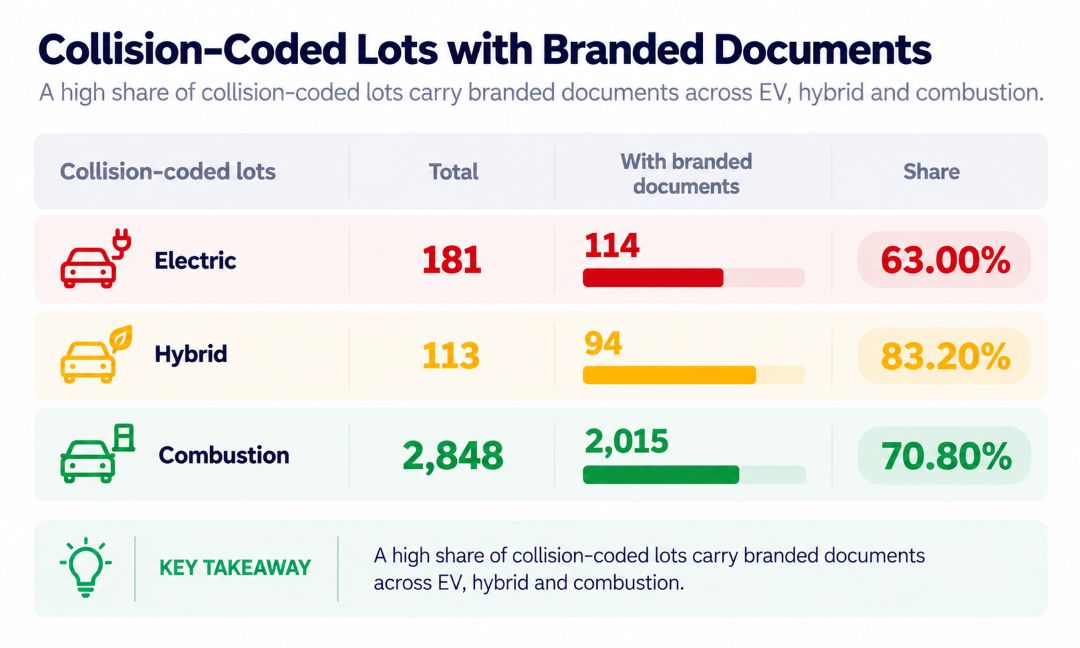
Here, 63.0% of 181 electric lots had branded documents, versus 83.2% of 113 hybrids and 70.8% of 2,848 combustion lots. The number of electric lots is small, and this auction comparison cannot establish how often insurance companies total EVs after a crash.
Auction inventories already select for damaged vehicles. They cannot reveal the probability that any electric vehicle accident will end in a write-off. Assess each lot independently. Do not assume the percentages predict your purchase.
Why Do Low-Mileage and Nearly New EVs Still Receive Branded Titles?
A nearly new electric vehicle may hide battery damage. An underfloor impact can demand costly checks. Manufacturer procedures and scarce parts can turn a compact repair into a major expense.
EV adoption brings newer models into salvage inventories. However, advanced technology can require proprietary tools. An EV may be involved in a side impact or a major car crash. Anyway, visible damage alone cannot establish repairability. A car may need:
- New cooling assembly.
- Wiring harness.
- Approved structural section.
Confirm which parts can actually be ordered before making any assumptions.
What Do Industry Insurance Claims Reveal About EV Total Losses?
CCC’s 2026 midyear claims analysis reports that 23.5% of claims resulted in total losses in the first half of 2026. Among drivable claims, the share increased from 6.3% to 11.2%. These are industrywide, not EV-specific, rates.
Mitchell’s Q2 2026 EV collision report records U.S. repairable claim severity of $5,684 for battery-electric models. It is $5,022 for plug-in hybrids and $4,955 for an internal combustion engine vehicle. The electric-to-gasoline difference narrowed to $729. However, it still matters to buyers.
How Do Totaled EVs Compare with Gasoline Cars in Age, Mileage, and Value?
Branded collision lots show how young and valuable written-off cars can be.
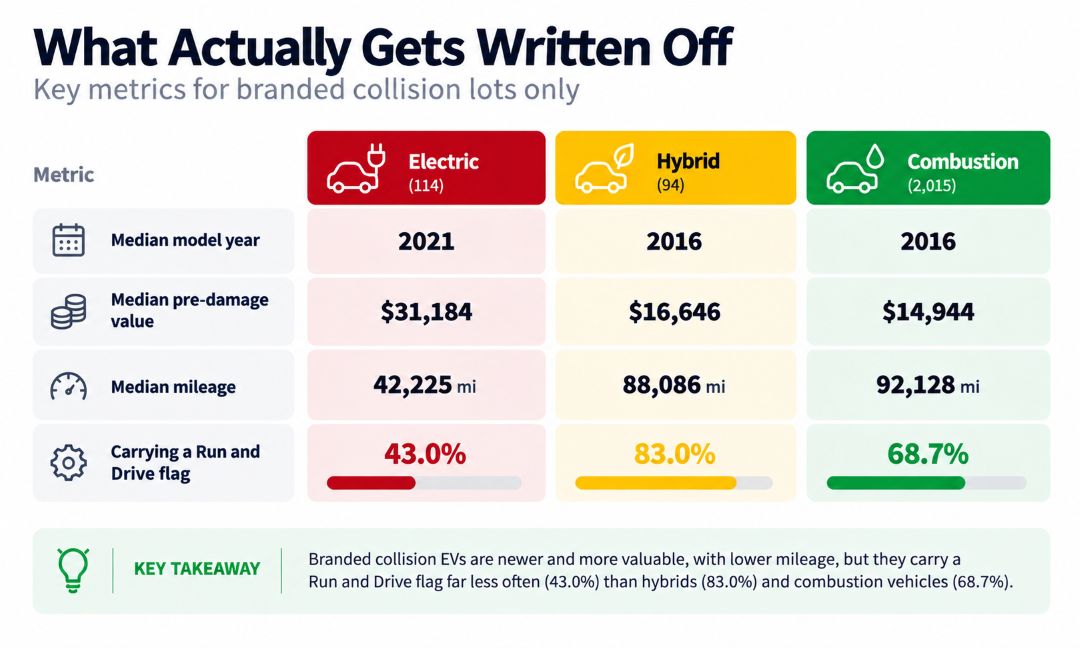
The median electric lot was a 2021 model with a pre-damage value of $31,184 and 42,225 miles. Both other groups had a 2016 median year, with values of $16,646 and $14,944 and mileage of 88,086 and 92,128. Electric lots carried Run and Drive flags less often: 43.0%, versus 83.0% for hybrids and 68.7% for combustion.
Can an EV Still Run and Drive After Being Declared a Total Loss?
Yes. Propulsion may work despite damage to structure or restraint systems. A warning-free dashboard is not proof of condition. An electrical fault can emerge after the auction start-up test.
A car might move a few feet without demonstrating safe charging or normal operation under load. The recorded flag may also describe an earlier condition.
Why Doesn’t a Run and Drive Flag Prove That Collision Damage Was Minor?
Run and Drive records an observed condition. It does not record whether an impact damaged part of the car or disconnected a sensor. These comparisons separate mobility from value.
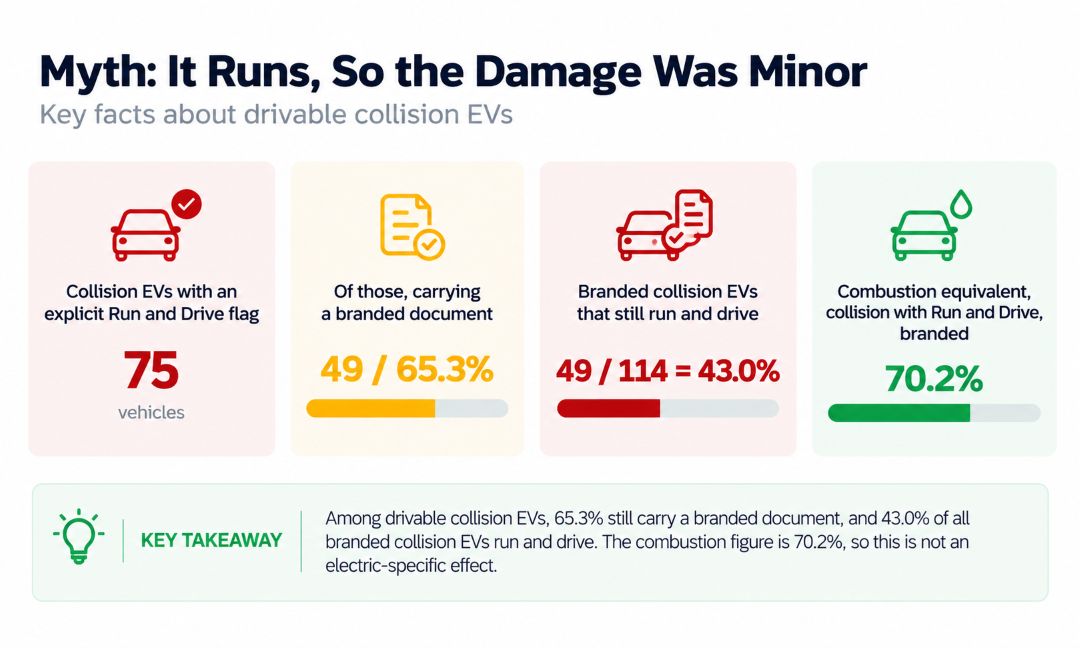
Of 75 drivable collision EVs, 49, or 65.3%, still had branded documents. Those 49 made up 43.0% of all 114 branded electric collision lots. The comparable branded share among drivable combustion lots was 70.2%. Being able to move is plainly not proof of light damage.
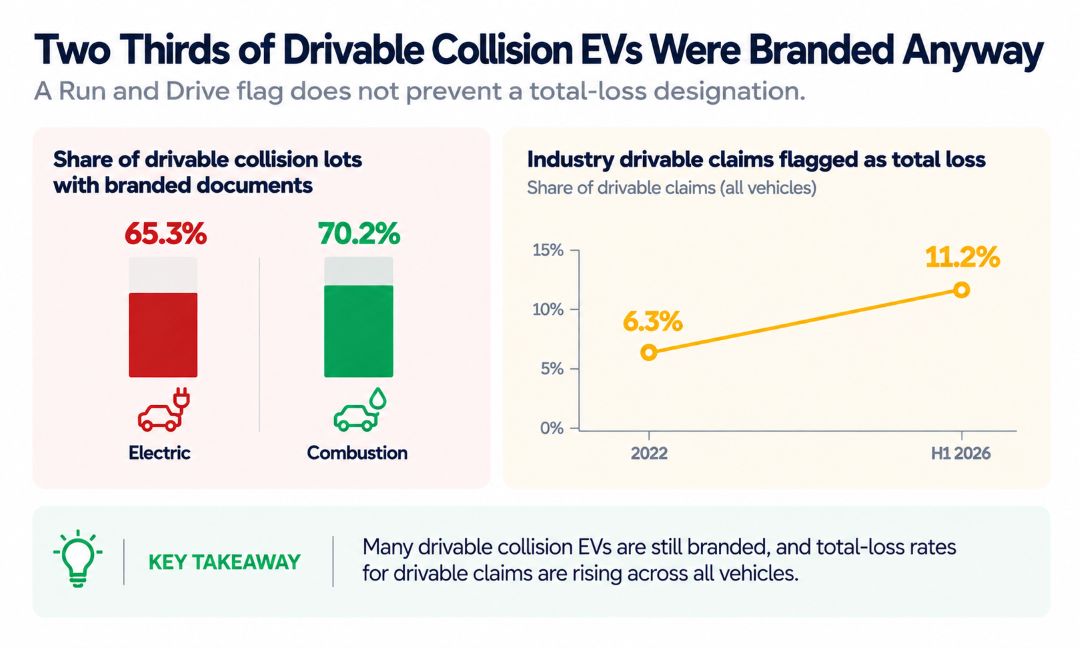
The 65.3% electric and 70.2% combustion branded shares tell the same story. Meanwhile, CCC’s industrywide drivable total-loss figure rose from 6.3% in 2022 to 11.2% in early 2026.
How Do Repair Costs and Actual Cash Value Turn a Small EV Crash into a Total Loss?
A total loss is primarily an economic outcome, not a verdict on whether occupants were safe in a crash. When a collision occurs, a vehicle manufacturer may require costly procedures before high-voltage reactivation. Repairs can exceed the car’s remaining value.
Insurers also consider the vehicle’s actual cash value (ACV), which reflects its market value immediately before the accident. As that value decreases, the same repair estimate can represent a larger share of the car’s worth. This means two EVs with identical collision damage may receive different total-loss decisions because their pre-accident values differ.
How Does the Repair-to-Value Ratio Determine Whether an EV Is Totaled?
Divide projected repairs by pre-damage vehicle value. $20,000 divided by $25,000 equals 80%. State thresholds differ. Insurers may consider salvage proceeds. There is no nationwide cutoff.
Request a written estimate from technicians specializing in EV repairs. Include:
- Structural work.
- Calibration.
- Disassembly-related surprises.
Why Can EV Depreciation Trigger a Total Loss Without More Damage?
If two EVs require $12,000 in repairs but were worth $30,000 and $16,000, their ratios are 40% and 75%. Identical damage can lead to different insurance decisions.
Some factors also explain why a traditional vehicle and an EV may be treated differently:
- Depreciation.
- Parts access.
- Salvage demand.
An electric motor has fewer moving parts than a combustion engine. Additionally, the former is quieter. However, fuel type alone does not determine whether collision repairs are cheaper.
Does Battery Fire Risk Automatically Mean an EV Is a Total Loss?
No. An EV fire accident requires urgent safety assessment. However, a dent near the pack does not prove an EV battery explosion is imminent. Likewise, an electric car battery explosion is not the default outcome of an EV accident. Fire risk depends on actual conditions, not headlines.
NHTSA’s electric and hybrid safety guidance warns: damaged high-voltage components can present shock hazards. They may cause immediate or delayed fire hazards.
First responders involved in electric vehicle recovery should treat damaged systems as energized. Buyers must not charge a suspect car before specialist clearance. A fire history, visible heat damage, or isolation fault warrants particular caution.
A defect may also be relevant. An incident caused by a defect can require recall investigation. Before buying, consider these precautions:
- Defective components. Investigate potential defects and check for applicable recalls.
- Fire damage. Document any fire concerns. The absence of visible fire does not prove that the battery pack is safe.
- Electrical safety. Have specialists evaluate insulation resistance and manufacturer-specified post-impact procedures.
- Storage and recovery. If thermal damage or an unresolved fault is suspected, follow professional safety guidance.
What Do Salvage Titles and Branded Documents Mean for EV Buyers?
Here is the difference:
- Salvage typically signals serious damage/a total-loss designation.
- Rebuilt means a car met state requirements after salvage. This title does not mean that the vehicle’s original crashworthiness is restored.
Parts-only documents may prohibit registration altogether.
According to the NMVTIS consumer guidance, despite later paper-title changes, reported brands remain in federal history records. Verify state rules and insurance eligibility. Resale also carries a branded-title discount.
After a car accident, determining liability and compensation is separate from title eligibility. The at-fault driver may be held liable. However, insurance payment does not make a salvage title transferable or road legal.
Confirm the seller can deliver the specific document advertised. Do not assume every branded unit is rebuildable.
How Do You Calculate the Maximum Safe Bid for a Salvage EV?
Shoppers comparing salvage electric cars can inspect descriptions and document types, including those for a Tesla Model 3.
SCA makes it convenient to compare listings. However, auction price alone says nothing about the completed-project cost. Before setting a bid limit, buyers should establish how they intend to use the vehicle: personal transportation, resale, or parts. Each purpose changes the acceptable purchase price and financial risk. A vehicle intended for resale must leave enough room for profit, while a personal-use purchase should cost less overall than a comparable road-ready EV. If those conditions cannot be met, even a low winning bid may be too expensive.
What Is the Maximum-Bid Formula for a Damaged Electric Car?
Start with the conservative value of a legally repaired vehicle. Subtract all costs, not from the original sticker price. For personal use, compare what you would actually pay for an equivalent repaired car. Storage charges and post-repair inspections remain real costs even if you perform some labor yourself.
Maximum bid = conservative completed value − repairs − fees − transportation − compliance − contingency − desired margin.
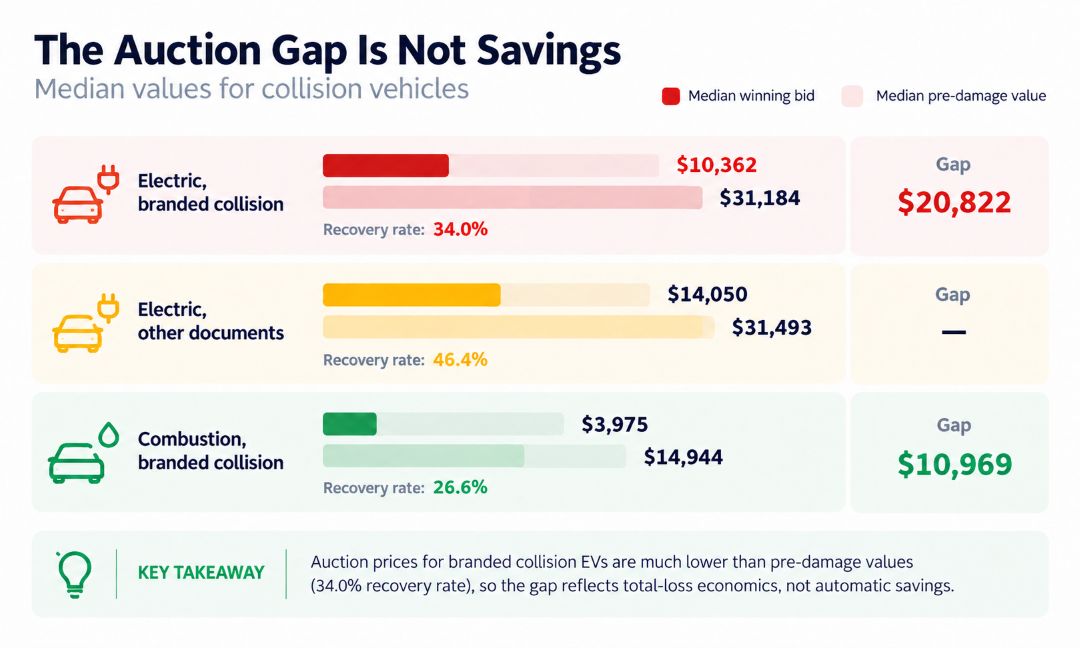
Branded electric collision lots had a $10,362 median bid against $31,184 before damage, with a reported gap of $20,822. Comparable combustion figures were $3,975, $14,944, and $10,969. Electric lots with other documents had a $14,050 bid versus $31,493 in prior value. That apparent auction spread is not profit.
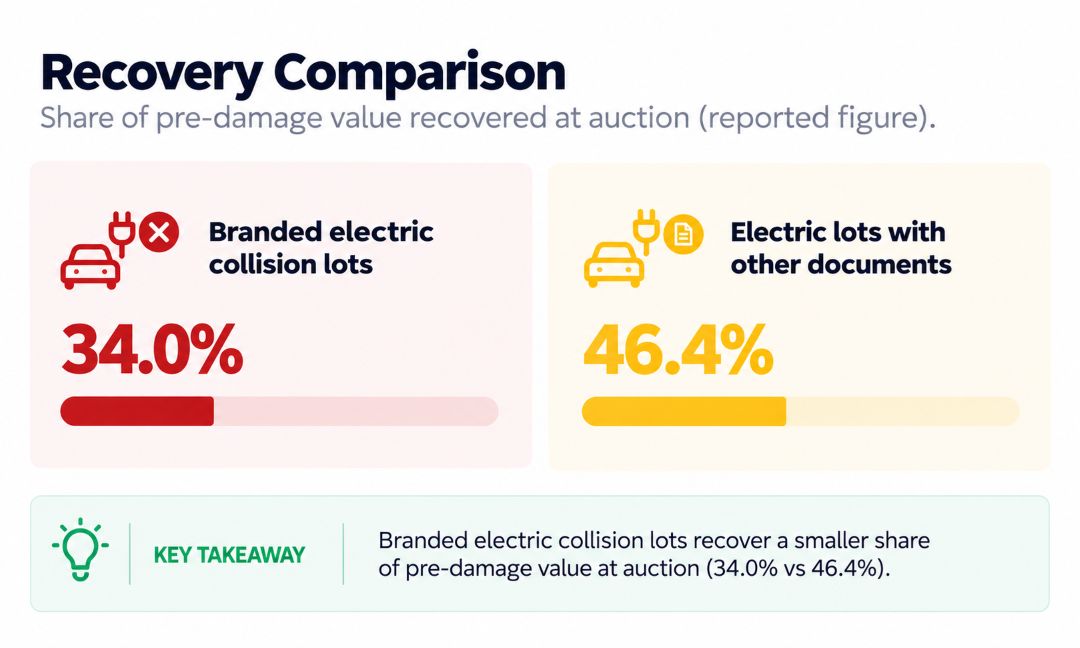
The reported recovery rate was 34.0% for branded electric lots and 46.4% for other-document electric lots. These are sample measures, not guaranteed resale returns. The $20,821 apparent gap must cover:
- Repair parts.
- Battery diagnostics.
- Calibration.
- Auction fees.
- Compliance.
- Shipping.
- Contingency.
- Lasting title stigma.
Work backward from realistic completed value, not forward from the winning bid.
Example: $19,000 finished value – $8,000 repairs – $2,000 fees and delivery – $1,500 compliance – $2,500 contingency – $2,000 margin = a $3,000 maximum bid. Unverified costs should lower that cap.
Such calculations are especially important when repair facilities charge for teardown before they can identify hidden issues.
What Should You Check Before Bidding on a Drivable Salvage EV?
Check documentation before bidding. Photos cannot reveal every electrical problem. Unpriced repair work can erase any potential profit. Pay particular attention to inconsistencies between the listing details and the vehicle’s apparent condition. Missing components, uneven panel gaps, dashboard warning lights, or signs of previous repairs may indicate issues that require further investigation.
What Should You Verify in the Auction Listing?
Use SCA’s free VIN decoder to check specifications and available recalls against the listing. It cannot certify present mechanical condition or repair quality. Request additional photographs. Ask for independent inspection access. Do not confuse missing damage disclosures with proof that a system is unaffected.
Before deciding, check these items in order:
- Match the VIN, model year, trim, and listed document.
- Review damage location, sale disclosures, keys, odometer notes, and available operating video.
- Confirm whether the document allows rebuilding in your state.
- Verify what inspections apply.
- Calculate all taxes and charges.
- Get independent estimates.
Which EV Components Require Professional Inspection?
For a car involved in an accident, a qualified EV specialist must assess structural and electrical integrity, not just body panels.
- Traction system. Enclosure damage, isolation tests, coolant leaks, and connection integrity around the high-voltage battery.
- Chassis. Underfloor deformation, suspension mounts, alignment, and approved structural repair methods.
- Safety equipment. Airbag deployment, seat-belt pretensioners, cameras, and sensor calibration.
- Charging and controls. Fault codes, charging-port operation, thermal management, and manufacturer-specific restart steps.
An accident with an electric model creates new challenges. However, car safety fundamentals remain. A heavier car is not automatically safer after repairs. IIHS crash safety tests found that five of seven EVs tested in 2025 performed well in moderate-overlap testing, while two had rear seat protection concerns. A model’s rating cannot validate an individual wreck.
Key Takeaways
- Auction branded-document percentages are not real-world total-loss probabilities.
- Newer electric vehicles can be expensive to restore despite low mileage and limited visible damage.
- A Run and Drive flag describes movement, not roadworthiness or hidden damage.
- Actual cash value + projected repair costs determine most write-off economics.
- Fire, electrical isolation, and structural questions require specialist verification.
- Bid backward from completed value, allowing for every expense and the title history.
A drivable salvage EV makes sense only when its paperwork and all-in cost withstand independent verification.
FAQ
Can Airbags Deploy Without an Electric Vehicle Being Totaled?
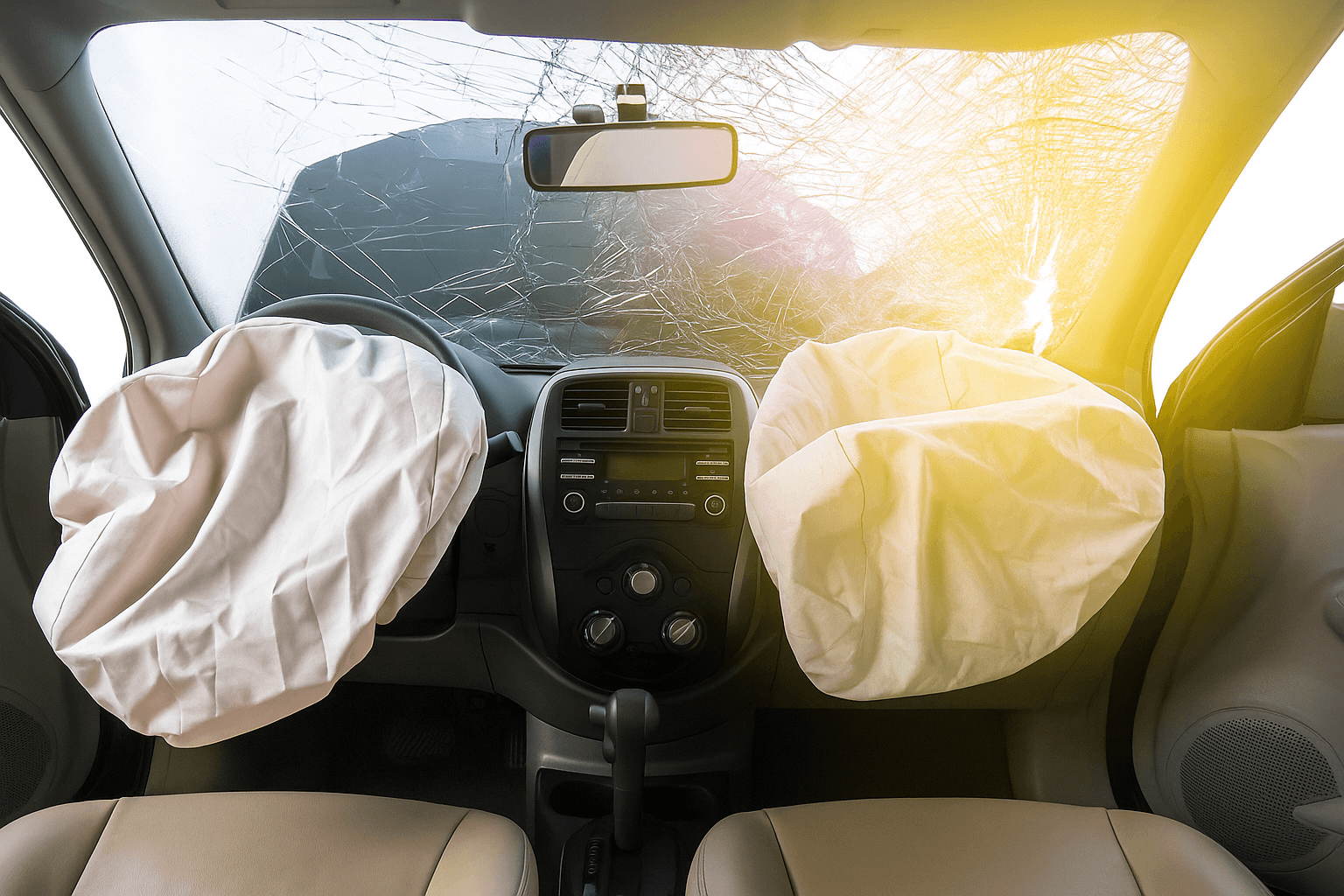
Yes. Airbag deployment increases repair costs. However, it does not automatically mean a total loss. The insurer compares the complete repair bill with the vehicle’s value. They also check applicable state rules.
Can the Salvage Brand Be Removed Once the EV Is Repaired?
Usually not from its history. A state may issue a rebuilt title after inspections. However, the earlier salvage brand generally remains visible in NMVTIS records.
Is Buying a Totaled EV for Parts Less Risky Than Rebuilding It?
Sometimes. It can reduce roadworthiness and registration obligations. Nonetheless, dismantling still presents risks. Confirm legal ownership. Check for parts demand. Review battery condition. Verify safe storage.
What Happens If an EV Develops Electrical Faults Weeks After a Collision?
Look for assistance from a qualified technician to diagnose the fault. Document the findings and check insurance or repair-shop remedies.
Does an EV Battery Warranty Remain Valid After a Total-Loss Accident?
Not necessarily. Warranty exclusions and transfer rules vary by vehicle manufacturer. Damage linked to a collision may not be covered. Verify the VIN-specific warranty terms.