Contents
To clear a salvage title in Tennessee, you must repair the vehicle, submit the salvage certificate, photos, receipts, and Form RV-F1315401 to the Tennessee Department of Revenue, pass the state’s rebuilt anti-theft inspection if required, and then apply for a rebuilt title at the county clerk’s office. In Tennessee, a salvage certificate and salvage title both mean the vehicle cannot legally be driven until rebuilt approval is completed.
What Makes a Car a Salvage Vehicle in Tennessee
A vehicle becomes salvage when damage is serious enough to change its legal status. Under Tennessee Code § 55-3-201, the key test compares the cost of parts and labor with retail value. The rule usually applies to newer passenger cars, motorcycles, and certain light trucks within Tennessee’s weight and model-year limits. That is why salvage cars in Tennessee should be researched before money changes hands. A Tennessee salvage title is a warning label, not a finished outcome.
A vehicle may fall into this category when:
- Damage costs exceed 75% of retail value.
- The owner asks Tennessee to mark it salvage.
- An insurance company pays a total loss claim.
- Fire, theft recovery, collision, or water damage affects road readiness.
- The vehicle cannot be registered until the rebuilt-title process is complete.
How the 75% ACV Threshold Is Calculated
The Tennessee total loss threshold is based on retail value, not the owner’s hope or loan balance. In real claims, adjusters often start with actual cash value, then compare the repair estimate. This means salvage car value a practical number, not just a listed price. The statute points to recognized retail-value databases and reasonable local labor rates.
Here is a simple way to read the math:
- Retail value: $12,000.
- 75% threshold: $12,000 × 0.75 = $9,000.
- Estimated parts and labor: $9,400.
- Result: Damage exceeds the line, so the vehicle may be declared a total loss.
- If the estimate is $8,500, the legal trigger may not be met.
If you are buying after the loss, SCA is a smart place to compare real inventory instead of chasing one private ad. You can browse salvage cars from specific states, such as Tennessee, Georgia, Kentucky, Texas, or Florida. Then, review damage photos, title status, and bidding history before choosing the right rebuild candidate.
Salvage, Flood, and Non-Repairable — Which Title Do You Have?
After an accident with a salvage vehicle, the title wording matters as much as the damage. A salvage certificate may still leave a path back to road use. A flood notation warns buyers about water exposure. A non-repairable designation is much more final. Tennessee law says some non-repairable cars can never be titled for highway use.
| Title Type | What It Means | Road-Use Path |
| Salvage | Damage crossed the legal threshold, or the owner requested the brand | Possible after rebuild, documents, and approval |
| Flood | Water damage is part of the history | Possible only if the vehicle also meets all rebuilt rules |
| Non-repairable | The vehicle is unsafe for roads, or kept only for parts or scrap | No road registration path in Tennessee |
| Rebuilt | A former salvage car completed the required anti-theft procedure | Can be titled, but the brand remains |
The Step-by-Step Tennessee Salvage-to-Rebuilt Title Process
Converting a salvage certificate into a rebuilt title is a document-first process. Complete the rebuild and keep proof. Then, mail the Tennessee packet, wait for review, and complete inspection if selected. After that, take the letter to your local office for title and registration. Build the repair plan around the vehicle, not around guesswork.
Repair the Vehicle to Manufacturer Requirements

Before you apply, restore the vehicle to the maker’s safety standards, not just a “looks fine” level. Check each vehicle system against service data. Use a VIN decoder to confirm trim, restraints, and options before ordering parts. Airbag replacement, structural work, and electronics should match the original build and support the rebuild.
What Documents to Gather Before You Mail Anything
Tennessee’s Form RV-F1315401 is the application for motor vehicle identification certification for rebuilt vehicles. It says the vehicle must be complete before submission. Missing proof is a common reason for rejection, so organize the packet before writing the check. The goal is to show ownership, damage history, parts documentation, and a traceable repair trail that documents the vehicle’s condition.
Use this checklist before mailing:
- Completed Form RV-F1315401.
- Original salvage certificate.
- Color photos of all four damage quadrants.
- Post-repair photos of repaired areas.
- Receipts for parts, including buyer and seller names.
- Include the VIN, year, make, and donor-car details.
- Rebuilder name and address, if someone else did the work.
- Check or money order for the correct payment.
The current form lists a $75 conversion fee for individuals and $85.50 for licensed dealers.
Mail Your Application to the Department of Revenue
Mail the completed application, supporting documentation, and payment to the Tennessee Department of Revenue, Vehicle Services Division, 500 Deaderick Street, Nashville, TN 37242. Do not highlight the form. Keep copies of every application, photo evidence, and the mailed packet for later questions. Tennessee reviews the file before deciding whether an anti-theft inspection is required, so incomplete packets can delay the process before the vehicle is ever seen in person.
Pass the Anti-Theft Inspection
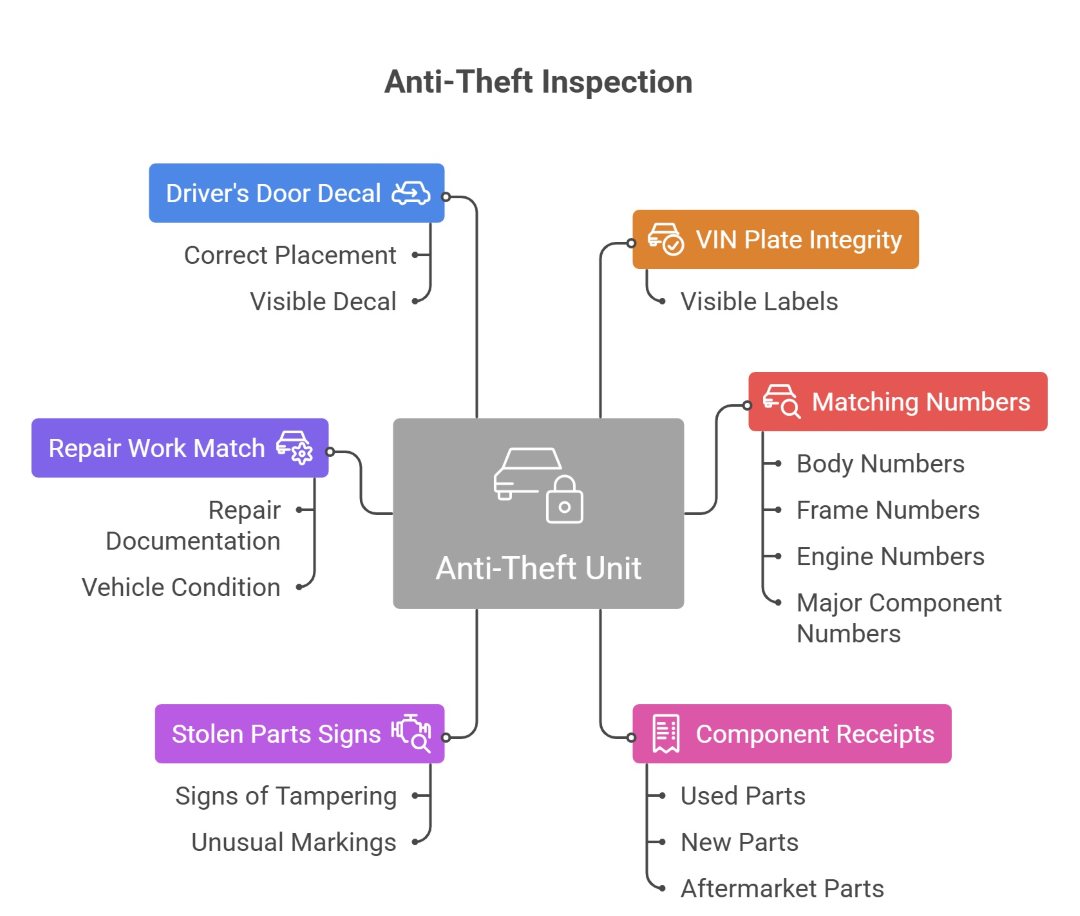
The anti-theft unit is not a substitute for a mechanical inspection. Its job is to confirm identity, ownership, and traceability before the brand is issued. If your file is approved but inspection is required, a Special Investigation Unit agent contacts you. The agent may inspect the car where it is located.
Expect the agent to focus on:
- VIN plate integrity and visible identification labels.
- Matching numbers on the body, frame, engine, and major component parts.
- Receipts for used, new, or aftermarket components.
- Signs that stolen parts were used.
- Whether the listed repair work matches the car.
- Placement of the driver’s door decal after the procedure.
Register at Your County Clerk’s Office
Once you receive approval, bring the letter to the county clerk and apply for title and registration. This is also when local taxes are handled. SCA can help earlier in the journey by showing title type and damage notes before you bid. County clerks may still reject incomplete paperwork even after state approval, so confirm that your approval letter, identification, proof of insurance, odometer disclosure, and supporting ownership documents are ready before visiting the office.
Anti-Theft Inspection vs. Safety Inspection in Tennessee
Tennessee vehicle inspection requirements for this process are often misunderstood. The check is mainly an anti-theft and identity inspection. It is not a full bumper-to-bumper safety certification. Still, the form requires the applicant to certify that the car was repaired to the manufacturer’s safety specifications. Treat both sides seriously before driving.
| Factor | Anti-Theft Inspection | Safety Inspection |
| Purpose | Confirms identity, ownership, and parts traceability | Checks roadworthiness and safe operation |
| Required for a rebuilt title in Tennessee | Yes, when the state requires it | Not the same rebuilt-title step |
| Who conducts it | Special Investigation Unit agent | Mechanic or authorized safety inspector, if needed |
| Scheduled by/how to arrange | Tennessee contacts the applicant after file approval | The owner arranges it separately |
| Location | The agent may come to the car | The owner usually brings the car in |
| Airbag system | Checks the listed restraint parts and proof | Tests warning lights and functions |
| VIN plate integrity | Central focus | Usually visual only |
| Parts traceability | Physical parts are reviewed | Not the main focus |
| Frame and structural repairs | Compared with the file | Checked for safe alignment |
| Brakes | Not the main purpose | Central safety item |
| Tires | Limited relevance | Tread and damage matter |
| Emissions/exhaust | Not the main purpose | May be checked where required |
| Electrical systems | Mainly identity-related, beyond airbags if relevant | Lights, charging, and warnings may be checked |
| Lighting | Not primary | Headlights and brake lights matter |
| Windshield and glass | Not primary | Cracks and visibility matter |
| Pass result/what you receive | Decal and clearance letter | Inspection report, if performed |
| Fail result/what happens next | Missing items must be corrected | Repairs must be made and rechecked |
| Cost | Tennessee’s conversion fee applies | Shop charges vary |
What to Do If Your Application Is Rejected
A rejected application is frustrating, but it is not always the end. Tennessee usually tells applicants what is missing. Read the letter before calling, because the fix may be simple. Do not resubmit the same paperwork unchanged. Prepare a more complete application and remove every doubt.
Follow these steps:
- Read the rejection notice and list each missing item.
- Match the problem to the form, photos, or title.
- Use complete seller and donor details.
- Add a signed explanation when pre-repair photos are unavailable.
- Resubmit only after the file can be approved on paper.
What Does It Really Cost to Clear a Salvage Title in Tennessee?
The obvious cost is the state fee. However, the real budget includes towing, diagnostics, parts, labor, photos, mailing, sales tax, local title fees, and possible storage. The best financial rule is simple: buy only when the finished car will be worth more than the bid, repair, and delay. In Tennessee, the rebuilt-title conversion fee is typically $75 for individuals and about $85.50 for licensed dealers, but the total real-world cost is usually much higher.
Insurance, Financing, and Resale in Tennessee with a Rebuilt Title
Before you insure a salvage car, ask the insurer what coverage is available. Some companies offer liability only, while others may cover comprehensive or collision after photos and underwriting. Financing can also be limited. Disclosure rules require dealers to tell buyers about title history in writing.
| Issue | What to Expect | Smart Move |
| Insurance | Possible coverage limits or insurance denial | Get quotes before bidding |
| Financing | Some lenders avoid branded cars | Use cash or specialty lenders |
| Resale | Smaller buyer pool | Price below clean-title cars |
| Disclosure | Dealer disclosure cannot be waived | Keep the signed notice |
| Title transfer | A rebuilt title can transfer, but history stays | Show records upfront |
| Market trust | Buyers want proof, not promises | Save photos and invoices |
SCA fits this stage because better buying data supports better resale planning. Instead of guessing, you can compare similar lots, damage types, and sale results before choosing an option with enough margin.
Key Takeaways
- A salvage car crosses Tennessee’s 75% retail-value rule or is voluntarily branded.
- Do not buy unless the post-rebuild value beats total cost.
- Tennessee can reject incomplete paperwork before inspection.
- The rebuild must meet the manufacturer’s safety specifications.
- A rebuilt brand remains part of the record.
- Apply only after repairs and photos are complete.
- Registration happens after clearance and the county visit.
A clean file, a careful repair plan, and realistic pricing matter more than speed.
FAQ
Does Tennessee Accept Rebuilt Inspections from Other States?
Usually, no. Tennessee controls its own procedure. Another jurisdiction’s inspection does not automatically replace Tennessee’s required paperwork and anti-theft inspection decision.
Can You Register a Salvage Car Temporarily While Repairs Are Ongoing?
No. A certificate proves ownership only. It does not allow normal road operation while repairs are ongoing or before you shift a salvage certificate to a rebuilt process.
Does Tennessee Require Emissions Testing Before Getting a Rebuilt Title?
Not as part of the anti-theft rebuilt-title process. However, emissions or exhaust compliance can still matter later, depending on local rules and normal registration steps.
Will Aftermarket Parts Disqualify My Rebuilt Title Application?
No, not by themselves. The receipt must clearly say the part is new or aftermarket, and the work must still meet manufacturer and department requirements.
Is a Tennessee Rebuilt Title Permanent?
Yes. Once issued, the rebuilt brand stays with the title history. It can be sold and registered, but buyers must treat the history as permanent.