Contents
To get a dealer’s license in Colorado, you must register a business, obtain a Colorado sales tax license, secure a compliant dealership location, purchase a $50,000 motor vehicle dealer surety bond, and submit a license application to the Colorado Department of Revenue Auto Industry Division. After passing a compliance inspection, approved applicants can legally buy and sell vehicles as licensed dealers.
When Do You Need a Dealer License in Colorado?
In Colorado, you usually should have a license when you are operating as a business instead of making an occasional private sale. That includes retail sales, some wholesale activity, auction work, and franchised operations, depending on the model. The rule is less about one transaction and more about whether you are acting like a business in the auto industry. That is why the state reviews your office, records, tax setup, and business plan. This matters even more if your niche includes salvage cars in Colorado. Title and disclosure issues become more sensitive.
Before you move forward, use this quick rule-of-thumb list:
- You plan to sell vehicles regularly for profit as an auto dealer.
- You want access to dealer plates, temporary permits, or wholesale sourcing.
- You are opening a retail lot, office, or dealership under a business name.
- You will handle buyer paperwork, reassignment forms, and the title transfer process.
- You want to work as a wholesaler or an auction-focused seller rather than as a private owner.
The FTC says the Used Car Rule has been in effect since 1985 and applies in every state except Maine and Wisconsin. This shows how seriously dealer compliance is treated nationwide.
Types of Colorado Dealer Licenses Explained
The correct license depends on whether you are retail, wholesale, auction-based, franchised, or powersports-focused. This is why many aspiring dealers confirm the appropriate license category before submitting an application. If you are selling new and used inventory, the business model matters just as much as the vehicle type. According to the Colorado Auto Industry Division guidelines, several license categories exist depending on how vehicles are acquired and sold. A Colorado auto dealer should match the license type to how the business will actually acquire and sell units.
The table below shows the main options in a practical way:
| License type | Best for | What it allows | Main extra notes |
| Motor Vehicle Dealer | Franchised stores offering new vehicles | Retail sales, trade-ins, dealer operations | Usually tied to a franchise agreement; a good fit when selling new units. |
| Used Vehicle Dealer | Independent retail stores | Retail sale of used cars to the public | Pre-licensing education and exam rules usually apply. |
| Wholesaler | Business-to-business sellers | Sales to other licensed dealers, not retail consumers | Cannot hold a salesperson role at the same time. |
| Wholesale Vehicle Auction Dealer | Auction-centered operators | Auction transactions among licensed parties | Often used where volume and inventory turnover matter more than retail foot traffic. |
| Powersports Dealer | Motorcycle, ATV, similar powersports businesses | Retail powersports sales | Separate category from standard car operations. |
| Used Powersports Dealer | Used powersports retail | Retail sale of used powersports inventory | Similar filing logic, different product class. |
Step-by-Step: How to Get a Dealer’s License in Colorado

If you are learning how to get your dealer’s license, the basic order is simple: form the business, secure the site, finish education, bond the file, and ensure all vehicle acquisition methods comply with state law. The state reviews the file as a single package, so the legal business name must match across the bond, tax registration, lease, and application documents. Ownership disclosures, financial statements, and identification records must also align with the information submitted through the Auto Industry Division portal.
Register Your Business and Tax ID
Start by forming your business entity and registering it with the Colorado Secretary of State before you build the rest of the file. The Colorado Department of Revenue also expects tax registration to line up with the legal business name and any trade name you plan to advertise. If the name on the bond, tax record, and lease do not match, delays are common. For those who want to know how to obtain a dealer’s license, this is the first real compliance step. It also sets up your dealership application and future tax reporting.
Once the company is active, the state expects several basics to be in place, so gather these items before moving on:
- Secretary of State business filing for the business entity.
- Trade name registration, if you will operate under a DBA.
- Federal EIN and state tax registration.
- Colorado sales tax account number or a copy of the sales tax license.
- Lease or ownership document for the business site.
Secure a Compliant Business Location
Your place of business must be a real, permanent location. This shouldn’t be a mailbox or borrowed desk. Colorado requires an enclosed office, electrical service, restroom access, space to display one or more vehicles, posted hours, and a sign visible to the public. The office and display area generally cannot be shared with another business.
Obtain the Required Dealer Bond
Most applicants should possess a surety bond, and the standard bond amount for dealer, wholesaler, and auction applications is $50,000. The bond must show the full legal name, and any DBA must appear correctly on the principal line. This surety bond exists to protect consumers and the state against losses tied to unlawful dealer conduct. A dealer bond is not the same as insurance for your lot. Your credit score can affect the bond quote, so the bond cost varies. The same filing may also be described as a motor vehicle dealer bond or auto dealer bond, depending on the form.
Before you buy the bond, make sure these bond details are right:
- The surety bond matches the exact legal business name.
- The auto dealer bond is signed by an owner, partner, officer, or LLC member.
- The bond amount is $50,000 unless you are in the small trailer category.
- The Colorado auto dealer bond is submitted as a copy with the file.
- Get a fresh bond quote if ownership or name details change.
Submit the Dealer License Application
When you submit your application, the state reviews ownership, education, finances, business records, and site compliance together. Incomplete files are a major reason people get stuck, especially when they are trying to shortcut the rules around buying cars without a license. The dealer application is now submitted online through the Auto Industry Division portal, and several items must be included with the application.
Pass the State Compliance Inspection
Colorado expects your file and your location to agree with each other. That means your hours, sign, office setup, records storage, and display area should all match what you claimed. The applicant should be ready to explain how inventory will be sourced, financed, and documented. In practice, this stage tests whether you are applying for a legitimate dealership operation. It is also where zoning compliance becomes visible.
To avoid surprises, check these points before review:
- Posted business hours meet the minimum schedule.
- Books and records are stored safely and available for inspection.
- The permanent sign uses the licensed name.
- The lease allows dealer activity, display space, and signage.
- The office is used exclusively for dealer business where required.
Dealer Location, Lot, and Signage Requirements

A Colorado motor vehicle dealer needs an enclosed office, vehicle display space, posted hours, and a permanent sign visible from outside the building or entry area. The lease must allow dealer operations, signage, and display. These details are a core requirement for approval. Colorado regulators also require dealers to notify the Auto Industry Division if a licensed dealership changes its business location.
Zoning Rules for Car Dealerships
Local zoning approval is separate from state licensing. However, both matter. The state wants proof that the site complies with local rules. This is one of the most overlooked licensing requirements in Colorado. It becomes even more important in mixed-use buildings where signage, display space, or customer traffic may be restricted. In the state of Colorado, local land-use approval can block an otherwise complete file.
Before signing a lease, confirm the following with the city or county:
- The parcel allows retail vehicle sales or wholesale use.
- Outdoor display is permitted.
- Signage size and placement are allowed.
- Customer parking and access meet local codes.
- Any home-office or shared-office setup is prohibited for your use case.
How Much Does It Cost to Start a Car Dealership in Colorado?
The cost of a Colorado startup is broader than the state filing fee. You will pay for the original license fee, the surety bond premium, entity registration, site rent, signage, utilities, and working capital for inventory. Your financial condition also matters because the state asks for statements showing assets and liabilities. For that reason, getting your Colorado file approved is only one part of opening the business.
A practical starter estimate looks like this:
- Original license fee: $841.
- Criminal background check/fingerprint fee: $39.50.
- Bond premium estimate: about $500-$5,000+. The sum depends on the credit score and the bond cost.
- Signage, office setup, and utilities: often $2,000-$10,000+.
- First inventory and reconditioning reserve: highly variable; many stores budget $25,000+ to start.
- Simple example calculation: $841 + $39.50 + $1,500 bond premium + $4,000 setup = $6,380.50 before vehicle inventory.
How Long Does It Take to Get a Colorado Dealer’s License?
Most complete files move faster than incomplete ones, so the real timeline depends on preparation. If you already have the location, bond, tax setup, and exam finished, you may obtain a license in weeks rather than months. Anyone trying to get a license to buy cars should finish the pre-file work first because corrections almost always add delay. Some applicants still need to complete education or exam steps before filing.
Common Reasons Dealer License Applications Get Rejected
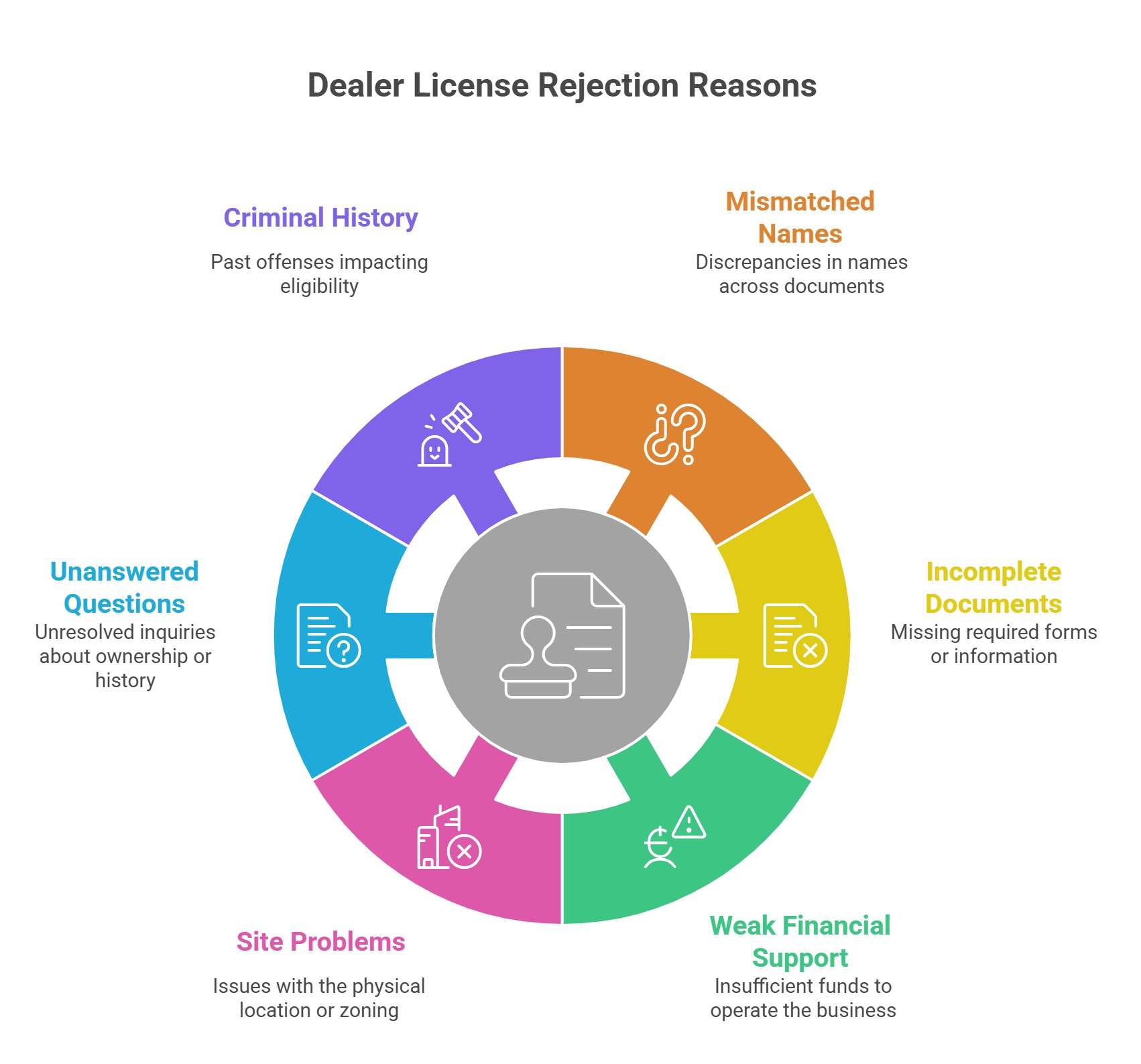
Most rejections come from mismatched names, incomplete documents, weak financial support, or site problems. The state is especially strict when the file leaves unanswered questions about ownership, criminal history, or funding. You need to provide a clear paper trail from business formation through tax registration and bonding. If an owner has a felony within the last 3 years for certain covered offenses, the license can be denied. Such tools as a VIN decoder can help with lawful inventory checks.
The most common rejection triggers are usually these:
- Missing addenda for owners, officers, or members.
- Failure to include a copy of the lease, ID, bond, or exam affidavit.
- No copy of the sales tax record or inconsistent sales tax information.
- Poorly documented assets and liabilities or weak proof of funding.
- A criminal background check issue, especially where someone has pled no contest or been convicted within the last covered period.
What Happens After You Get Your Dealer License?
Approval is not the end of the licensing process. Dealers must keep the business compliant every day, not just at renewal time. That includes records, bond coverage, title work, and federal used-car disclosures. The Colorado Department of Revenue and federal regulators both expect ongoing compliance from every active auto dealer license holder. A motor vehicle dealer license holder also has to keep operating records accurate after approval.
After approval, keep this operating checklist in place:
- Renewing the dealer license: Track the expiration cycle and pay renewal fees before a late fee applies.
- Maintaining the dealer bond: Keep the surety bond active with no lapse in coverage.
- Processing vehicle titles correctly: Follow the title transfer process and reassignment rules on every deal.
- Keeping transaction records: Store deal jackets, tax records, and acquisition documents for inspection.
- Complying with the FTC Used Car Rule: Post a Buyers Guide on each used vehicle offered for sale.
- Maintaining dealer plates: Use each plate permit and dealer plate only for authorized dealer activity.
Alternatives to Getting a Dealer License
Not every business model needs a full retail license right away. Some operators start by partnering with a licensed dealer, working consignments, or building a brokerage arrangement first. These models can reduce risk while you learn the industry and decide whether fully getting licensed makes sense. They can also help you understand the application process before you commit to rent, staff, and compliance systems. Still, none of them should be used to hide unlicensed retail activity.
| Alternative Option | How It Works | Advantages | Limitations |
| Partner with a licensed dealer | You source opportunities and operate under an established dealer structure | Lower startup risk, built-in compliance help | Less control and shared profit |
| Vehicle consignment sales | The owner keeps the title while the dealer markets and sells the vehicle | Lower inventory cash needs | Must be structured carefully under dealer rules |
| Auction resale through a licensed dealer | Inventory is bought and resold through a licensed partner | Useful if you need to obtain auction access without a full retail launch | You still cannot act like an unlicensed retail dealer |
| Brokerage model | You connect buyers and sellers for a fee without holding inventory | Lean overhead and easier testing of demand | Limited control over closing, titles, and customer experience |
Key Takeaways
Getting a Colorado auto dealer license is mostly about preparation and accuracy. The state wants a legitimate business, a compliant location, a valid surety bond, and complete documents that all match.
- A license is required when you operate like an auto dealer instead of a private seller.
- The main steps are business setup, tax registration, pre-licensing, exam, bond, and filing.
- Startup costs usually exceed the state fee once bond, location, and setup are added.
- Approval time depends on how complete your file is before you submit it.
- Common mistakes include name mismatches, missing forms, weak financial proof, and site issues.
- Ongoing duties include renewals, records, title work, bond maintenance, and FTC compliance.
- Before applying, confirm zoning, funding, and the exact license type you need.
FAQ
Who Is Allowed to Legally Drive Vehicles Using Colorado Dealer Plates?
Authorized dealer staff and qualified prospective buyers in limited demonstration situations may use dealer plates, but the use must fit Colorado rules and documented dealer business purposes.
Are Colorado Dealers Required to Maintain a Minimum Number of Cars in Inventory?
Colorado requires space to display one or more vehicles, but the official place-of-business rules do not set a fixed minimum inventory count for a standard dealer operation.
Who Needs to Be Listed on a Colorado Dealer License Application?
Each owner, partner, member, officer, and certain stockholders must be disclosed, and addendum forms are required, so the information must match the full ownership structure.
Do You Need a Separate License to Sell Boats or Motorcycles in Colorado?
Motorcycles and other powersports units follow separate powersports licensing categories, while boats are outside the motor vehicle dealer framework covered by the Auto Industry Division dealer page.
Can New Dealers Buy Inventory from Auto Auctions?
Yes, new dealers can usually buy inventory from auctions once properly licensed, but lawful acquisition records still matter because every unit must submit a copy of ownership documents when required.