Contents
You can legally buy a car at an auto auction without a dealer license as long as the auction is open to the public. You register and bid as a retail buyer, but you cannot enter dealer-only lanes and you must follow your state’s sales limits (usually 2–5 sales per year before dealer rules apply). Public auctions, online consumer auctions, and government surplus sales all allow non-dealers to participate.
What You Can and Cannot Do Without a Dealer License
Some auctions require credentials, yet many public auctions are open to the public on set days, so anyone can attend and purchase. You can bid, pay, and take a car from an auction home, but you cannot enter a dealer auction lane or act like used car dealers who resell all month. If you want to buy cars for your business, you may still need a separate business license and to follow your state’s resale limits. This is buying a car at the auction for personal use, without a dealer’s license, with strict title checks.
| Action | Allowed for retail buyers | Not allowed | Practical note |
| Attend auctions open to the public | Yes | No | Read the auction house rules before arrival |
| Bid and become the highest bidder | Yes | No | Set a ceiling before you start bidding |
| Enter a dealer-only lane | No | Yes | Reserved for licensed dealers |
| Resell repeatedly for profit | Sometimes | Sometimes | A license required may be triggered by volume |
| Use a broker service | Yes | No | The broker may add additional fees |
| Expect warranties and no test drives | Rare | Often | Assume “as-is” and inspect hard |
| Receive title paperwork fast | Usually | No | Ask about title timing and title delivery |
Across the U.S., the used vehicle market moves tens of millions of vehicles per year, and auctions offer a major pipeline for used vehicles.
How State Rules Work: Dealer License Limits and Sales Thresholds
State law decides when a private buyer becomes a dealer, and the lines differ across many states. The trigger is usually how many cars are sold in your name per year, or whether you buy vehicles mainly to resell. Auctions and dealer auctions can explain their policies, but the DMV is the final authority. If you plan to flip regularly, it’s safer to get a license to buy cars and confirm whether a business applies in your state, where the vehicle is titled.
Here’s what to verify before you shop:
- Sales threshold: Check the private-sale cap for your state.
- Tax handling: Confirm whether tax is collected at checkout or later.
- Temporary tags: Learn if you can drive home or must transport.
- Registration rules: Confirm ID rules, setup, and payment limits.
- Disclosure rules: Ask what counts as dealer activity in your state.
Types of Auto Auctions You Can Access Without a Dealer License
Not every type of auction is locked behind credentials. Retail-friendly types of car auctions include public car auctions, city surplus sales, and online auto auctions that accept consumer registration, and you’ll also find that car auctions open seasonally for charity or municipal sales. Some platforms also host government fleet liquidations, police impound releases, and seized-property sales that are open to the general public. In many cases, the inventory comes from official agencies rather than private sellers.
Public Auctions vs Dealer-Only Auctions
Public auctions are designed for anyone. Dealer-only auctions are built for speed and wholesale turnover. That difference changes pricing, inspection time, and what protections exist if the title is delayed or the car has hidden issues. Auctions may publish condition notes. However, retail listings can be thin, so you must inspect harder. Many buyers compare pricing to wholesale, but the best choice depends on risk and title rules.
| Feature | Public Auctions | Dealer-Only Auctions |
| Access | Often open to the public | Limited to licensed dealers |
| Pricing | Mixed, sometimes near retail | Often closer to wholesale prices |
| Vehicle quality | Wide range, including project car units | More trade-ins and fleet cars |
| Inspection options | Basic preview and walk-around | Deeper lane tools and reports |
| Buyer protections | Varies by auction house | Usually, clearer arbitration rules |
How to Avoid Overpaying When You Don’t Have a License

When you can’t use dealer-only tools, discipline matters. The goal is getting a good deal, not winning every bid. You should plan your ceiling, include title costs, and treat “cheap” cars at auction as potential repair projects. It also helps to monitor recent sale prices for similar models, compare condition grades across listings, and watch early bidding patterns to identify auctions that escalate too quickly. Many experienced buyers track multiple vehicles at once so they don’t become emotionally attached to a single listing.
Hidden Fees Non-Licensed Buyers Often Miss
Retail buyers often focus on the hammer price and forget the invoice items. That’s where totals jump, especially on an online auction. Read the posted auction fees and add them to your ceiling before you bid on a car, because the same car can cost very different amounts after checkout.
Use this checklist to avoid surprises:
- Buyer’s fee tiers: Sliding fee tied to price brackets.
- Gate fee: Yard/processing charge at pickup.
- Late pickup storage fee: Daily storage after the pickup window.
- Document fee: Paperwork processing and title handling.
- Online platform fee: Per-sale charge for the platform.
- Transport surcharge: Distance or fuel add-on for shipping.
Maximum Bid Formula Explained
Use: Market value minus repairs minus transport minus auction fees minus a buffer for unknowns. The result is your maximum bid; if the price crosses it, stop. This keeps you from paying retail for a used car that still needs work and time for title processing.
How to Inspect a Vehicle When You Can’t Access Dealer-Only Tools

At retail lanes, you won’t see the same reports that licensed dealers see. Thus, your inspection must be stricter. Bring a flashlight and, if allowed, a small scanner. Pull history reports. Compare them with the listing and the title label. A VIN decoder helps confirm engine, trim, and factory options, which matter when a listing is vague. Auctions may describe the condition briefly, so your eyes do the real work. For guidance on what certified technicians look for during inspection, review ASE’s test standards.
To keep checks fast, use this routine before you bid:
- Exterior: Mismatched paint, panel gaps, rust.
- Glass and lights: Chips, cracks, and water intrusion signs.
- Fluids: Oil and coolant level and color.
- Tires: Uneven wear can signal suspension issues.
- Interior: Windows, locks, HVAC, warning lights.
- Paper trail: Match VIN, mileage, and title status to the listing.
Data reviews consistently show a noticeable share of used car listings with prior damage or title events, so verification is not optional.
Start-to-Finish Process for Buying at Auction Without a Dealer License
If you know how to buy step by step, the day feels controlled instead of chaotic. To find out how to buy with less stress, treat the process like a checklist. You need to register, inspect, set limits, and close out the paperwork correctly.
Add clear timing benchmarks: confirm the deposit requirement before bidding, check payment deadlines (often 1–3 days), verify storage fees after day two or three, and note the title-processing timeframe listed by the auction. These fixed checkpoints prevent missed deadlines and unexpected charges.
Registration & Eligibility for Retail Buyers
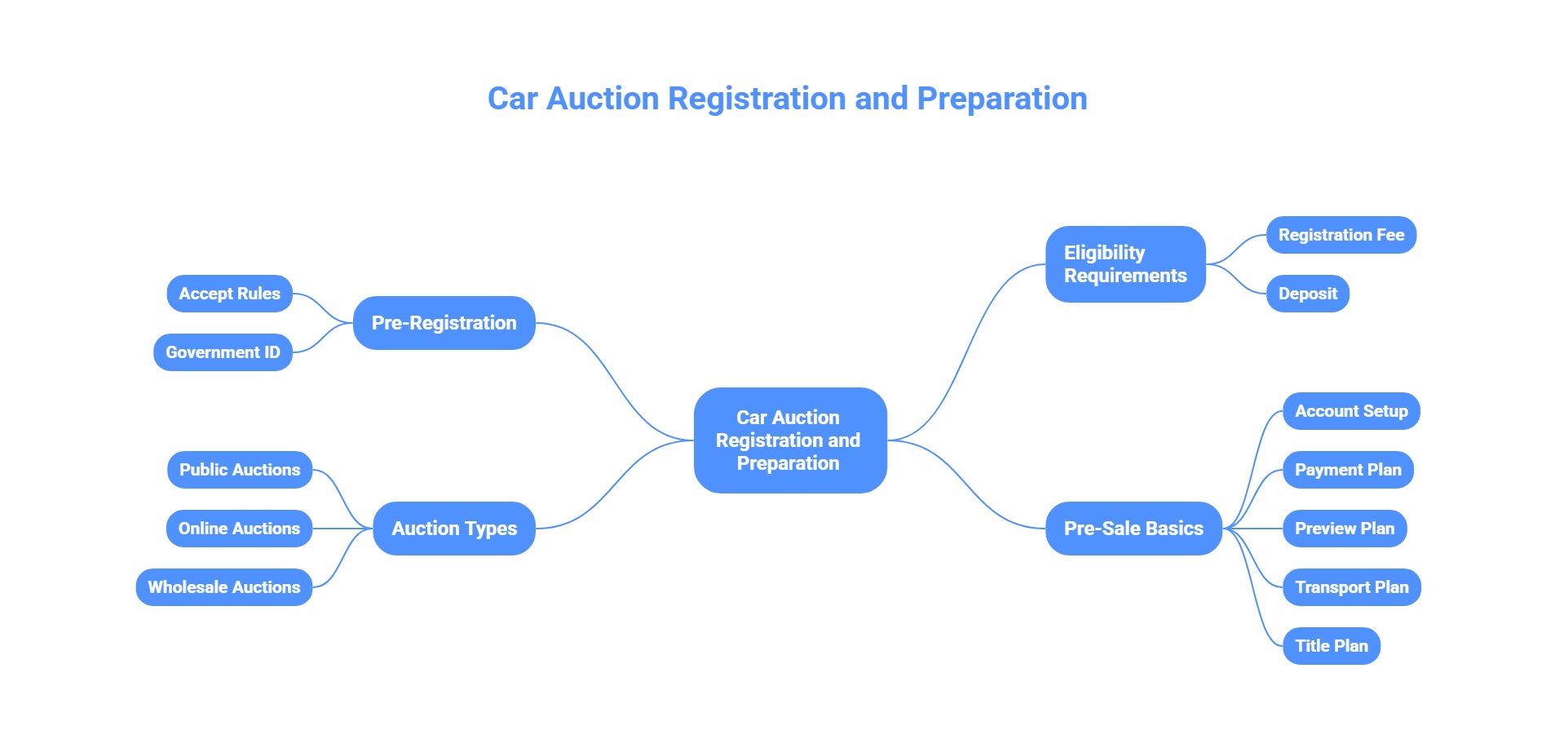
Most public car auctions use pre-registration, and they are open only after you accept the rules. You’ll need government ID, and some sales charge a registration fee or require a deposit. Many auctions remind public buyers about warranties and no test drives, so inspection matters. If you’re using online car auctions, confirm login, payment limits, and whether the car at the auction can be started during the preview. If you want to buy cars at auction through a broker, confirm broker fees and title timing. Remember that online wholesale auctions without dealer credentials may still restrict certain inventory categories.
Before the sale day, handle these basics:
- Account setup: Create your profile and verify identity.
- Payment plan: Confirm accepted methods and deadlines.
- Preview plan: Attend inspection hours with a checklist.
- Transport plan: Book a tow or a carrier in advance.
- Title plan: Ask how the title transfer packet is issued.
How Bidding Works on Public Auctions
The auctioneer calls numbers. Each bidder signals. Then, the bid rises in steps until one person stops. That’s how car auctions work in real time: fast, public, and final when the gavel drops. When the gavel falls, the highest bidder wins. Cars are sold under the posted terms. At online auto auctions, timers may extend if late clicks arrive, so watch your limit.
Payment, Pickup, Transport & Title Transfer Steps
After the end of the auction, the work becomes paperwork. Pay attention to deadlines. Late payment can trigger penalties. Title timing varies by state and auction house, so keep copies of every title form and receipt. If you can’t drive it legally, arrange transport and pick up the vehicle fast to avoid storage, and remember you can still buy a vehicle and complete DMV steps even with no license.
- Pay invoice: Pay the full amount, including additional fees, by the deadline.
- Confirm title status: Verify whether the title is clear, branded, salvage title, or pending.
- Arrange release: Get a gate pass and pickup appointment.
- Pick up the vehicle: Bring ID and release documents.
- Transport home: Haul it, tow it, or use a legal temporary permit.
- Complete DMV work: Register, pay taxes, and finalize title transfer.
When You Should NOT Buy at an Auction Without a Dealer License
Auctions reward patience, but punish urgency. If you need a daily driver tomorrow, it may be smarter to shop retail. Alternatively, you can check unsold cars at dealerships where you can test drive. Skip the sale if the listing is thin, the title is delayed, or the price is already near retail. Cars may look clean in photos but hide costly faults; in particular, flood-related damage is often invisible at first glance, and NHTSA provides guidance on identifying these risks. So know when buying cars means walking away, especially if you’re trying to do it without a license and you can’t absorb delays.
Walk away when you see these red flags:
- No preview window: You cannot inspect or verify the condition.
- Unclear title timeline: The title may take weeks, delaying registration.
- No transport option: You can’t move the car safely the same day.
- Tight budget: You can’t cover repairs and fees.
- Overheated crowd: The bid keeps climbing past your number.
Summary
- You can legally buy from public auto auctions without a dealer license, but you cannot access dealer-only lanes and you must stay within your state’s annual sales limit.
- Most states allow only 2–5 private-party vehicle sales per year before triggering dealer requirements. Exceeding that limit can lead to fines, title delays, or registration blocks.
- Always calculate your maximum bid before participating. Use ACV minus estimated repairs and all fees; retail buyers face higher add-ons, so discipline protects your budget.
- Run a VIN check, review the history report, and inspect photos or condition grades every time. Hidden damage, frame issues, and odometer discrepancies are common at public auctions.
- Know the risks of each title type. Salvage and rebuilt titles may be cheap to buy but can restrict insurance, resale value, or registration; clean titles are safest for first-time buyers.
- Walk away from listings showing red flags. Missing VIN photos, unclear fee disclosures, mismatched mileage, or “title pending” details often signal higher financial and legal risk.
FAQ
Do I Need Special Insurance to Drive a Car Home from an Auction?
You need active insurance plus a legal plate or temporary permit from your DMV. If the title is delayed or the car is unsafe, towing is the safer option.
Can a Broker Markup the Auction Car Price without Telling Me?
A broker can add service charges and should disclose them, but invoices can feel bundled. Ask for a written breakdown before you bid and compare it to posted charges.
What Risks Do You Face If You Exceed Your State’s Limit on Private Vehicle Sales?
Exceeding your state’s limit on private vehicle sales is treated as unlicensed dealer activity. When this happens, the state can issue fines, assess unpaid taxes, block future title transfers, or open formal enforcement cases. Buyers may also file claims if a vehicle later shows undisclosed issues.
Are Transport Delays Common When Buying from a Non-Dealer Auction?
They can be, especially during peak weeks or bad weather. Book transport early. Also, confirm pickup hours and avoid storage charges.
Can I Buy Salvage or Rebuilt Title Cars If I Don’t Have an Auction License?
Yes, at some public sales. However, read the rules. You can purchase vehicles at auctions with branded titles, but you must understand inspection steps, repair costs, and how your DMV handles rebuilt registration.