Contents
A salvage title motorcycle is not road-legal until it passes state inspection and receives a rebuilt title. The damage category, your registration state’s process, and the true all-in cost determine whether this is a smart buy or a stranded asset. This guide covers all three.
What Do Damage Types Mean on Salvage Motorcycles?
On salvage motorcycles, the damage code is only the starting point. Photos rarely show alignment, wiring, frame stress, or leaks. A motorcycle has a salvage title because an insurer or authority decided its condition had changed its legal and financial status. That does not mean the bike is not necessarily unsafe. It means the buyer must connect the code, actual cash value (ACV), parts, and state rules before the motorcycle salvage title is issued. Start by sorting the damage into clear categories:
- Cosmetic damage: Fairings, mirrors, luggage, paint, and trim; usually best when hard parts are straight.
- Theft recovery: Missing keys, ignition parts, plastics, or electronics; check for a stolen motorcycle history.
- Front-end impact: Look for fork tube damage. Examine for bent triples, wheel runout, rotor warp, and steering stop cracks.
- Flood exposure: Connectors, bearings, switches, ABS pumps, and harnesses can fail months later.
- Fire or burn: Heat can weaken metal, melt insulation, and hide future electrical faults.
- Frame notation: Treat it as high risk unless a professional can measure the chassis.
Which Damage Codes Have the Best Rebuilt Title Success Rates?
The easiest projects have complete paperwork and damage away from the frame. A clean title comparison shows whether the discount is real. The deal must survive fees, transport, parts, labor, tax, and delay. Before buying a salvage title motorcycle, set a break-even point. Do not chase the bid. Use the table as an initial filter, not a guarantee. Have a mechanic estimate the cost to repair first.
| Damage category | Estimated repair range | Transport cost (fixed range) | State inspection fee range | Titling fee range | Total estimated all-in cost range | Break-even ACV threshold |
| Light cosmetic, runs | $600-$1,800 | $350-$750 | $50-$200 | $25-$120 | $1,025-$2,870 | $4,500+ |
| Theft recovery, complete | $900-$2,700 | $350-$750 | $50-$200 | $25-$120 | $1,325-$3,770 | $5,500+ |
| Minor side impact | $1,400-$3,800 | $350-$750 | $75-$250 | $25-$150 | $1,850-$4,950 | $7,000+ |
| Front suspension hit | $2,500-$6,500 | $350-$750 | $100-$300 | $50-$175 | $3,000-$7,725 | $10,000+ |
Salvage Title vs Rebuilt Title on a Motorcycle
A bike with a salvage title is usually not ready for registration. A rebuilt motorcycle has passed the state process and may be eligible for road use. One common problem is title jumping, where a seller skips the transfer and leaves messy paperwork. Always match the seller, motorcycle’s title, bill of sale, and receipt trail.
| Status | What it means | Can you ride it? | Main buyer risk | Best use |
| Active motorcycle title | Normal ownership document with no major brand | Yes, if registered | Hidden damage | Everyday riding |
| Title brand pending | Claim or auction paperwork is in transition | No, verify first | Delay or missing title | Experienced buyers |
| Repairable brand | A salvage vehicle that can be rebuilt under state rules | Usually no | Failed review | Project build |
| Rebranded title | Legal status changed after review | Often yes | Lower resale value | Budget rider |
49 U.S.C. §30504 requires monthly reporting by junk yards and salvage yards.
How Rebuilt Title Rules Work by State
Rules are local, and the registration state controls the process. Some states focus on a percentage threshold, while others rely on insurer judgment. A displacement threshold can matter when the machine is closer to a moped, scooter, or off-road conversion than a standard street bike. Use this table as a reference checklist:
| State | Total-loss threshold percentage | Who conducts the VIN inspection | Number of inspection steps required | Typical processing timeline |
| California | No fixed percentage; insurer/DMV practice | DMV or CHP when referred | 1-2 | 2-6 weeks |
| Florida | 80% damage-to-value guideline | DMV examiner or approved rebuilt facility | 2 | 2-8 weeks |
| Texas | Damage greater than ACV standard | TxDMV paperwork review plus safety path | 1-2 | 2-6 weeks |
| New York | 75% for many late-model cases | DMV salvage examination | 2 | 4-10 weeks |
| Virginia | 75% late-model ACV trigger | DMV vehicle branding process | 1-2 | 3-8 weeks |
The Registration State Rule Most Buyers Get Wrong
You do not get a salvage title cleared by choosing the easiest auction state. The state where you register the bike decides whether papers, photos, invoices, and vehicle inspection proof are enough.
That is why re-registering a salvage bike across state lines can fail. A prior brand follows the record, and the new state can require extra proof before it will change the title.
For example, California may require CHP verification even when a motorcycle already holds a rebuilt title from another state. New York requires a separate salvage examination and can reject incomplete repair records. Florida allows many rebuilt vehicles back on the road but often requires detailed ownership and parts documentation.
What to Do If Your State Issues a Certificate of Destruction
A certificate of destruction is not a normal project document. Many buyers search: How to get a salvage title for a motorcycle after purchase? Remember that the document cannot become street paperwork. The key is to stop spending until you know whether the vehicle from salvage can return to road use or is beyond repair. Use this order before purchasing parts or booking transport:
- Read the exact document name, not just the auction headline, because stranded asset risk starts there.
- Call the DMV in the registration state and ask whether the brand can ever be changed.
- Ask whether selling salvage parts is the only legal route.
- Keep every receipt, photo, and bill of sale in one file.
- If the title has been changed to a non-repairable brand, walk away.
The Real Cost of a Salvage Motorcycle
The purchase price is only the starting point. The real cost includes transport, storage, parts, tools, shop time, fees, review, delays, and resale value.
Purchasing this way can be a way to save money, but only when the discount is larger than the repair costs and paperwork risk. Many buyers focus on repair estimates and overlook secondary expenses that can materially change the final investment. Typical motorcycle transport costs range from $300-$800 for in-state shipping and $800-$1,800 for cross-country delivery. New OEM keys and immobilizer programming often cost $150-$600, while replacement gauge clusters can add $200-$1,000. A professional frame measurement typically costs $150-$400, and a pre-purchase inspection may cost another $100-$300.
How Is ACV calculated on a motorcycle?
ACV means actual cash value right before the total loss. For motorcycles, it is usually based on year, make, model, trim, mileage, condition, local sales, accessories, and prior claims. Insurance companies may treat factory options differently from aftermarket parts. A strong ACV estimate protects you from overbidding. To get a realistic number, compare:
- Same-year bikes in the local motorcycle market.
- Mileage and service records.
- Factory accessories versus removable add-ons.
- Prior brand history on the vehicle title.
- Dealer retail prices, private-party asking prices, and auction results.
- Seasonal demand in your region.
- Needed parts and realistic shop labor.
- Whether the bike is roadworthy today.
NAIC states that a totaled vehicle may be paid at actual worth before the crash, not guidebook value alone.
ACV vs Market Value vs Bid Price
These numbers are related, not identical. ACV is the insurer-style value before the loss. Market value is what similar riders are paying now. Bid price is what someone will risk at auction. A VIN decoder can help confirm trim, engine size, and options before the numbers are compared.
| Number | What it shows | Best use | Common mistake |
| ACV | Pre-loss value | Setting a ceiling | Treating it as guaranteed resale |
| Market value | Current buyer demand | Comparing finished bikes | Ignoring brand discount |
| Bid price | Auction appetite | Measuring competition | Forgetting fees and transport |
| All-in basis | Your true investment | Deciding whether to purchase | Leaving out time and taxes |
SCA helps because listings, photos, sale data, and vehicle details let shoppers compare risk before bidding. It is a way to slow down, check the story, and avoid paying finished-bike money for unfinished risk.
What to Check Before Placing a Bid on a Salvage Motorcycle
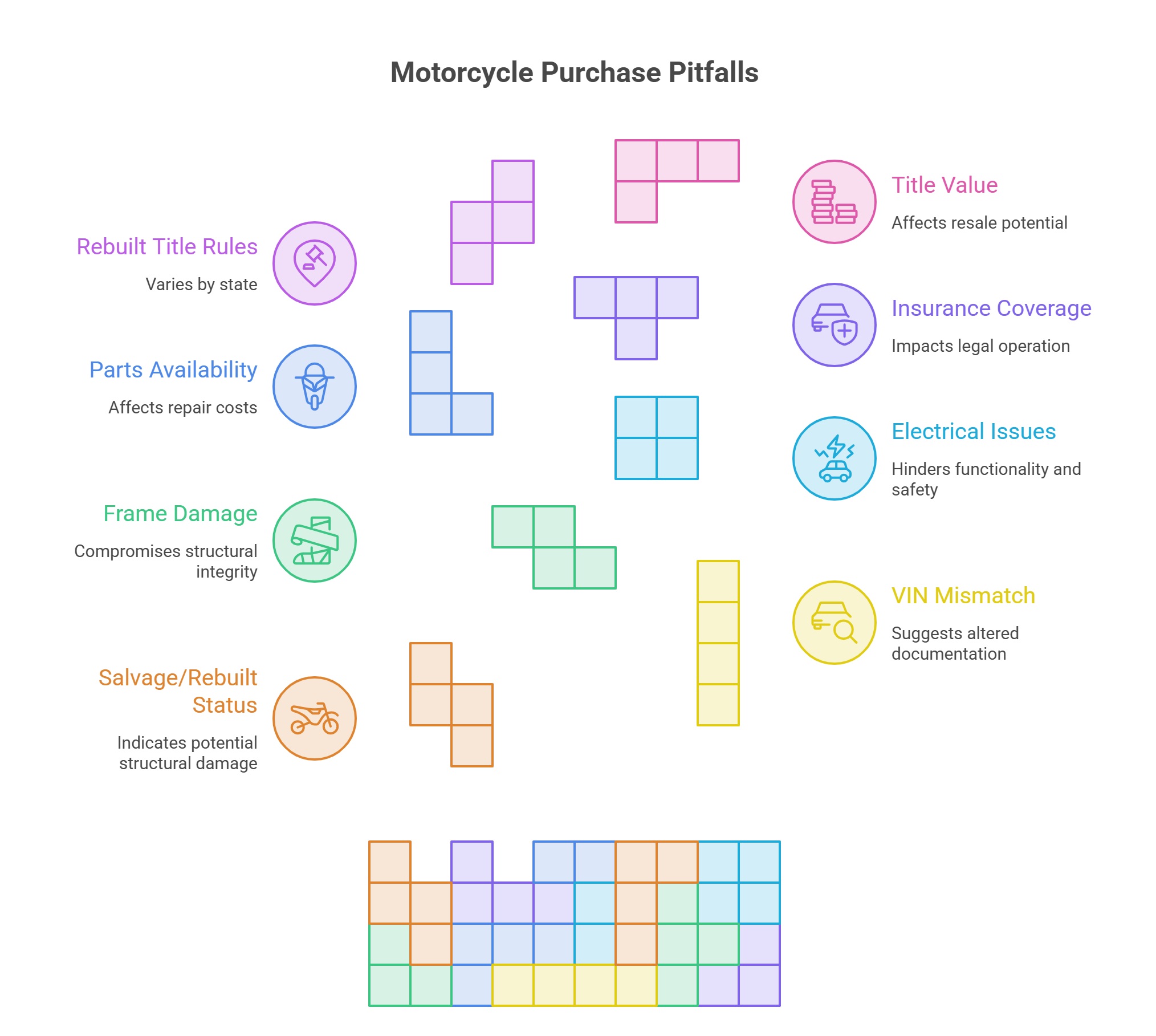
A low price can hide problems. Before purchasing a motorcycle, inspect the listing as if you were already the owner. The goal is to find issues that stop plates, coverage, or safe riding. A pre-purchase inspection is ideal. A professional inspection is better for high-dollar bikes. Move through this list before bidding:
- Confirm whether the listing says salvage or rebuilt.
- Compare the VIN with photos and documents.
- Check for frame, steering neck, and swingarm damage.
- Look for cut wires, missing keys, or changed gauges.
- Price OEM parts before assuming used parts are available.
- Ask insurance agencies whether coverage is available.
- Review the rebuilt-title rules in your registration state.
- Decide whether the title is worth the finished value.
Can You Insure a Salvage Motorcycle?
You usually cannot insure a motorcycle for street use until it has passed the state process. After the motorcycle changes from salvage to rebuilt status, liability may be easier than full motorcycle insurance, and insurance rates vary by carrier. Ask an insurance agent early, especially if you also plan to make a dirt bike street-legal.
Salvage Auction vs Private Rebuilt vs Clean Used
Each buying path fits a different rider. Auctions offer upside, but they demand research and patience. Private rebuilt listings reduce work, but the seller’s story must be proven. Clean used bikes are simpler, yet cost more up front. The right choice depends on skill, timeline, and paperwork tolerance.
| Option | Upfront price | Work needed | Paperwork risk | Best buyer |
| Salvage auction | Lowest | Highest | High | Builder or patient rider |
| Private rebuilt | Mid-range | Medium | Medium | Buyer who can verify records |
| Clean used | Highest | Lowest | Low | Daily commuter |
Consider SCA a useful platform. It lets shoppers compare bikes with salvage titles against cleaner examples in one search flow. That makes it easier to see when a discount is real and when a finished bike is smarter.
What Life with a Rebuilt Title Motorcycle Looks Like Three Years In

Here’s a real-life case from SCA:
A bidder bought a refurbished Yamaha on SCA after comparing photos, prior sales, and local prices. Its brand history was clear, and the paperwork was complete with front-end parts invoices. He used it as a weekend bike, not a commuter, which helped.
| Time owned | What changed | Owner lesson |
| Month 1 | Passed review and got plates | Documentation mattered more than speed |
| Year 1 | Needed tires, battery, and minor wiring cleanup | Budget extra after the first ride |
| Year 2 | No major failures, but full coverage quotes stayed limited | Insurance for a motorcycle may require shopping around |
| Year 3 | Lower trade offers than expected | Plan to keep it, not flip it |
The conclusion is simple. A rebuilt bike can serve well when the buyer accepts the brand, keeps records, and prices for ownership.
Key Takeaways
- Buying can work when the damage is clear. The math should be conservative, and the paperwork should be complete.
- The best candidates usually have cosmetic or theft-related damage. There should be no frame, flood, or burn history.
- Always inspect documents before bidding, because a bad brand can stop registration.
- ACV, market value, and bid price must be compared before a deal makes sense.
- Coverage is possible after rebuilding, but carriers may limit options.
A smart buyer treats every branded motorcycle as a full project. Legal, mechanical, financial, and future-use questions must all work together.
FAQ
Can a Motorcycle Be Declared Salvage Because It Was Stolen?
Yes. A recovered or unrecovered theft can lead to a brand when the insurer pays the claim, and paperwork requires it.
Does Mileage Matter Less on a Salvage Motorcycle?
Mileage still matters. However, condition, damage type, paperwork, and parts availability matter more. Low miles do not cancel structural, flood, or electrical risk.
Can Moving a Motorcycle to Another State Remove a Salvage Title Brand?
No. Moving states may change forms or steps, but it should not erase a brand. Federal and state records are designed to prevent brand washing.
Can You Register a Motorcycle with a Salvage Title in Any State?
No. Most states require rebuilding, proof, and review first to get a vehicle properly inspected. Some documents are non-repairable. Some states reject brands that another state accepted.
How Much Does It Cost to Rebuild and Title a Salvage Bike?
A basic project may cost $1,500-$4,000 beyond the bid. Complex electrical, flood, or structural work can push the final bill above $8,000.