Contents
A rebuilt car can start, drive, and look fully repaired while still having a counterfeit, missing, defective, or improperly installed airbag. “Run & Drive” status and title wording do not verify the SRS. Before buying, check the vehicle’s collision history and repair records, then require an SRS-capable scan and qualified physical inspection.
Why Are Used-Car Buyers Being Warned About Fake Airbags?
The danger stays hidden until a crash. A counterfeit airbag may sit beneath an original-looking cover. Then, it can fail, deploy incorrectly, or expel metal fragments. NHTSA warns that drivers and passengers may be injured or killed.
Treat these signs as reasons for closer review:
- Salvage, rebuilt, total-loss, or bill-of-sale history.
- Auction photos showing deployed bags, damaged trim, or cut belts.
- Missing invoices for airbag repairs and SRS system repair.
- An SRS warning light that behaves unusually at startup.
- No named supplier for a replacement airbag.
In the United States, approximately 67 million Takata airbags have been recalled, showing how widely a defective airbag issue can affect the market without being counterfeit.
What NHTSA Has Confirmed About DTN60DB Inflators
NHTSA determined that frontal driver airbag inflators marked DTN60DB contain a federal safety defect. The regulator found that they may fail or rupture violently. They were likely illegally imported and installed in American vehicles after crashes or theft and are prohibited from sale in the United States.
NHTSA has confirmed several important facts:
- The inflator is etched or labeled with an identifier beginning DTN60DB. It may also show the number sequence 144415654 666631 or 144415654 666633.
- Known incidents involved vehicles with replacement airbag equipment.
- Ruptures sent fragments into occupants’ chests, necks, eyes, and faces.
- If a counterfeit airbag inflator marked DTN60DB is found, the vehicle should not be driven.
- Owners must not attempt personal airbag testing.
- Only a qualified technician should inspect it.
As of June 2026, ten people died and three suffered severe injuries in 13 crashes involving DTN60DB inflators; NHTSA said the crashes should not have been fatal.
Why Is This a Rebuilt-Car Problem, Not a Malibu/Sonata Problem?
Known ruptures occurred in Chevrolet Malibu and Hyundai Sonata cars, but NHTSA cannot confirm the risk is limited to them. This is a used vehicle repair issue: original bags were replaced after crashes, and installation of counterfeit equipment may occur during undocumented collision repair. The relevant question is therefore not whether a model appears on a known-incident list, but whether its restraint system was opened, replaced, or repaired without traceable parts and records.
How Are Counterfeit, Defective, Used, and Missing Airbags Different?
These categories are different. A recall on a car addresses approved original equipment with a documented defect. A counterfeit unit imitates legitimate branding. A used airbag may have an unknown donor or storage history. A missing unit may hide behind a cover or resistor, creating a false safety signal. The table shows the main checks.
| Type | Origin | Can It Look Genuine? | How It’s Typically Found |
| Counterfeit | Unauthorized import | Yes | Physical inspection and part authentication |
| Defective/recalled | Factory defect | Yes | Recall lookup and manufacturer records |
| Used/salvage-yard | Pulled part | Yes | Invoice, donor VIN, date code, condition report |
| Missing/non-functional | Removed and not replaced | Sometimes | Visual absence, scan, wiring check |
Takata equipment illustrates a factory defect, not a counterfeit part. A salvaged component may be genuine but unsuitable. Buyers must verify origin, compatibility, condition, and installation.
What Is the SRS System, and Why Does It Matter for Rebuilt Cars?
The supplemental restraint system connects airbags, impact sensors, seat belt pretensioners, wiring, occupant sensors, and control modules. A normal test drive may not reveal an SRS airbag system malfunction. After a collision, several of these components may need inspection, replacement, programming, or calibration even when only one airbag visibly deployed.
Modern Cars Make SRS Repair More Complex
Newer cars may have front, side, curtain, knee, and seat-mounted airbags. This makes salvage car airbag deployment costly to restore and easy to underestimate.
In SCA Auction’s collision sample, 1,566 vehicles were from model year 2015 or later, 999 were 2018 or newer, and 628 were 2020 or newer.
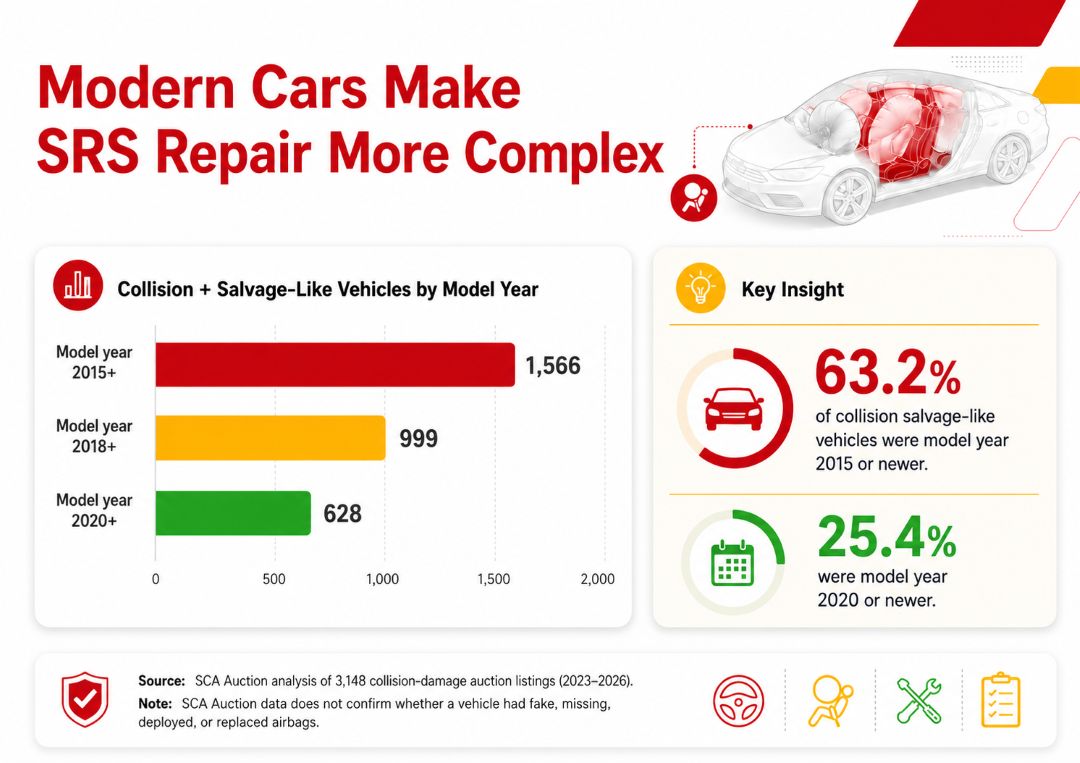
Among collision vehicles with salvage-like titles, 63.2% were model year 2015 or newer. 25.4% were model year 2020 or newer.
SCA Auction data does not confirm fake, missing, deployed, or replaced airbags. It shows a modern collision inventory where airbags installed in vehicles require detailed SRS verification.
Does “Run & Drive” Confirm That a Rebuilt Car’s Airbags Are Safe?
No. “Run & Drive” indicates limited yard drivability, not verified vehicle safety. In SCA Auction’s 2023–2026 sample, 1,688 of 2,477 collision vehicles with salvage-like titles carried that designation.
That equals 68.1%, but drivability does not confirm that airbags, belts, sensors, wiring, or control modules were restored correctly.
A running engine cannot identify counterfeit components, cleared crash codes, or an unsafe replacement airbag inflator. Scanning, records, and physical verification remain necessary.
SCA’s Review of Collision Listings
SCA Auction analyzed 3,148 collision-damage listings from 2023–2026. Title descriptions were grouped as salvage-like/branded or clean-looking. Salvage-like records included Salvage, Rebuilt, Rebuildable, Bill of Sale, MV-907A, Non-Repairable, Junk, Scrap, Certificate of Destruction, and similar variants. The analysis did not verify any airbag condition.
Most Collision Lots Carried Salvage-Like Titles
Of the 3,148 listings, 2,477, or 78.7%, fell into the salvage-like group. 665 had clean-looking title descriptions. Six could not be classified because title information was missing or ambiguous. This shows that collision vehicles requiring careful review are a major auction segment, not an unusual edge case. Repairs can extend beyond visible panels and car frame damage to restraints, wiring, sensors, and control modules.
A salvage or rebuilt title is a warning to investigate, not proof of unsafe workmanship. Some vehicles have complete records and genuine parts. Others may contain rebuilt title airbag problems, missing equipment, or installation of counterfeit airbags that only a professional examination can uncover.
A Clean-Looking Title Is Not Enough
The remaining 665 collision listings – 21.1% of the sample – had clean, original, regular, or similar title descriptions. Among them, 453 were marked Run & Drive. These categories do not prove that a title is inaccurate or that the vehicle contains unsafe equipment. They show why title wording alone cannot measure post-collision condition.
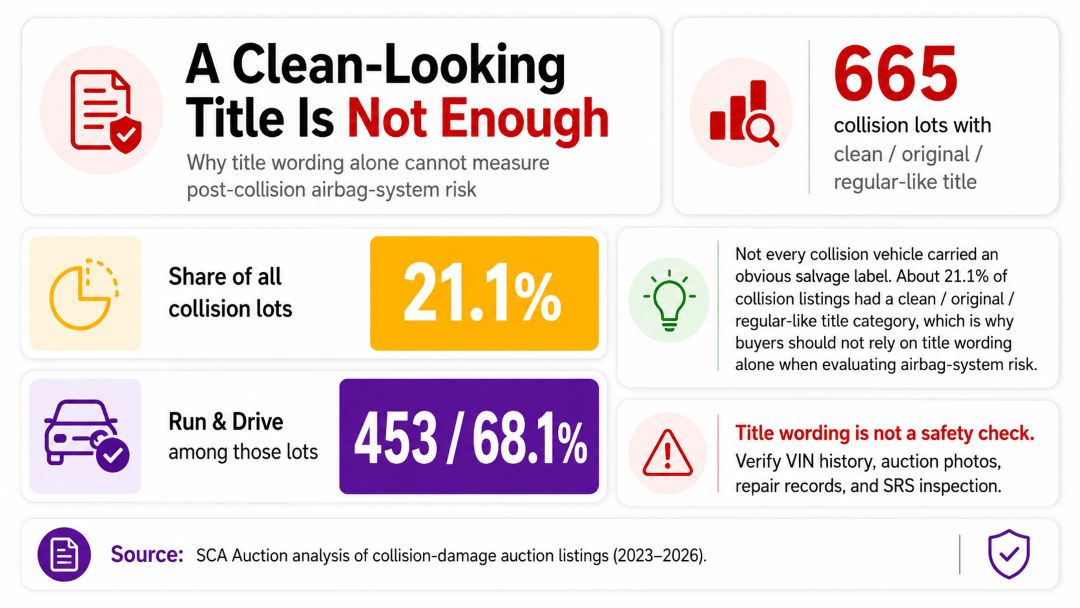
Start with a VIN decoder. Compare NMVTIS data, commercial history reports, auction photos, and invoices. NMVTIS, however, cannot authenticate a hidden counterfeit airbag.
Common Models and States in the Collision-Salvage Segment
Popular cars naturally appear in large samples. Their presence does not establish a model-specific defect. State totals show inventory concentration, not where counterfeit products are more common. The sidebars provide context without labeling models or locations as dangerous.
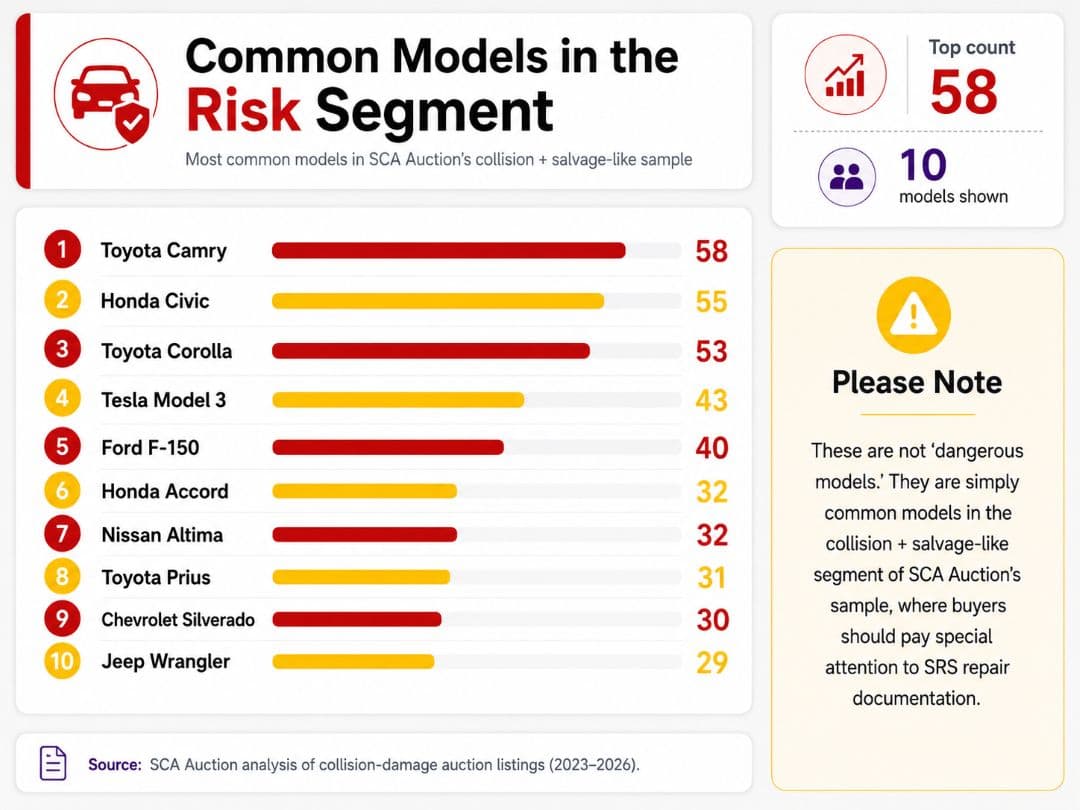
These common models show where buyers are most likely to encounter collision + salvage-like inventory at the vehicle level. But the risk segment is not only about what models appear most often — it also has a geographic pattern. The next chart shows which states had the highest concentration of relevant SCA Auction listings in the sample.
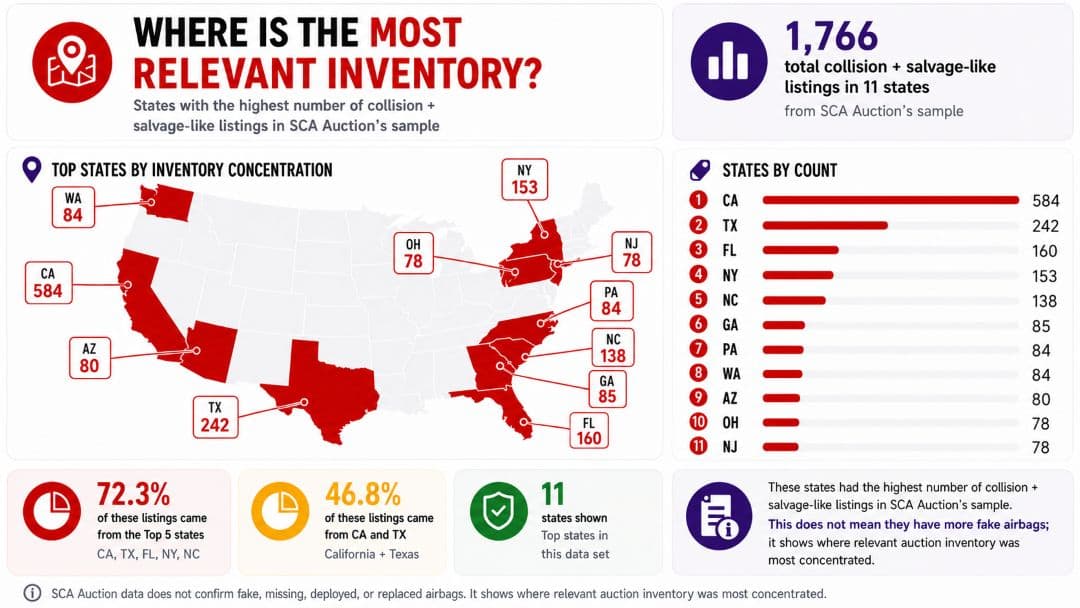
These are common models and locations in the collision-salvage segment, not confirmed sources of counterfeit automotive parts.
How Deep Discounts Can Create Repair Shortcuts
Among 2,459 lots with valid bid and ACV figures, the median bid equaled 27.4% of ACV. The implied discount was 72.6%, and 1,428 lots—58.1%—sold at 30% of ACV or less. That pricing can reward cosmetic work while deferring costs for hidden safety systems.
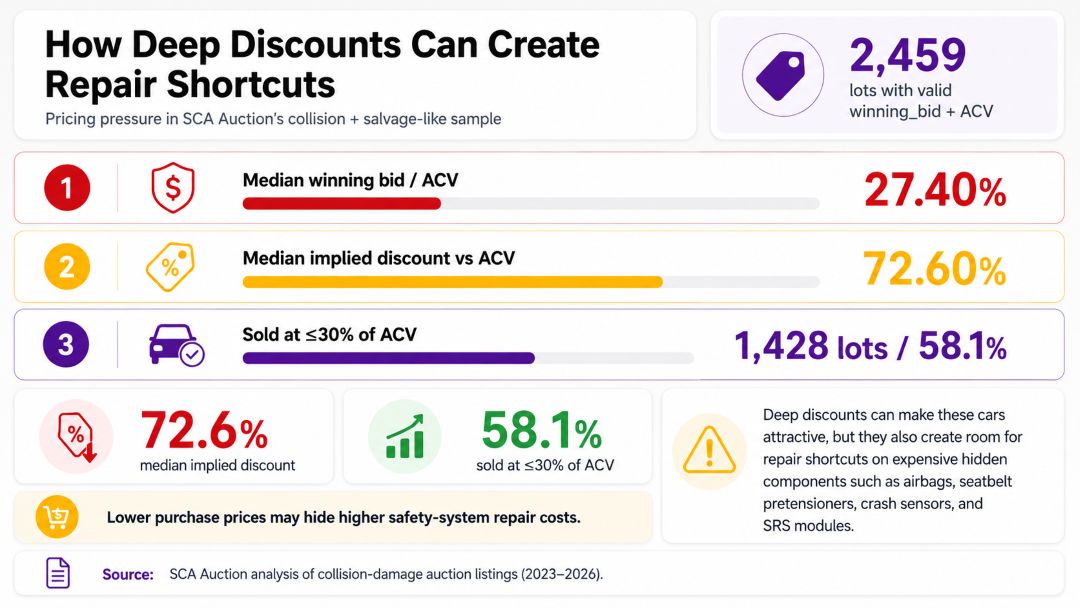
Airbag inflators, a replacement airbag, belts, sensors, modules, and programming can cost thousands. A rebuilder might source parts through online marketplaces or skip steps. That does not prove airbag fraud or selling counterfeit equipment; it makes documentation essential.
Calculator — Is the Discount Worth the Risk?
A low bid is only the first expense. Add fees, transport, visible repairs, diagnostics, genuine parts, programming, and contingency. This example uses the sample’s 27.4% median ratio. Replace estimates with quotes from a body shop and an authorized car dealership repair shop.
| Step | Item | Calculation / Added Cost | Running Total |
| 1 | ACV | Assumed vehicle value | $20,000 |
| 2 | Winning bid | $20,000 × 27.4% | $5,480 |
| 3 | Fees and transport | + $2,200 | $7,680 |
| 4 | Visible collision repair | + $6,500 | $14,180 |
| 5 | SRS inspection | + $250 | $14,430 |
| 6 | Safety reserve | + $4,500 for restraints, modules, sensors, and programming | $18,930 |
| 7 | Final comparison | Apparent bid discount: $14,520. Remaining gap vs ACV after repairs: only $1,070 | $18,930 total cost |
If hidden repairs reach $7,000, the total project cost rises to $25,930, exceeding the assumed ACV by $5,930.
How to Check Airbags and SRS Before Buying a Rebuilt Car
Learning how to check if airbags have been replaced requires records and physical inspection. Do not remove a cover because accidental activation may cause serious harm. NHTSA recommends professional review when previous airbag activation, theft, total loss, or non-certified work appears in the history.
Use this sequence:
- Obtain NMVTIS history and a detailed commercial report.
- Use a trusted VIN decoder.
- Review auction photos for deployed airbags, torn trim, cut seat belts, or cabin damage.
- Request invoices listing part numbers, suppliers, donor details, and calibration work.
- Confirm that all activated restraints were replaced, not reset or bypassed.
- Scan every SRS module and verify warning-lamp behavior.
- Inspect labels, connectors, dates, mounting points, and wiring.
- Ask the manufacturer to confirm equipment compatibility.
- Walk away if the seller refuses access or cannot document airbag replacement.
What Does a Rebuilt Title or State Inspection Actually Verify?
A rebuilt title means a previously salvaged vehicle completed a state retitling process. Requirements vary. State legislation may focus on identity, ownership, stolen parts, receipts, or roadworthiness. Even when a car was totaled and later passed inspection, the result may not prove inflator authenticity, crash-data reset, calibration, or full SRS operation.
Typical limits include:
- Often checked: VIN identity, ownership, title chain, and major-part receipts.
- Often checked: Altered identifiers and possibly stolen components.
- Sometimes separate: Brakes, lights, emissions, or roadworthiness.
- Not guaranteed: Authentication of every replacement component.
- Not guaranteed: Complete scans, programming, or dynamic SRS checks.
New York explicitly states that its salvage examination is not a safety, emissions, or insurance inspection, although it requires model-specific new restraints for activated or removed units.
What Happens If You Skip This – Resale, Insurance, and Liability
Undocumented restraint work can reduce resale value. It may complicate insurance and create liability. A used car retailer, installer, or rebuilder may face disputes if claims are inaccurate. Outcomes depend on law, contracts, and evidence.
| Risk | Possible Consequence | Buyer Protection |
| Resale | Lower offers or disclosure disputes | Keep reports, scans, invoices, and photos |
| Insurance | Coverage or valuation questions | Disclose history and confirm terms |
| Crash | Failure to inflate, rupture, severe harm, or fatality | Require professional inspection |
| Liability | Claims tied to installing counterfeit equipment | Preserve ads, messages, bills, and findings |
| Registration | Rejection for missing required equipment | Check state rules before purchase |
A deeply discounted purchase is not a bargain when counterfeit safety components expose occupants to death or serious injury.
Key Takeaways
- A running rebuilt vehicle can still contain a missing, defective, used, or counterfeit airbag.
- SCA Auction statistics describe collision inventory, not verified fake-airbag cases.
- Clean-looking title wording does not erase damage or repair history.
- A VIN report cannot authenticate a hidden replacement component.
- DTN60DB inflators are defective and prohibited from U.S. import or sale.
- Independent inspection is essential before trusting the restraint system.
The safest purchase combines history research, repair records, genuine-part verification, and professional SRS diagnostics.
FAQ
Can a VIN Check Confirm a Fake Airbag Inflator?
No. A VIN check may reveal recalls, crashes, or title history. However, only a qualified physical inspection can identify an airbag scam.
Do Dealers Always Disclose Information About Deployed Airbags?
No. Disclosure requirements vary. Records may be incomplete. Review history reports, auction photos, invoices, and written seller statements independently.
Who Should Inspect Airbags Before Buying a Rebuilt Car?
Use a manufacturer-authorized service center or reputable technician. They should be experienced with SRS diagnostics.
Can Shipping or Storage Damage an Airbag System After Purchase?
Yes. Moisture, impact, corrosion, disconnected wiring, or improper handling can affect components. Arrange another inspection if the condition changed during transport or storage.
Should Buyers Verify Seat Belts Even When No Airbags Deployed?
Yes. Belts, buckle switches, tensioners, wiring, and control logic can be damaged without obvious restraint activation. A complete restraint inspection should cover every seating position.